Jakarta – The United Nations General Assembly has adopted a landmark resolution affirming that states have legal obligations to address climate change, drawing strong support from vulnerable countries and rights advocates while prompting renewed calls for accountability from civil society groups.
The resolution, passed on Wednesday, May 20, with a large majority, endorses the 2025 advisory opinion of the International Court of Justice, which clarified that governments have binding duties under international law to prevent climate harm and protect human rights.
Introduced by Vanuatu and backed by a coalition of climate-vulnerable nations, the measure urges countries to align their actions with limiting global warming to 1.5°C and to strengthen accountability for climate-related damage. The resolution was adopted with 141 in favour, 8 against and 28 abstentions. While non-binding, the resolution is widely seen as carrying significant political and legal weight, particularly as climate litigation gains momentum globally.
UN Secretary-General António Guterres welcomed the vote as a reaffirmation of “international law, climate justice and state accountability,” underscoring its importance in shaping future climate action.
Civil society groups reacted positively, describing the resolution as a turning point in the global push for climate justice.
In a statement coordinated by the Center for International Environmental Law, advocacy organisations said the vote sends a clear signal that “the climate crisis is not beyond the reach of justice.” They stressed that governments can no longer treat climate obligations as voluntary, but must be held accountable for both action and inaction.
“The era of impunity for climate destruction is coming to an end,” the groups said, adding that the resolution reinforces the legal basis for holding both states and corporate actors responsible for environmental harm.
Campaigners also highlighted the implications for communities already facing climate impacts, noting that the decision strengthens efforts to pursue remedies for loss and damage.
“This resolution affirms what frontline communities have long demanded—that those most responsible for the climate crisis must be held accountable,” the statement said, pointing to growing momentum for climate litigation and reparations.
In July 2025, the International Court of Justice (ICJ) unanimously delivered its Advisory Opinion on the legal responsibilities of states in addressing climate change, where the Court held that where States breach their extensive obligations under international law, they will be liable to provide restitution, compensation or satisfaction to States harmed by climate change.
Legal experts say the UNGA resolution could influence court cases worldwide by reinforcing the ICJ’s opinion as an authoritative interpretation of international law, even if it does not create new binding obligations on its own.
The vote marks one of the clearest expressions to date of global consensus linking climate action with legal responsibility, setting the stage for heightened scrutiny of national policies and corporate conduct in the years ahead. (nsh)
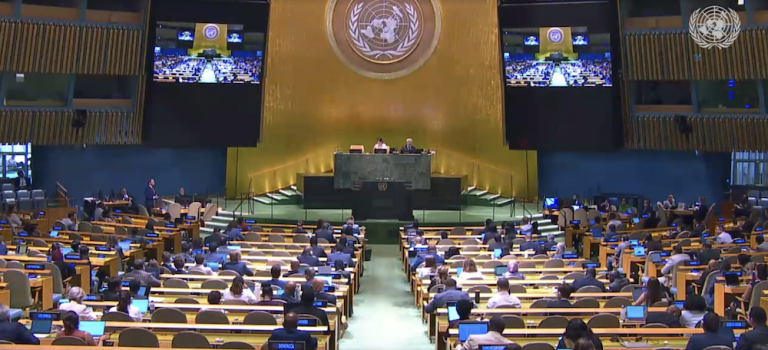
Banner photo: UN General Assembly. Source: UN WebTV Screenshot