Jakarta – Indonesia’s palm oil sector has recently been rocked by a significant drop in the price of fresh fruit bunches (FFB) at the farmer level. This decline varies across different regions, ranging from Rp50 (USD 0.0028) to as much as Rp1,200 (USD 0.067) per kilogram, as observed in West Sulawesi. In response to this situation, the Ministry of Agriculture immediately convened a coordination meeting involving the Indonesian Palm Oil Association (GAPKI), farmers’ associations, and the National Police’s Food Task Force. This step was taken to maintain price stability and provide certainty amidst the transition to new export policies.
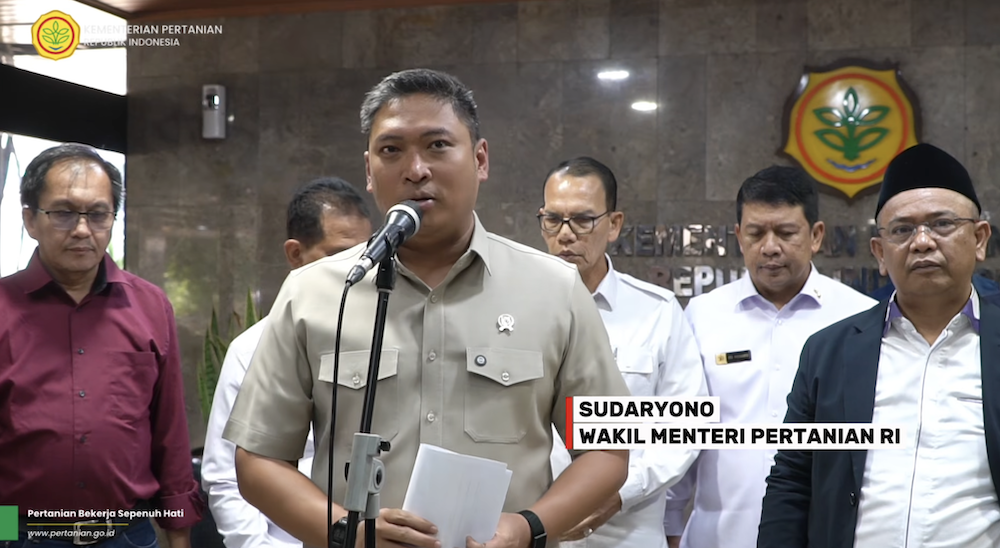
Deputy Minister of Agriculture Sudaryono stated at a press conference on Tuesday, 26 May, that the root cause of this price drop was not fundamental economic factors, but rather market perception. He said that “the bottleneck in this situation is the psychological effect of concern, uncertainty and a lack of understanding regarding the new single-window export policy implemented by PT DSI (PT Danantara Sumber Daya Indonesia)”.
To quell speculation, the government has emphasised that PT DSI carries out its role as administrator and supervisor in a transparent and accountable manner. The Deputy Minister emphasised that: “PT DSI… does not charge fees or profit from transactions… it manages and simultaneously supervises export activities”. The government has also established a three-month transition period, from 1 June to 31 August 2026, to allow downstream businesses to continue operating normally before full implementation in January 2027.
Structurally, PT DSI has now been officially designated as a State-Owned Enterprise (SOE). Its ownership structure comprises 99% of shares held by PT Danantara Indonesia and 1% of Dwi Warna Series A shares held by the SOE Regulatory Agency (BP), which grants the government special control, as is the case with other SOEs.
PT DSI is set to become the sole exporter of certain natural resources, including palm oil, coal and iron alloys. The vision behind this structure is to ensure that “Indonesia’s natural wealth is used for the prosperity of the Indonesian people” through more orderly governance mechanisms. This policy also aims to eradicate illegal practices such as “alleged transfer pricing and under-invoicing”, which have long been deemed detrimental to national interests.
The Ministry of Agriculture has identified at least 139 palm oil mills (PKS) that have set their purchase prices for fresh fruit bunches (FFB) below the stipulated levels. The Deputy Minister has urged all palm oil mills to comply with the reference prices set by each province, as these prices are the result of an agreement between local governments, the industry and farmers’ associations.
The government will not hesitate to take firm action against businesses that breach the regulations. Under Ministry of Agriculture Regulation No. 13 of 2024, the Ministry of Agriculture may “impose sanctions in accordance with applicable regulations, which may include administrative measures or the revocation of licences”. Monitoring will be stepped up through cooperation with the National Police’s Food Task Force to detect any deliberate actions that harm farmers.
Data analysis shows that the fall in prices has had the greatest impact on independent farmers, as they are not bound by contracts or contract farming arrangements. In contrast, prices for partner farmers tend to be more stable due to guaranteed purchases from the factory.
As a long-term solution, the government is encouraging a structural transition for independent farmers: “We are encouraging independent farmers to gradually become partner farmers, so that they have certainty regarding both the price and the market for their produce,” said Sudaryono. Through these partnerships, it is hoped that in future every palm oil mill will be required to partner with farmers in order to ensure stability in supply and prices.
The transition to this one-stop export system represents a major step towards improving the governance of Indonesia’s natural resources. The government has emphasised that this reform is being carried out in the interests of economic fairness, without penalising industry players who have been operating effectively. The success of the transition period in 2026 will be key to the stability of the national palm oil industry when the policy is fully implemented in 2027. (nsh)
Banner photo: Suwit Ngaokaew/shutterstock.com