Jakarta – As uncertainty over international climate finance grows and developed countries struggle to meet long-standing commitments, China is positioning South-South cooperation as an increasingly important mechanism to help developing nations pursue their energy transition. For Indonesia, one of China’s closest strategic partners in Southeast Asia, that could translate into greater investment, technology transfer and industrial collaboration in renewable energy.
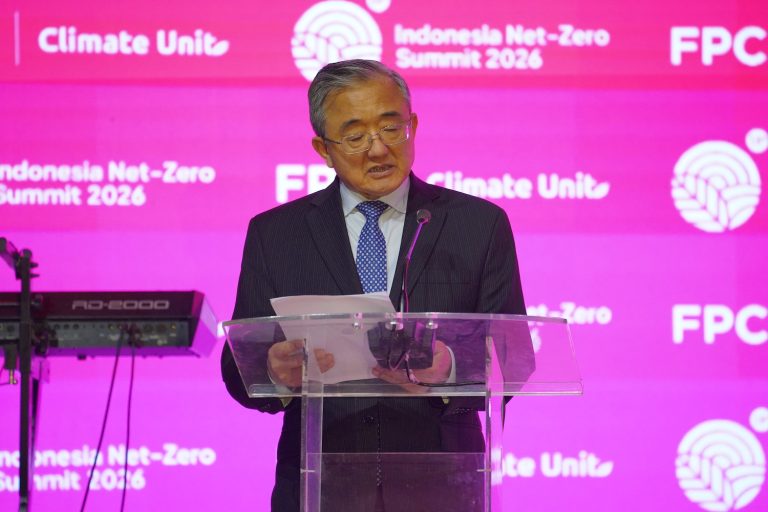
Speaking during a special address at the Indonesia Net-Zero Summit 2026 organised by the Foreign Policy Community of Indonesia on Saturday, August 1, China’s Special Envoy for Climate Change, Liu Zhenmin, argued that cooperation among developing countries has become more critical as global climate governance faces mounting challenges.
“North-South cooperation between developed and developing countries lies at the core of the global climate governance system, while South-South cooperation among developing countries serves as a valuable complement,” Liu said, noting that reduced climate finance commitments and weaker political leadership from developed countries have made it more difficult to deliver support for developing nations.
Shared development challenges
Liu said Indonesia and China occupy a unique position because both are attempting to industrialise while simultaneously pursuing carbon neutrality—a challenge that differs significantly from the historical pathways followed by developed economies.
“As major developing countries… China and Indonesia have joined the process to achieve carbon peaking and carbon neutrality… before completing industrialisation,” he said. “Our challenges are very different from the developed country parties.”
That shared development trajectory, he suggested, provides a strong foundation for deeper bilateral cooperation rather than relying solely on traditional North-South climate assistance.
From aid to partnership
Rather than framing China as a conventional donor, Liu emphasised partnerships built around investment, technology and industrial cooperation.
One immediate opportunity is Indonesia’s ambitious solar energy expansion. Liu welcomed President Prabowo Subianto’s proposed 100-gigawatt solar program and said Beijing is encouraging Chinese companies to participate.
“I’m glad to see that President Prabowo’s 100-gigawatt solar program has been well received by the Indonesian people,” he said. “My government actively encourages Chinese companies to join hands with Indonesian partners to deliver this program.”
The remarks suggest China’s support may extend beyond financing to include manufacturing partnerships, engineering expertise and deployment of renewable technologies.
Technology and finance as the key enablers
Liu identified technological innovation and financing as the twin engines of the global energy transition.
“Financing and technological innovation are the source and driving force for global energy transition,” he said, calling for greater cooperation in developing low-carbon technologies and sharing practical experience among countries.
He also acknowledged that traditional climate aid alone will not be sufficient, urging countries to develop new green investment models while encouraging multilateral development banks to mobilise larger capital flows for developing economies.
For Indonesia, which requires hundreds of billions of dollars to meet its long-term net-zero ambitions, diversified financing sources could become increasingly important as global public climate finance remains constrained.
Lessons from China’s own transition
During a subsequent panel discussion, Li Zheng, Dean of the Institute of Climate Change and Sustainable Development at Tsinghua University, argued that China’s renewable energy achievements were not the result of short-term policies but decades of strategic planning.
Kevin Zongzhe Li, Fellow at the Asia Society Policy Institute’s Center for China Analysis, who moderated the panel discussion on China’s green development journey, said that China’s achievements stemmed from “decades of policy direction, sustained industrial investments and the deliberate construction of domestic manufacturing capabilities.”
He noted that China added 315 GW of solar power, 119 GW of wind power and approximately 18 GW of hydropower in 2023 alone, bringing installed renewable capacity to more than 1,800 GW. Electricity generation from renewables reached roughly four trillion kilowatt-hours—exceeding the combined annual electricity consumption of the European Union’s 27 member states.
In his speech, Liu highlighted several aspects of China’s energy transition that could serve as valuable lessons for Indonesia and other Global South countries. These include integrating climate goals into national economic planning through China’s “1+N” policy framework, embedding green development into long-term legislation, building the world’s largest renewable energy system, developing comprehensive clean-energy manufacturing supply chains, implementing nationwide carbon management policies and operating the world’s largest emissions trading system.
China’s 1+N policy is a framework designed to achieve carbon dioxide peaking before 2030 and carbon neutrality before 2060.
Expanding South-South cooperation
Liu said China has already established an extensive international cooperation network on clean energy, working with more than 100 countries and regions.
By June 2024, China had signed 56 memoranda of understanding on South-South cooperation on climate change with 43 developing countries, demonstrating Beijing’s intention to institutionalise climate partnerships across the developing world.
For Indonesia, such cooperation could encompass renewable energy deployment, industrial development, technology transfer, capacity building and investment in clean-energy supply chains.
A strategic opportunity
Liu concluded by reaffirming China’s willingness to deepen cooperation with Indonesia as both countries pursue carbon neutrality.
“China is ready to work with Indonesia and other parties to make even greater contributions to achieving global carbon neutrality,” he said.
As geopolitical tensions reshape global climate cooperation and traditional sources of climate finance face increasing uncertainty, the China-Indonesia partnership may become an increasingly important example of how South-South cooperation evolves—from development assistance toward long-term collaboration on clean industry, technology and energy transition. (nsh)
Banner photo: China’s Special Envoy for Climate Change, Liu Zhenmin, speaking during a special address at the Indonesia Net-Zero Summit 2026 organised by the Foreign Policy Community of Indonesia on Saturday, August 1, 2026. Source: FPCI Secretariate
tanahair.net is a media partner of the Indonesia Net-Zero Summit 2026