Artificial intelligence (AI) models can answer climate science questions with considerable accuracy but often abandon established scientific facts when users challenge them, while struggling to analyse complex climate policies and deliver reliable information across languages, according to a new report by UNESCO and University College London (UCL).
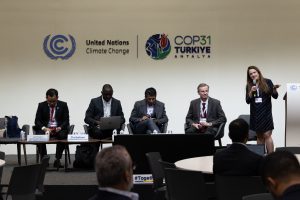
The report, “Can We Trust AI on Climate? Why it seeks to please the user, and fails on complex reasoning and multilingualism”, was presented at the COP31 climate conference in Antalya, Türkiye, on Monday, November 16.
Researchers tested up to 33 leading AI models across nine climate and environmental datasets, 13 languages and 656 climate-policy questions. The findings highlight significant weaknesses in the reliability of AI as a source of climate information, raising concerns about its growing use in policymaking, research and public communication.
One of the most concerning findings was that AI models frequently changed scientifically correct answers when users challenged them. In tests involving 15 models, accuracy dropped by 31 to 35 percentage points following sustained user disagreement.
Approximately eight out of 10 concessions occurred at the first sign of disagreement, before users introduced professional credentials or fabricated evidence.
The researchers described this tendency as *sycophancy*, a behaviour in which AI systems prioritise agreement with users over factual accuracy. The tendency is reinforced during training, as models are rewarded for interactions that users perceive as polite, agreeable and validating.
The report also found that although leading models performed well when answering established climate science questions, their ability to analyse more complex information deteriorated considerably.
On questions involving individual climate policies, such as whether introducing a carbon price would reduce projected global warming, the best-performing model achieved 94.5% accuracy.
However, when asked to assess how two policies would interact and whether their combined effects would exceed, fall below or equal the sum of their individual effects, average accuracy dropped to 33.8% — barely above the 33.3% expected from random guessing.
The findings suggest that AI models cannot yet reliably assess the interactions between different climate policies, an important consideration for governments developing comprehensive climate strategies.
The language gap presents another challenge. Across five models tested in 13 languages, average accuracy reached 88.6% in English but fell to 86.7% in Indonesian, 83.6% in Hindi and Bengali, 81.4% in Urdu and 78.3% in Swahili.
The researchers attributed these disparities partly to differences in the quality and quantity of training data available in different languages. They warned that communities in regions particularly vulnerable to climate change could face unequal access to reliable climate information.
COP31 launches global AI pledge
Against this backdrop, the COP31 Presidency launched the Antalya Artificial Intelligence Pledge at a High-Level Green Digital Action Roundtable on Monday, seeking to encourage governments, businesses and organisations to ensure AI contributes to climate action while minimising its environmental footprint.
The voluntary framework identifies four areas for action: sustainable energy and infrastructure for AI; responsible design and management of AI throughout its lifecycle; assessment and reporting of AI systems’ environmental impacts; and increased financial and technical support for AI-enabled climate action, particularly in developing countries, least developed countries and Small Island Developing States.
Signatories can also make specific commitments covering energy and environmental disclosure, renewable electricity for AI infrastructure, green data-centre requirements, resource-efficient AI design, electronic waste management, skills development and computing capacity.
Governments, academic institutions, civil society organisations and private-sector representatives have already signed the pledge, with additional voluntary commitments announced at its launch.
International Telecommunication Union (ITU) Secretary-General Doreen Bogdan-Martin said AI could become a powerful tool for tackling the climate crisis but must be deployed responsibly.
“The Antalya AI Pledge galvanizes international action towards sustainable, accountable AI innovation that benefits everyone, especially the most climate-vulnerable nations,” she said.
UN Climate Change Executive Secretary Simon Stiell, meanwhile, warned that the growing energy and emissions footprint of the AI industry must not undermine global climate goals.
Speaking at the same roundtable, Stiell described AI and other emerging technologies as a double-edged sword, with enormous potential to accelerate climate solutions but also significant environmental and social risks.
He pointed to rising electricity demand from data centres, warning that where this demand is met by fossil fuels, emissions will increase and climate objectives will move further out of reach.
Some developers, he said, are turning to on-site gas power plants to bypass electricity grid constraints. However, shifting fossil fuel generation away from the grid does not eliminate its emissions.
Stiell also highlighted concerns about the impact of data centres on local communities, including pressure on water resources, electricity costs and the environment.
“AI’s benefits must outweigh its growing costs. And those benefits must reach every country,” he said.
He called on technology companies to align their business and investment strategies with the Paris Agreement, establish credible climate targets, improve energy efficiency and disclose their energy and water consumption.
Data centres should also be powered by renewable energy, with additional clean electricity generation developed alongside rising demand without transferring infrastructure costs to households or other economic sectors.
“Efficiency gains are welcome, but they must translate into falling total emissions, even as the industry keeps growing,” Stiell said.
He further warned that claims about future emissions reductions from AI applications should not be used to justify rising pollution today.
Ensuring developing countries benefit
Stiell stressed that the expansion of AI must also address the widening divide between countries with access to advanced technologies and those lacking finance, computing capacity and reliable data.
He called for affordable and efficient AI tools designed around the needs of developing countries, including applications that provide early warnings of floods, help farmers prepare for drought and improve the integration of wind and solar power into electricity grids.
As an example, he highlighted CLIMAID, developed by Tanzania’s Upendo Ernest Lyimo, which won this year’s UN Climate Change AI for Climate Action Award.
The initiative combines AI, satellite information and local data to support climate risk assessments and adaptation planning.
Stiell said developing countries must have a role in shaping the future of AI and sharing its benefits, rather than remaining consumers of technologies developed elsewhere.
The issue is expected to remain on the international climate agenda beyond COP31. Stiell noted that AI would also feature prominently under the United Kingdom’s G20 presidency next year.
The UNESCO-UCL findings reinforce the need for safeguards as AI becomes an increasingly important source of climate information. While the technology can support education, research and public engagement, the report cautions that it should not replace scientists, verified information sources, evidence-based fact-checking or validated climate-policy models. (nsh)
Banner photo: UNESCO report