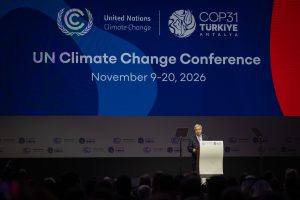
World leaders and senior climate officials have called for faster action to tackle climate change, a more equitable distribution of climate finance and an accelerated transition away from fossil fuels as the UN Climate Change Conference (COP31) entered its high-level segment in Antalya on Wednesday, November 11.
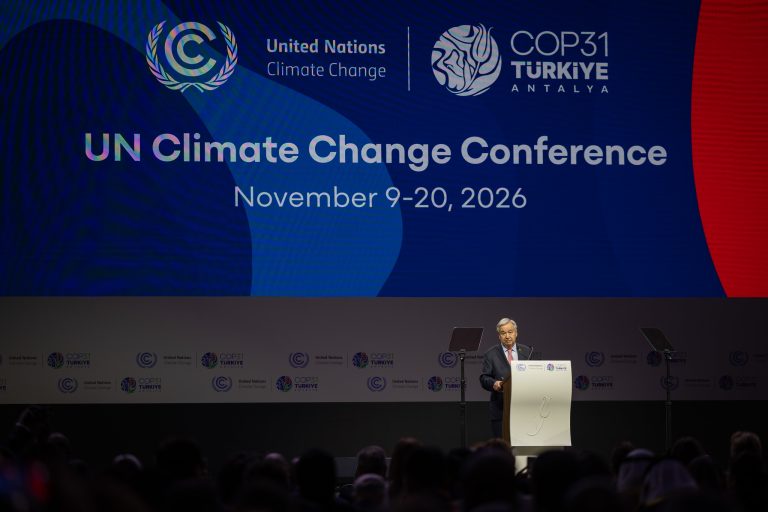
UN Secretary-General António Guterres warned that the world was falling further behind its climate commitments, with global emissions reaching record levels in 2025 and the past four years marking the hottest on record.
He said exceeding the 1.5-degree Celsius global warming threshold agreed under the 2015 Paris Agreement was now inevitable, but stressed that this should not be an excuse for inaction.
“Science is not telling us to surrender. It’s telling us to fight harder,” Guterres told the COP31 Leaders’ Summit.
The challenge, he said, was to ensure that any overshoot remained temporary and that its impacts were minimised through faster emissions reductions and stronger climate action.
Guterres highlighted three lessons from the past decade, including the rapid growth of renewable energy and electric vehicles, the increasingly weak economic case for fossil fuels, and the persistent gap between the pace of climate action and what science requires.
Solar power, which accounted for just 1 per cent of global electricity generation a decade ago, met nearly three-quarters of the growth in global electricity demand last year, he said. Meanwhile, electric vehicles are expected to account for nearly one in three cars sold this year, compared with one in every 100 a decade ago.
However, existing national climate plans remain insufficient. Global emissions need to decline by approximately 6 per cent annually, while current national commitments, including conditional targets, would deliver at best only one-third of that reduction.
Even if fully implemented, these commitments would leave the world on track for more than 2.5 degrees Celsius of warming by the end of the century, Guterres warned.
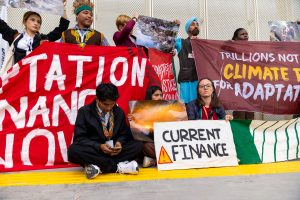
He called for a new Climate Justice Compact built around four priorities: accelerating a just transition away from fossil fuels, protecting vulnerable communities, ensuring adequate and affordable climate finance, and strengthening international cooperation.
The transition must include an end to new coal development and oil and gas infrastructure incompatible with the 1.5-degree goal, alongside faster deployment of renewable energy, electricity grids and storage systems.
Guterres also called on developed countries to deliver at least USD 300 billion annually in climate finance by 2035 and to establish concrete plans to at least triple adaptation finance by that year.
He urged governments to consider taxing the windfall profits of fossil fuel companies to help vulnerable countries recover from climate-related losses and damage.
In the last quarter alone, the nine largest oil companies generated USD 95 billion in profits, while the Loss and Damage Fund had received approximately USD 600 million, he said.
“Polluters must pay,” Guterres said.
Implementation takes centre stage
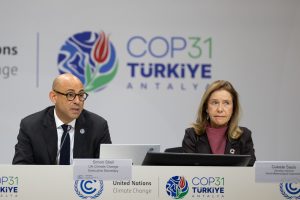
UN Climate Change Executive Secretary Simon Stiell said international climate cooperation had already helped reduce projected global warming from well above 4 degrees Celsius before the Paris Agreement to approximately 2.6 degrees today.
Cooperation had also helped bring adaptation into mainstream climate policy and driven an energy transition in which clean energy investment now exceeds investment in fossil fuels, he said.
However, the benefits of climate action remained unevenly distributed, with vulnerable countries needing substantially more support despite contributing relatively little to the climate crisis.
Stiell said COP31 should focus on translating existing international commitments and national climate plans into practical solutions that deliver tangible economic and social benefits.
“We’re going to be working differently,” he said, highlighting the importance of moving beyond targets towards implementation.
The conference would pursue two complementary tracks: formal climate negotiations and the Global Climate Action Agenda, which seeks to bring governments, businesses and other economic actors closer to the UN climate process.
Key priorities include electrifying economies, tripling adaptation finance and improving access to climate finance without reopening previously agreed commitments.
Stiell urged national leaders to ensure that COP31 delivered both a strong negotiated outcome and meaningful progress under the Global Climate Action Agenda.
COP31 seeks practical solutions amid global crises
COP31 President of Negotiations Chris Bowen acknowledged that the conference was taking place amid multiple overlapping crises, including energy insecurity, geopolitical conflicts, rising living costs and growing electricity demand driven by artificial intelligence and data centres.
He described the situation as a global “polycrisis” but argued that climate action could help address several of these challenges simultaneously.
Expanding renewable energy, electrifying economies and diversifying energy supplies could strengthen energy security, reduce exposure to volatile fossil fuel markets and support economic stability, he said.
Bowen reaffirmed Australia’s commitment to multilateralism and the Paris Agreement, noting that international cooperation had helped mobilise USD 2.2 trillion in clean energy investment last year, twice the amount invested in fossil fuels.
He also pointed to the growing employment benefits of the transition, with clean energy jobs globally now outnumbering fossil fuel jobs.
Bowen outlined three major priorities for COP31: accelerating electrification, strengthening climate adaptation and resilience, and improving access to climate finance.
The conference aims to increase electricity’s share of global final energy consumption from around one-fifth to one-third, with the 35 by 35 pledge providing a pathway towards that goal.
On adaptation, he emphasised the need to strengthen resilience as climate impacts intensify, particularly in countries facing the greatest risks.
Climate finance must become faster, simpler and fairer, enabling developing countries to turn their national climate commitments and adaptation plans into investment-ready projects.
Bowen highlighted the particularly limited support reaching small island developing states, noting that only 0.2 per cent of global climate finance goes to these countries for adaptation.
He also welcomed the Pacific’s leadership on resilience, including the proposed Pacific Resilience Facility, and Türkiye’s Antalya Ocean Declaration, which seeks to translate ocean-related climate commitments into practical and investable solutions.
The Australian and Turkish COP31 presidencies, he said, would advance a presidency-led, party-driven decision aimed at accelerating implementation and delivering practical solutions.
“Success here in Antalya means progress across the full negotiating agenda,” Bowen said, adding that it should also give governments greater confidence to act and investors confidence to deploy capital.
A test of international cooperation
Despite differences in emphasis, the three speeches converged on a central message: the world has made progress in expanding clean energy and establishing climate commitments, but the pace of implementation and the availability of finance remain inadequate.
For Guterres, the immediate challenge is climate justice and ensuring that developing countries have the resources to transition away from fossil fuels while protecting vulnerable communities.
Stiell emphasised the need to translate international commitments into measurable results, while Bowen positioned COP31 as an opportunity to demonstrate that multilateral cooperation can deliver solutions amid mounting global uncertainties.
Their messages set the tone for the high-level discussions in Antalya, where governments face growing pressure to demonstrate that international climate commitments can translate into concrete action on the ground. (nsh)
Banner photo: UN Secretary-General, António Guterres delivers remarks at the opening of the high-level segment of COP31 (Photo: © UN Climate Change – Kiara Worth)