Jakarta – Civil society groups have stated that Indonesia’s energy transition and the development of critical mineral industries must be directed not only towards reducing carbon emissions, but also towards creating formal jobs, protecting affected communities and extending economic benefits to local areas. They argue that without workforce readiness and transparent governance, the decarbonisation agenda risks creating new inequalities.
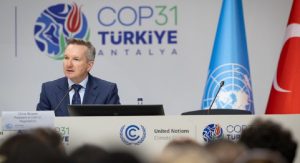
This issue has become one of Indonesia’s major challenges following the conclusion of the 31st United Nations Climate Change Conference (COP31) in Antalya, Turkey, on 22 November 2026, which ended without producing an overarching agreement or ‘cover decision’.
The deadlock in negotiations, triggered by conflicting national interests—particularly regarding the transition away from fossil fuels and climate finance—should be a subject of review for the government. Moreover, the success of climate commitments cannot be measured solely by emission reduction targets, but must also take into account their impact on the economy and people’s lives.
Muhammad Faisal, Director of the Centre for Reform on Economics (CORE) Indonesia, said that the agenda for tackling climate change should go hand in hand with economic development, particularly through the creation of formal jobs.
“Climate action and economic development should go hand in hand, particularly when it comes to creating formal jobs. Therefore, the development of critical minerals and the energy transition need to be designed in such a way that the economic benefits are truly felt by the countries and communities where these investments take place,” he said on Tuesday, 24 November.
According to Faisal, the mineral downstreaming strategy, which has so far focused on primary processing or the midstream sector, has not been sufficiently effective in creating job opportunities. The government needs to encourage the development of downstream industries so that the economic value chain is extended and opportunities are created for the involvement of micro, small and medium-sized enterprises (MSMEs).
However, these opportunities will not automatically benefit the local workforce. The government and industry stakeholders need to put in place vocational education, skills development and business capacity-building from the very start of the investment.
In addition to the number of jobs created, the quality of employment must also be an indicator of the success of downstream processing. Thus, investment in critical minerals not only generates added value for the industry, but also ensures the well-being of the community.
Meliana Lumbantoruan, Deputy Director of Publish What You Pay (PWYP) Indonesia, emphasised that the development of critical minerals to support the energy transition must be accompanied by transparency and the protection of communities’ rights.
“When we talk about emissions reduction and the energy transition, we must not forget critical minerals. Their governance must ensure that affected communities, women and indigenous peoples are recognised not merely as stakeholders, but as rights-holders,” she said.
According to Meliana, the government needs to provide access to information on industrial emissions, workplace accidents and environmental incidents in the vicinity of mineral processing facilities or smelters. The availability of such data is essential to ensure that industrial activities can be monitored by the public and that affected communities have access to complaint mechanisms.
The issue of worker protection is also a concern for Verena Puspawardani, Programme Director at Koaksi Indonesia. She believes that the structural transformation of industry towards a low-carbon economy must be accompanied by protection for the workers affected.
“The energy transition is not just about transforming fossil-fuel-based industries into low-emission industries. We must also ensure that affected workers receive retraining, certification and a social safety net so that they do not become victims of the transition process,” she said.
Verena also cautioned that energy transition financing schemes must not increase the debt burden or shift economic risks onto workers and the public.
Climate policy mandate
On the other hand, the deadlock at COP31 also highlights the importance of regulatory and institutional readiness at the national level. Riko Wahyudi, a researcher at the University of Indonesia’s Research Centre for Climate Change (RCCC UI), said that the success of climate negotiations is not determined solely by the reaching of an agreement, but also by the clarity of the mandate to implement those decisions.
“No matter how well-worded a COP decision may be, if it is not accompanied by a clear mandate for follow-up, that decision will not bring about meaningful change. “What matters most is not merely what is agreed, but how that agreement is translated into the negotiation and implementation processes,” he said during a hybrid discussion entitled “From Antalya to Addis Ababa: Reflections and Action Following COP31”, on Tuesday, November 24.
Riko believes that Indonesia needs a legal framework that mandates emissions reductions across all sectors, from energy and industry to agriculture. It is hoped that the deliberations on the Climate Change Bill will clarify the division of responsibilities whilst strengthening coordination between ministries and agencies in achieving the Nationally Determined Contribution (NDC) targets.
In addition to regulation, technical capacity to access climate finance also needs to be improved. Indonesia requires attribution studies to explain the link between a particular event or loss and climate change, as well as an adequate measurement, reporting and verification system.
Nadia Hadad, Director of Madani Berkelanjutan, added that the deadlock at COP31 highlights the lack of a shared vision and political commitment amongst nations in tackling the climate crisis.
“The climate negotiation process is indeed ongoing, but the problem is that no significant decisions have actually been reached. Without a clear mandate, targets and obligations, this process risks becoming nothing more than a formality without yielding any meaningful progress,” he said.
Another issue requiring attention is access to climate finance for indigenous peoples and local communities. Ode Rahman, Director of Dana Nusantara, believes that the very groups that have long been at the forefront of ecosystem protection are still facing bureaucratic obstacles in securing funding.
“Indigenous peoples, farmers, fishermen, women’s groups and young people are at the forefront of safeguarding the Earth’s ecosystems. Therefore, global climate finance must provide a larger allocation that is directly accessible to indigenous peoples and local communities,” he said.
As part of the COP31 programme, around 14 organisations that provide direct funding to indigenous peoples and local communities are helping to consolidate funding initiatives from countries in the Global South to expand access to such funding.
Maryati Abdullah, Programme Officer at the Ford Foundation Indonesia, emphasised that the failure to reach a consensus on the COP31 umbrella decision must not halt action to tackle climate change.
“The challenge of climate change continues, and its impacts are becoming increasingly evident, particularly for communities at the grassroots level who face these risks first-hand. This situation should, in fact, serve as an opportunity to strengthen existing climate commitments and efforts, whilst ensuring that every step taken is capable of protecting communities and promoting climate justice,” he explained.
In the run-up to COP32 in Addis Ababa, Ethiopia, Indonesia faces the challenge of reconciling its emissions reduction agenda with economic development priorities. Strengthening regulations, ensuring industry transparency, protecting workers and ensuring equitable access to funding are key to ensuring that the energy transition does not merely involve a shift in energy sources, but also leads to fairer and more sustainable development. (Hartatik)
Banner photo: Long Bà Mùi/Pexels.com