by Roffie Kurniawan
Indonesia faces major challenges in accelerating electrification after declining to adopt a global commitment to raise electricity’s share of final energy consumption to 35% by 2035, highlighting the gap between its energy ambitions and the realities of its power system.
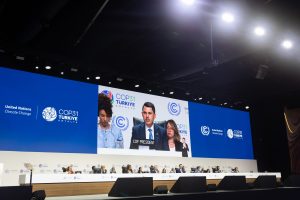
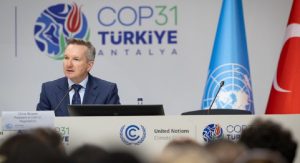
Launched by COP31 President Murat Kurum in Antalya, Türkiye, on November 10, the 35-by-35 initiative aims to increase electricity’s share of global final energy consumption from about 23% at present to 35% by 2035. The shift would involve replacing direct fossil-fuel use with electricity in transport, industry and buildings, while expanding power generation and electricity networks.
By November 18, 75 countries had backed the initiative, while China and Australia issued a joint statement supporting it. Indonesia did not adopt it as a national commitment, reflecting the scale of the transformation required.
Satya Widya Yudha, a member of the National Energy Council (DEN), said at COP31, “I appreciate the 35/35 Electrification initiative of the COP31 Presidency. Although Indonesia, in its current National Energy Policy, has an electrification target of around 24 per cent by 2030 in the high scenario. This needs to be pursued!”
Government Regulation No. 40/2025 sets Indonesia’s electrification target at 22%–24% by 2030. Former DEN member Herman Darnel Ibrahim has estimated the current level at around 15%.
The Institute for Essential Services Reform (IESR) estimates that electricity consumption must rise from 455 terawatt-hours in 2025 to 971 TWh in 2035, requiring average annual growth of about 8%.
Transport remains heavily dependent on liquid fuels, around 60% of which are imported. Fuel subsidies reached Rp415 trillion (USD 22.76 billion) by November 2026, leaving the economy exposed to international supply disruptions and price fluctuations while putting pressure on public finances.
IESR argues that electrifying transport, households and industry could strengthen energy security and reduce fossil-fuel dependence, provided additional electricity demand is increasingly met by renewable sources.
Nickel ambitions clash with coal dependence
Indonesia sees electrification as an opportunity to strengthen its industrial base through nickel processing, battery production and electric vehicles.
Satya has outlined a six-stage battery value chain, from mining and processing to battery-cell manufacturing, electric-vehicle assembly, charging and storage infrastructure, and exports.
Indonesia produces around 65% of the world’s nickel, positioning it to benefit from growing demand for batteries and electric vehicles. But nickel smelters rely heavily on captive coal-fired power plants, tying part of the electric-vehicle supply chain to high-emissions energy.
Captive coal-fired power plants serving industry had a combined capacity of about 19 gigawatts in 2025, according to Publish What You Pay Indonesia, and could exceed 31 GW as projects are developed. A November 2026 study by PWYP Indonesia and the Sustainable Development Strategies Group estimated that these plants emitted 107 million tonnes of carbon dioxide in 2023.
The risk is that electrification could increase electricity consumption without delivering equivalent emissions reductions if coal continues to power energy-intensive industries.
Observers warned that there is no point in raising electrification if its main source is still dominated by fossil-fuel sources.
For this reason, IESR chief executive Fabby Tumiwa has called for credible energy-transition projects, clear policy reforms and protections for workers and regional economies. He argues that the transition should create low-carbon industries and green jobs while keeping clean energy affordable.
PLN’s grid and renewable-energy challenge
For Indonesia to electrify more of its economy, it must expand renewable generation and ensure the electricity can reach consumers. In a Nov. 18 press release, PLN president director Suroso Isnandar said COP31 diplomacy must be translated into concrete infrastructure projects through PLN’s Electricity Supply Business Plan (RUPTL) for 2025–2034.
PLN’s priorities include green financing and carbon markets under Article 6 of the Paris Agreement; faster procurement of solar and wind power integrated with battery energy storage systems (BESS); smart grids and inter-island connections; and a managed transition away from fossil-fuel power plants.
These measures are critical to the government’s 100-gigawatt-peak (GWp) solar target for 2029. Yet IESR’s Indonesia Solar Energy Outlook 2027 puts installed solar capacity at only 1.59 GWp, indicating that intensified efforts are needed to implement the solar “crash program”.
Closing the gap will require faster project development, investment in storage and transmission, and greater grid flexibility. Indonesia’s archipelagic geography adds complexity because renewable resources and major electricity users are not always in the same locations.
Suroso also noted that 35-by-35 encompasses measures beyond electricity consumption, including a 25% reduction in building energy intensity, at least 15% global circular-material use, methane-emissions reduction alongside zero waste, and stronger use of clean energy and nuclear power.
In addition, industrial electrification faces further economic barriers. Many factories still use coal and gas for heat, although electric boilers and heat pumps are available for some applications. Cheap domestic coal and subsidised gas can weaken incentives to switch.
IESR has called for a comprehensive national electrification roadmap with sector-specific targets to guide investment and accelerate the shift to electricity in transport, buildings and industry.
Environmental and social costs
Environmental groups warn that the transition must not reproduce the damage associated with Indonesia’s resource-driven development model.
WALHI executive director Boy Jerry Even Sembiring argues that clean energy cannot be considered sustainable if projects displace communities, damage ecosystems or violate Indigenous peoples’ rights.
Indonesia produced around 790 million tonnes of coal in 2025, of which about 514 million tonnes were exported. WALHI has also estimated that nickel mining eliminated approximately 193,830 hectares of natural forest between 2001 and 2023.
Mining, energy plantations and food-and-energy projects, including in Merauke, Papua, have raised concerns about pressure on forests and Indigenous communities. Demand for minerals and energy infrastructure could intensify these pressures without stronger environmental safeguards.
WALHI has called for renewable-electricity requirements, ecosystem protection and respect for Indigenous rights throughout supply chains. Commission XII House of Representatives member Ratna Juwita Sari has also warned that the transition must not primarily serve industrial interests at the expense of long-term environmental protection.
A target without binding commitments
At COP31, the conference’s second draft cover decision retained 35-by-35 as a voluntary initiative rather than a binding commitment. References to fossil fuels were removed, drawing criticism from environmental groups.
Indonesia left Antalya without adopting 35-by-35 as a national target. The initiative nevertheless highlights three major challenges: expanding electricity supply fast enough, ensuring additional power comes increasingly from clean sources, and preventing further environmental damage.
International Energy Agency executive director Fatih Birol has argued that energy security and the clean-energy transition can reinforce each other. For Indonesia, electrification could reduce exposure to imported fuels, support new industries and create jobs. But those benefits depend on how the transition is carried out.
The challenge is not simply to use more electricity, but to deliver power that is clean, affordable and reliable while protecting forests and communities. Otherwise, Indonesia risks shifting emissions from vehicle exhausts to power plants and transferring environmental pressure from cities to mining areas.
The 35-by-35 initiative is therefore a test of whether Indonesia can turn its industrial ambitions and energy-security concerns into an electrification strategy that is practical, environmentally sustainable and socially just.
Banner photo: HYRLF meng/Pexels.com