Jakarta – Indonesia’s target of achieving a net sink for emissions from the forestry and land-use sector (FOLU) by 2030 faces serious challenges. The expansion of sugarcane plantations for bioenergy, mineral downstream projects and rising deforestation are seen as having the potential to undermine the government’s planned emissions reduction targets.
According to Statistics Indonesia (BPS), the country’s net deforestation in 2024 reached 175,437.7 hectares, an increase from 121,103.5 hectares recorded in 2023. This rise is a warning that forest conservation still requires serious attention, particularly as various development projects demand large-scale land clearance.
Nadia Hadad, Executive Director of the Madani Berkelanjutan Foundation, said that the commitment to forest protection must not waver simply because global climate negotiations have not yet produced a strong political agreement.
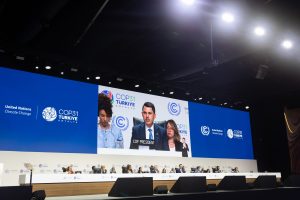
At the 31st United Nations Climate Change Conference (COP31) in Antalya, Türkiye, the draft ‘cover decision’ initially included a call to halt and reverse deforestation by 2030. However, as no consensus was reached on this umbrella decision, the call did not become a joint agreement amongst the participating countries.
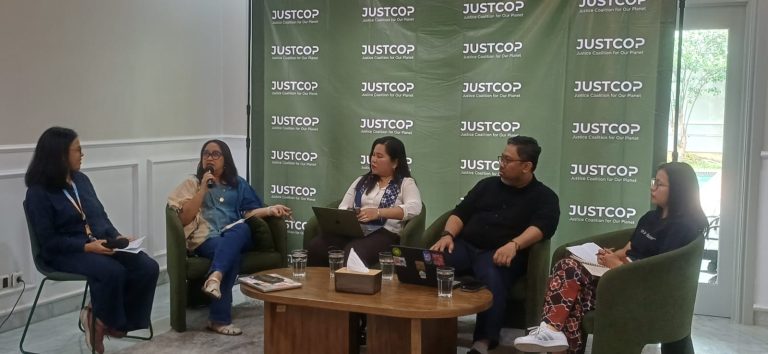
“The process is underway, but there is no binding language that would compel countries to take it seriously,” he said during a hybrid media briefing organised by the Justice Coalition for Our Planet (JustCOP) on the theme “Analysing the Direction of Indonesia’s Climate Commitments and Their Implications for the Energy, Forestry, Marine and Economic Sectors” on Thursday, 26 November.
According to Nadia, problems arise precisely when international commitments are not matched by consistent domestic policies. The expansion of sugarcane plantations to support bioenergy and the development of the mineral downstream industry have the potential to increase pressure on forest areas.
She said that forest conservation should not be viewed solely in terms of its economic value—including its potential for carbon trading—but also in terms of its ecological functions and the sustainability of the livelihoods of the communities that depend on these areas.
Inconsistent energy transition
A disconnect between national ambitions and policy is also evident in the energy sector. Agung Budiono, Executive Director of the Yayasan Indonesia Cerah, believes that Indonesia has not yet been able to translate its clean energy development targets into concrete positions and commitments in global climate diplomacy.
The government had previously announced its ambition to develop solar power stations with a capacity of 100 gigawatts and to accelerate the use of renewable energy.
However, during the COP31 discussions, Indonesia was deemed not to have taken a clear stance on its commitment to increasing clean electrification.
“I don’t see any reflection of what the Indonesian Government is promoting in the context of energy at this COP31,” said Agung.
He also cautioned that carbon capture and storage (CCS) technology should not be used as a justification for continuing the use of fossil fuels in the long term.
The development of CCS must be approached in a balanced manner and must not overshadow investment priorities in renewable energy. This is because carbon capture technology does not, in itself, solve the problem of dependence on fossil fuels.
On the other hand, the government is also being urged to expand opportunities for the public to generate clean energy independently. One way to achieve this is by removing the quota on the installation of rooftop solar panels, so that policies hindering consumer participation do not restrict the use of solar energy.
Debt-based financing
In addition to energy and forestry issues, funding arrangements present a further challenge to the implementation of Indonesia’s climate commitments.
The Executive Director of the Centre for Economic and Law Studies (Celios), Bhima Yudhistira, has cautioned the government against becoming trapped in climate finance schemes that consist largely of commercial loans. Such schemes have the potential to increase the fiscal burden without delivering optimal benefits to the public.
Indonesia’s climate investment requirements, as set out in its Second Nationally Determined Contribution (Second NDC) document, are estimated to reach USD 472.6 billion by 2035. Meanwhile, Indonesia is also calling for global climate finance of USD 300 billion per year until 2035.
The scale of these funding requirements means that the government needs to be more selective in determining the sources and mechanisms of funding.
“We must not repeat the mistakes of the JETP; many of the solutions are debt-based and focused on commercialisation, with the host country actually deriving little benefit,” he said, referring to the Just Energy Transition Partnership or JETP.
Bhima believes that the JETP experience should serve as a lesson when designing future financing schemes. Climate finance should allow developing countries the scope to undertake an energy transition without increasing their debt burden or dependence on commercial interests.
He also highlighted Indonesia’s diplomacy, which is considered not yet active enough in forging a common position with developing countries. Cooperation with the Global South needs to be strengthened so that the interests of developing countries in securing funding and implementing the energy transition can be championed on a more equal footing.
Youth participation
A lack of coherence in climate policy is also linked to issues of justice and the involvement of community groups directly affected by climate change.
The Chair of the Archipelago Indigenous Youth Alliance (BPAN), Elisabeth Simanjuntak, said that the presence of young people, particularly indigenous youth, at international forums such as COP31 does not necessarily reflect meaningful participation.
Elisabeth identified three key aspects of youth engagement: recognition of their existence, participation in the negotiation process, and a real influence on decision-making.
According to him, involving the younger generation is not enough simply by giving them a place at the table. They must have the opportunity to express their views, be involved in the negotiation process, and even influence the decisions that are reached.
“Young people, indigenous youth and future generations are the ones who will feel the impact of the decisions made today. It is only right that they should be given a genuine opportunity to express their views and help shape those decisions,” she said. (Hartatik)
Banner photo: JustCOP