The Indonesian government delegation attending the UN Climate Change Conference (COP31) in Turkey has attracted attention. This is because the delegation is particularly large, comprising 193 delegates (party) plus 793 additional participants (party overflow).
“The total number of members of the Indonesian delegation registered for COP 31 is 978. This is the fifth-largest delegation representing Indonesia worldwide. In fact, this figure is even higher than the 565 delegates who attended the UNFCCC COP 30 in Belém, Brazil, in 2025,” JustCOP wrote on Instagram on Saturday, 14 November.
JustCOP has revealed the five countries with the largest number of registered delegations at COP 31. In first place was the host country, Turkey, with 2,950 people. Brazil followed in second place with 1,994 people. Nigeria came third with 1,506 people. Next, China was in fourth place with 1,021 delegates. Indonesia was in fifth place, having sent 978 delegates.
This delegation from Indonesia comprised 559 government representatives (57.1 per cent), 311 representatives from the private sector/business (31.79 per cent), 36 researchers/academics (3.6 per cent), 36 representatives from civil society organisations (CSOs) (3.6 per cent), 17 representatives from international organisations (1.7 per cent), 17 media representatives (1.7 per cent), and 2 key opinion leaders (KOLs)/content creators (0.2 per cent).
“A large delegation, but to no avail. Indonesia’s ranking has actually plummeted, and its climate report card is in the red,” added JustCOP.
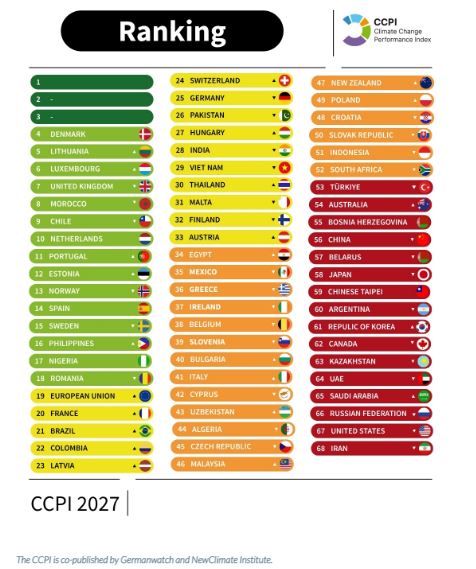 The ranking in question is Indonesia’s assessment in the 2027 Climate Change Performance Index (CCPI) report, published by Germanwatch and the NewClimate Institute in November 2026 on the sidelines of COP31.
Every year, the Climate Change Performance Index (CCPI) assesses the climate mitigation performance of 64 countries plus the European Union, which together account for over 90 per cent of global greenhouse gas emissions. The index assesses four categories: greenhouse gas emissions, renewable energy, energy use, and climate policy. The latter category is assessed by around 500 experts worldwide. The index has been published annually for over 20 years and is a widely used analytical tool in politics, academia and financial markets.
Indonesia is classified as a ‘low performer’, alongside several other G20 countries such as South Africa and Italy, which rank below the group of ‘medium performers’. The CCPI 2027 report shows that Indonesia is ranked 51st, down eight places from 43rd last year.
Indonesia scored poorly on all four key indicators of climate mitigation: greenhouse gas (GHG) emissions, energy use, renewable energy, and climate policy. In terms of GHG emissions, Indonesia received a low score, influenced by a continuing upward trend in national emissions and a heavy reliance on fossil fuels.
Renewable energy indicators: Indonesia received a low score as the green energy transition continues to face challenges in terms of capacity and market regulation. Next, energy use indicators: Indonesia received a low score for per capita energy efficiency. Furthermore, the climate policy category was also rated low due to the lack of a clear and legally binding plan to phase out coal-fired power stations (PLTU).
Meanwhile, Uli Arta Siagian, National Executive Campaign Coordinator at WALHI Indonesia, believes that the significant representation of the business sector within the Indonesian delegation attending COP31 demonstrates that the country’s climate agenda is driven by corporate interests.
“This is what we refer to as corporate power, whereby corporations hijack the public interest to reap huge benefits from policies that should, in fact, be geared towards the public interest, not their own business interests,” explained Uli. (Hartatik)
Banner photo: © UN Climate Change – Kiara Worth