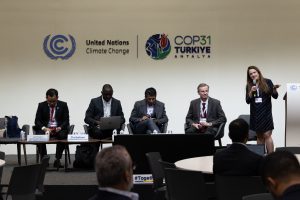
The limited flow of climate finance for the protection of the seas and coastal areas has prompted the Presidency of the 31st United Nations Climate Change Conference (UNFCCC) COP31 to launch the Antalya Pact for the Seas and Oceans. This agreement aims to expand access to blue finance whilst accelerating the recovery of coastal ecosystems affected by climate change.
Through this pact, countries are encouraged to incorporate marine protection into their national climate policies, including efforts to reduce emissions, adapt to climate change and enhance the resilience of coastal areas.
One of the targets is to restore at least 20 per cent of priority coastlines that have suffered degradation by 2035. In addition to ecosystem rehabilitation, the programme also encompasses the development of cleaner maritime energy, environmentally friendly ports, and investment in the shipping and tourism sectors to make them more resilient to climate change.
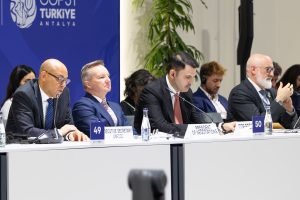
Fatih Turan, Director-General of Environmental Management at the Turkish Ministry of Environment, Urbanisation and Climate Change, said the pact was a step towards translating commitments to marine protection into concrete action plans.
“The Antalya Ocean and Seas Compact translates our shared commitment to protecting our seas into a concrete plan of action,” he said on Tuesday, 17 November.
According to him, the threats posed by global warming, marine pollution and coastal erosion require cross-border cooperation. Moreover, the Mediterranean region is one of the areas facing significant pressure from climate change.
The Turkish Government is also seeking to strengthen regional cooperation through the Regional Climate Change Activity Centre in Istanbul, including by mobilising existing financing mechanisms and partnerships without creating new bureaucratic burdens.
The UN Secretary-General’s Special Envoy for the Oceans, Peter Thomson, believes the pact strengthens the role of the oceans as a key component of the climate change agenda. However, the protection of marine ecosystems must go hand in hand with ending dependence on fossil fuels.
He said that no serious consideration of climate change is complete without taking the oceans into account, nor is it complete without recognising the importance of the transition away from burning fossil fuels.
As well as opening up access to funding, COP31 also launched the Regional and International Cooperation Initiative for the Oceans and Seas. The programme brings together countries and international partners to strengthen the protection of the oceans and coastal areas through the exchange of marine data, the development of early warning systems, and ecosystem restoration.
This initiative is also aimed at transforming coastal protection needs into projects that are ready to attract investment. In this way, conservation programmes will not only rely on political commitment, but will also have the financial support and partnerships needed for their implementation.
Meanwhile, the issue of marine litter is also a cause for concern. The COP31 Presidency has expanded the scope of the Marine Litter Action Platform, which was previously launched at the Trabzon Summit on the Seas and Oceans in September 2026.
The platform will connect countries and marine litter management projects with access to expertise, knowledge and funding. Its development draws on Turkey’s experience through the Zero Waste programme to expand the implementation of solutions to reduce marine pollution.
Kilaparti Ramakrishna, Senior Adviser to the President and Director of Marine and Climate Policy at the Woods Hole Oceanographic Institution, believes the pact could serve as a shared agenda for linking marine science with policy and funding.
According to him, the success of marine conservation is determined not only by the government’s commitment, but also by the ability to ensure that its benefits are felt by coastal communities and small island states.
Beyond the marine agenda, the COP31 Presidency is also promoting the integration of climate, biodiversity and land protection policies through the establishment of the Rio Synergy Action Group. This state-led voluntary initiative aims to align the priorities of these three environmental agendas so that expertise, partnerships and funding can be utilised in a more coordinated manner.
International cooperation has also been extended to the sectors of green industrialisation and the circular economy. Turkey, together with Germany through the German International Climate Initiative (IKI), has launched a major call for grant proposals for energy transition and the circular economy in the building sector.
These various initiatives form part of COP31’s efforts to accelerate the implementation of climate policies through cross-national and cross-sectoral collaboration. The next challenge is to ensure that commitments regarding funding, ecosystem restoration and strengthening the resilience of coastal communities are effectively realised at the operational level. (Hartatik)
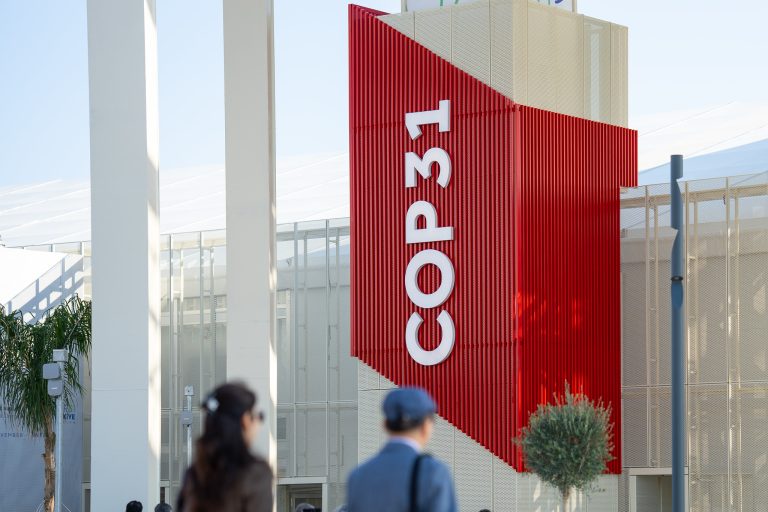
Banner photo: © UN Climate Change – Kubilay Citfci