Jakarta — The Institute for Essential Services Reform (IESR) welcomed President Prabowo Subianto’s commitment to building up to 100 gigawatts (GW) of solar power capacity, calling it one of the most progressive announcements in his state address and presentation of the 2027 state budget proposal.
The energy think tank said after the speech on Friday, August 14, that the target signals a growing recognition that solar power is Indonesia’s most abundant energy resource, can be deployed relatively quickly, and is increasingly competitive economically.
IESR also welcomed plans to accelerate the retirement of diesel-fired power plants and develop village-based solar power projects, saying these measures could expand energy access while reducing dependence on imported fossil fuels, and the success will depend less on their scale than on the government’s ability to implement them.
“The ambitious target must immediately be translated into a clear roadmap, complete with annual targets, financing sources and mechanisms to monitor implementation,” said IESR Chief Executive Officer Fabby Tumiwa, according to the organisation’s response to the President’s speech.
IESR said the programme could become an important foundation for strengthening national energy security, reducing power generation costs and creating new jobs in clean energy and solar supply-chain manufacturing. But this would require strong institutions, integrated planning and consistent implementation, with meaningful participation from communities and local governments.
To deliver 100 GW of solar capacity, IESR called for faster development of electricity transmission and distribution networks, energy storage systems, reforms to national power-sector planning, simpler regulations and licensing, and financing schemes that can attract private investment.
The government also needs to prepare a skilled workforce across the provinces and strengthen a competitive domestic industry that can integrate into global solar supply chains, IESR said.
Cutting fuel subsidies through electrification
IESR also welcomed the government’s commitment to gradually reduce fuel subsidies by accelerating transport electrification and providing incentives for domestically produced electric motorcycles. The policy could reduce energy imports, improve urban air quality and support the development of Indonesia’s electric vehicle industry, the institute said.
But it stressed that fuel-subsidy reform must be accompanied by protection for vulnerable groups, improved public transport, more evenly distributed charging infrastructure and a growing share of clean electricity in the national power system.
Without decarbonising the electricity sector, the full benefits of transport electrification will not be realised, IESR said.
The institute also noted that the President’s speech continued to include higher oil and gas lifting targets as part of the national energy strategy. Energy independence, IESR argued, should not be measured only by increased domestic energy production or reduced imports.
State budget must support the transition
IESR called on the government to strengthen climate- and energy-transition budgeting, increase investment in renewable energy and energy efficiency, accelerate the early retirement of uneconomic coal-fired power plants, strengthen green-finance instruments and ensure that public investment is aligned with Indonesia’s net-zero emissions target.
The call echoes concerns raised by the Indonesian Working Group on Forest Finance (IWGFF) about ensuring that financing for energy independence does not create new forms of dependency.
IWGFF has supported accelerating renewable energy that strengthens national energy security and expands access to affordable energy, while stressing that the transition should prioritise domestic potential, innovation, green jobs and community participation.
The group has also warned that the scale of green financing alone is not enough. Its use must be traceable, deliver demonstrable benefits and be backed by strong environmental and social safeguards to prevent greenwashing.
IWGFF has called for stronger environmental, social, governance and integrity due diligence throughout the financing cycle, as well as greater public access to information so that citizens can assess whether financing commitments and portfolios are delivering real-world impacts.
Governance at the heart of sustainable development
Meanwhile, the Interdisciplinary Intellectual Forum (FIAD), in a manifesto issued ahead of the President’s state address, identified the quality of state governance as a root cause of many of Indonesia’s current challenges.
FIAD called for the protection of state institutions, an end to democratic backsliding, institutional reform and stronger state capacity. It argued that weak institutions, shrinking democratic space, corruption, environmentally damaging development, inequality and the growing distance between scientific knowledge and policymaking are interconnected problems.
As part of its second phase of national transformation, FIAD included energy transition and natural-resource governance among efforts to rebuild the state’s capacity to provide services and protect its citizens.
The forum also warned that development focused too heavily on economic growth figures can overlook social and ecological costs, including environmental degradation, agrarian conflicts, inequality and injustice in the energy transition. (nsh)
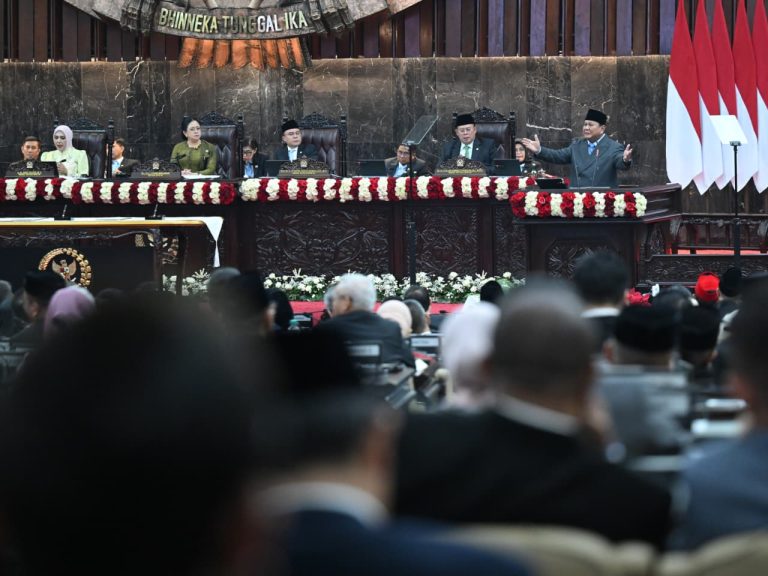
Banner photo: President Prabowo Subianto delivers the Government’s Statement on the Draft Law (RUU) on the State Budget for the 2027 Financial Year, and the Financial Memorandum, during the Plenary Session marking the opening of the First Session of the Indonesian House of Representatives (DPR RI) for the 2026–2027 parliamentary year at the Nusantara Building, Parliament Complex, Jakarta, on Friday, 14 August 2026. Photo: BPMI Setpres/Kris