
Jakarta — Global ocean temperatures have remained at record levels for more than three months, an unprecedented streak of warmth that is being amplified by a developing El Niño but is rooted in the longer-term heating of the planet, analysts warned.
Global daily sea surface temperatures outside the polar regions have been at record levels for the time of year since June 3, according to observations from Climate Reanalyzer. June 2, 2026 was tied with the previous record set on June 2, 2024, while every day since has been hotter than the same date in any other year.
The streak was expected to reach 100 consecutive days around September 10, and continue beyond that.
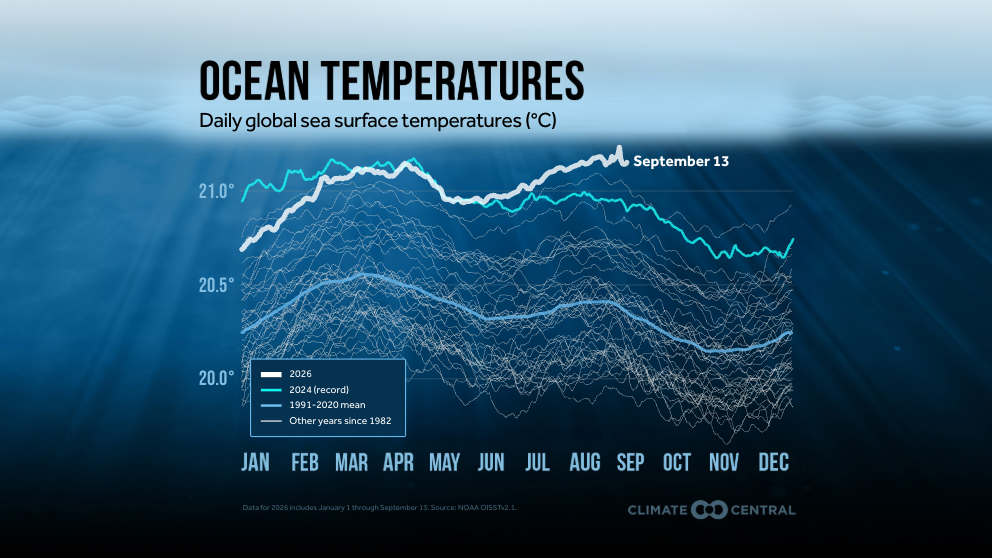
“Speaking as a scientist, the main takeaway for me is not the 100 number, but it’s just the fact that we’ve seen such consistent record warmth,” said Zachary Labe, a climate scientist at Climate Central in the United States, said in an online media briefing on Thursday, September 10.
“A streak of 99 versus 102 days will not change much in terms of impacts; the real driver of these impacts is the prolonged stretch of record warmth we continue to see this year as part of a broader, long-term trend,” he said.
The persistence is important because the current El Niño is adding heat to an ocean that was already exceptionally warm.
Global non-polar sea surface temperature was provisionally 21.17°C on September 9, compared with 20.73°C on the same date in 2015, when a record-strong El Niño was driving global temperatures higher.
Current global ocean temperatures are also about 0.95°C above the 1982-2010 average — a striking increase for the vast expanse of ocean outside the polar regions.
Global extra-polar sea surface temperatures from August 22 to 25 have now been confirmed at 21.18°C, breaking the previous record of 21.17°C set on April 24, 2024.
The data reinforce a broader trend. The ocean remained unusually warm after the previous El Niño ended in May 2024, with sea surface temperatures staying close to or above previous records through 2025 and early 2026 despite cooler La Niña conditions.
The factsheet accompanying the media briefing says climate change is the main driver of hotter ocean temperatures, with fossil fuel burning warming the planet and most of the resulting excess heat being absorbed by the ocean. The rate of ocean warming over the past 20 years has been more than twice that of the previous 40 years.
“El Niño is contributing to record-breaking ocean temperatures this year,” the factsheet says, but the heat it is redistributing “sits on top of the shoulders of long-term climate change”.
Ecosystems under pressure
The consequences of sustained ocean warming are already being seen across marine ecosystems and coastal economies.
“Even a 1°C increase in sea temperature can have a significant effect on marine life,” said Claire Bergin, a researcher at the ICARUS Climate Research Centre at Maynooth University in Ireland.
“While on land we can install air conditioning to cool ourselves down, adaptation for seas and marine life is not as simple and is highly limited,” she said.
The ocean has absorbed about 93% of the excess heat trapped in the Earth’s climate system, while also absorbing carbon dioxide and helping regulate global temperatures, weather and rainfall. But rapidly warming surface waters and a reduction in the ocean’s capacity to absorb CO2 suggest that this natural buffer is under pressure.
Climate change has made marine heatwaves about 10 times more intense than in pre-industrial times and three times longer-lasting, according to the factsheet. Nearly half of marine heatwaves recorded since 2000 would not have occurred without global warming.
During the extreme ocean heat of 2023 and 2024, marine heatwaves contributed to widespread coral bleaching, mass fish and shellfish deaths, harmful algal blooms and marine mammal strandings. They also helped intensify cyclones, extreme rainfall and heatwaves on land.
The impacts are also reaching food supplies. Morocco’s sardine landings fell 46% in 2026, contributing to an export ban on frozen sardines and shortages in European markets. In Peru, the fishing sector fell 73% year on year in May, while anchovy catches plunged to about 0.5 million tonnes from 1.9 million tonnes a year earlier.
A climate solution as well as a victim
Scientists say the immediate response to ocean warming must ultimately be a rapid reduction in greenhouse gas emissions.
“Individually we can make conscious choices, but ultimately, we need to cut emissions. That is the key,” said Tom Pickerell, Global Director of the Ocean Program at the World Resources Institute.
Pickerell said the ocean should not be viewed solely as a victim of climate change, but also as part of the solution through measures such as decarbonising shipping and expanding offshore renewable energy.
“If existing technologies, such as decarbonising shipping and offshore renewables, were used at scale, we could reach 35% of emissions reductions by 2050,” he said.
He also hopes the issue will gain greater prominence at the upcoming COP31 climate summit.
“We’re hoping that COP31 actually takes this message on board,” Pickerell said. “Turkey and Australia, the co-hosts, are being very positive about the role of the ocean, so maybe we will see the ocean move from the margins into the main part of the negotiations.”
For Labe, however, the significance of the current temperature streak lies less in whether it reaches a particular numerical milestone than in what it says about the direction of travel. (nsh)
Banner photo: Pok Rie/Pexels.com