Jakarta — The Institute for Essential Services Reform (IESR) has urged the government to conduct a comprehensive review of Indonesia’s electricity transmission system after the collapse of 12 transmission towers in North Sumatra triggered rolling blackouts in Medan and surrounding areas, only weeks after a massive power outage affected much of Sumatra.
The latest disruption has renewed concerns over the resilience of Indonesia’s power infrastructure as the country faces increasingly frequent extreme weather events linked to climate change. The collapse involved both the 275-kilovolt Galang–Simangkuk extra-high-voltage transmission line and the 150-kV Tebing Tinggi–Sei Rotan transmission corridor. Three towers on the Galang–Simangkuk line reportedly collapsed while two others suffered structural deformation. Six additional towers on the Tebing Tinggi–Sei Rotan line also fell, with another tower bent.
The latest transmission tower collapse comes just weeks after a massive blackout left large parts of Sumatra without power in May. At the time, Vice Minister of Energy and Mineral Resources Yuliot said the government was conducting a comprehensive investigation into the outage and preparing mitigation measures to prevent future blackouts. Industry analysts have warned that restoring and strengthening the grid will require significant investment in transmission infrastructure and climate resilience measures.

However, IESR argues that the recurrence of major transmission failures suggests deeper questions about the resilience of Indonesia’s electricity infrastructure in the face of increasingly extreme weather conditions. IESR chief executive officer Fabby Tumiwa said adverse weather alone should not be considered a sufficient explanation for such extensive damage.
“Transmission towers are designed to withstand heavy rain, lightning, and strong winds that commonly occur in Indonesia. The key question is why relatively new infrastructure suffered consecutive failures under these conditions,” Fabby said.
The Galang–Simangkuk transmission line forms part of the Sumatra Electricity Toll Road project and has been operating only since 2019. According to IESR, the failure of a relatively new strategic asset suggests possible weaknesses in design standards, construction quality, maintenance practices, or climate-risk assessments.
The think tank called on the Ministry of Energy and Mineral Resources and the Directorate General of Electricity to establish an independent multidisciplinary investigation team to determine the root causes of the failure. The review should examine whether the towers were exposed to weather conditions beyond their design limits, whether structural or foundation weaknesses contributed to the collapse, and why the damage spread across multiple towers.
IESR also urged authorities to conduct a nationwide audit of transmission infrastructure and develop a National Grid Resilience Strategy that incorporates climate resilience as a key performance indicator alongside conventional reliability measures such as SAIDI and SAIFI.
The organisation warned that strengthening transmission networks is becoming increasingly urgent as Indonesia seeks to integrate tens of gigawatts of renewable energy into the national grid over the next decade.
“In modern electricity systems, lightning, heavy rain and strong winds are not exceptional conditions,” said Fabby, “there are a number of international standards that are applied to transmission infrastructure.”
“A thorough investigation must not merely scratch the surface, but must get to the root of the technical and institutional issues, as well as the lack of investment commitment, which have left our electricity system in a vulnerable state,” he stressed. (nsh)
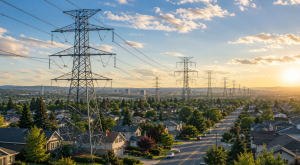
Banner photo: Image generated by OpenAI’s DALL·E via ChatGPT (2024)