Jakarta – The Indonesian government’s decision to provide a Rp3 million incentive for the purchase of electric motorcycles could fall short of its goal of accelerating the shift away from fuel-powered motorcycles, the Institute for Essential Services Reform (IESR) said on Monday, August 24.
The government has allocated Rp3 trillion for the programme, targeting one million domestically produced electric motorcycles. The incentive is lower than the initially planned Rp5 million per vehicle.
IESR Director of Energy System Transformation Deon Arinaldo said the incentive was a positive step, but its size and design should be reassessed to ensure it can significantly influence consumer purchasing decisions.
IESR modelling shows that a Rp5 million purchase incentive combined with a Rp3 million trade-in incentive for replacing fuel motorcycles, alongside disincentives such as raising Pertalite fuel prices closer to market levels, could increase electric motorcycle adoption by around 810,000 units above the business-as-usual scenario by 2030.
IESR estimates that replacing one fuel-powered motorcycle with an electric model could provide the government with about Rp5.6 million in benefits over 10 years through reduced fuel consumption and related costs. Including indirect benefits such as foreign exchange savings, lower air pollution and carbon values, the total benefit could reach around Rp28 million per vehicle.
For consumers, electric motorcycles also offer lower ownership costs. IESR estimates battery-electric motorcycles cost about Rp346 per kilometre to own and operate, compared with around Rp506 per kilometre for fuel-powered motorcycles.
“Electric vehicle incentives should not be viewed merely as purchase subsidies. If they can accelerate the shift from fuel to electricity, the government benefits from lower fuel consumption and import costs, while households gain from lower mobility costs,” Deon said.
IESR also called for a broader policy package covering charging and battery-swapping infrastructure, vehicle performance and the domestic electric vehicle supply chain.
The think tank said the programme should incorporate safeguards to ensure state funds are targeted at consumers whose purchasing decisions could be changed by the incentive. It proposed linking eligibility to the national identity number (NIK) and the National Socioeconomic Single Data (DTSEN), as well as excluding high-income households based on income deciles or ownership of high-value four-wheeled vehicles.
IESR further urged the government to use the incentive programme to strengthen the domestic electric motorcycle industry. It recommended that subsidised motorcycles have batteries of at least 2.2 kWh, a minimum three-year battery warranty, five years of after-sales service and a domestic component level (TKDN) of at least 40%. (nsh)
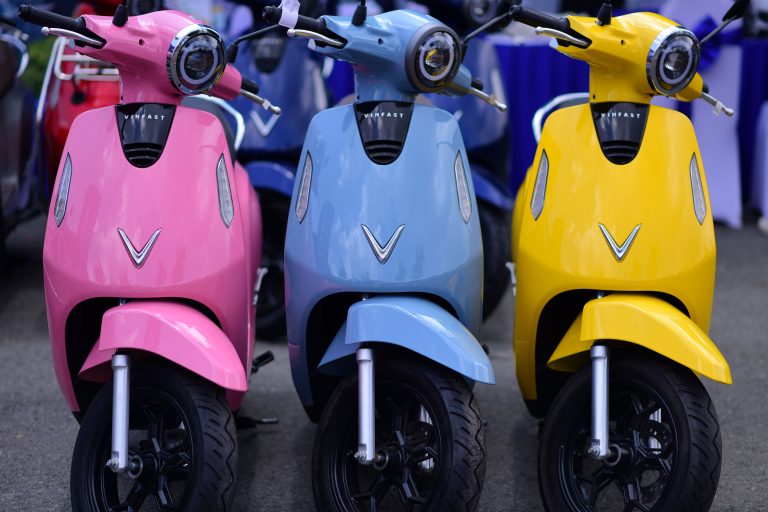
Banner photo: A vibrant outdoor display of pink, blue, and yellow VinFast scooters. Sóc Năng Động/Pexels.com