by: Roffie Kurniawan
Indonesia will revise its national electricity supply business plan, or RUPTL, to accommodate a proposed 100 gigawatt-peak solar expansion over the next two to three years, as the government seeks investment in new generation and grid infrastructure to meet rising power demand.
President Prabowo Subianto ordered the revision because the existing 2025-2034 RUPTL provides for only 69.5 GW of additional generation and energy-storage capacity, Coordinating Minister for Economic Affairs Airlangga Hartarto said on Tuesday, September 29. “The RUPTL needs to be revised because the current requirement is only around 69.5 GW by 2034, whereas the President recently urged the development of projects — specifically solar panels — totalling 100 gigawatt-peak,” Airlangga said.
The government also plans to develop 47,758 kilometres of transmission lines integrated with smart-grid technology to accommodate and distribute additional renewable electricity, he said.
The planned expansion comes as Indonesia prepares for increasing electricity demand from digital infrastructure, industrialisation and downstream processing.
Energy and Mineral Resources Minister Bahlil Lahadalia separately invited investors to participate in the renewable-energy expansion, saying Indonesia’s growing electricity requirements and energy resources create significant investment opportunities.
“If you want to invest, this is the moment,” Bahlil said at the Electricity Connect 2026 conference and exhibition, held by the Indonesian Electricity Society (MKI) and Enlit Asia, at ICE BSD, Tangerang, on September 22-24. “The timing is right.”
Revised power plan
The existing RUPTL targets 69.5 GW of additional generation and storage through 2034, with around 70 per cent coming from renewable sources.
The government’s new 100 GW solar ambition means that plan will have to be revised substantially, Airlangga said.
Rapid development of solar generation and battery energy-storage systems will be central to reducing emissions from Indonesia’s power sector, he said.
“Energy remains the largest source of emissions. Therefore, the President is pushing for that 100-gigawatt program,” Airlangga said.
He said successful implementation could allow Indonesia to bring forward its net-zero emissions target by 10 to 15 years from the current 2060 goal. Bahlil has said the government wants the 100 GW solar program completed within three years.
“This isn’t just a theme. It has been turned directly into a concrete program,” he said.
Neither minister provided details on how the 100 GW will be procured or financed, how capacity will be allocated geographically or what intermediate deployment targets will apply.
The revision of the RUPTL will therefore be an important next step in determining how the target translates into individual projects and supporting grid infrastructure.
Transmission expansion
Adding generation alone won’t be sufficient to accommodate the expected increase in renewable electricity.
Stable and affordable clean electricity will be particularly important to support Indonesia’s expanding digital infrastructure, including data centres, Airlangga said.
The government is simultaneously expanding electricity access in more remote parts of the archipelago. Its rural electrification program has been increased to 4,390 locations this year, from 1,505 locations in 2025, he said, adding that investments are expected to lift Indonesia’s electrification rate above 99 per cent.
Renewable resources
Solar is only one part of the renewable-energy investment the government is seeking.
Bahlil identified potential hydropower capacity of around 23 GW on the Mamberamo River in Papua and around 12 GW on the Kayan River in Kalimantan.
“If anyone wants hydro, in Papua, the Mamberamo River has potential of 23 gigawatts,” he said. “In Kalimantan, in Kayan, it’s approximately 12 gigawatts.” Indonesia also has substantial geothermal and wind resources, Bahlil said.
The government sees those resources as an opportunity as electricity consumption grows and energy-intensive digital businesses increasingly seek low-carbon supplies.
Bahlil said energy supplies in some other countries are already coming under pressure, particularly as demand for renewable electricity increases.
Data centers are among the new sources of demand, and the government is encouraging operators to invest in Indonesia by linking digital-infrastructure development with the country’s renewable-energy potential.
The immediate task will be incorporating the much larger solar ambition into Indonesia’s formal electricity planning and ensuring transmission and storage can keep pace with new generation.
The RUPTL revision, alongside the proposed transmission expansion, will determine more precisely how the government intends to move from its 100 GW target to projects that investors can develop and connect to the grid.
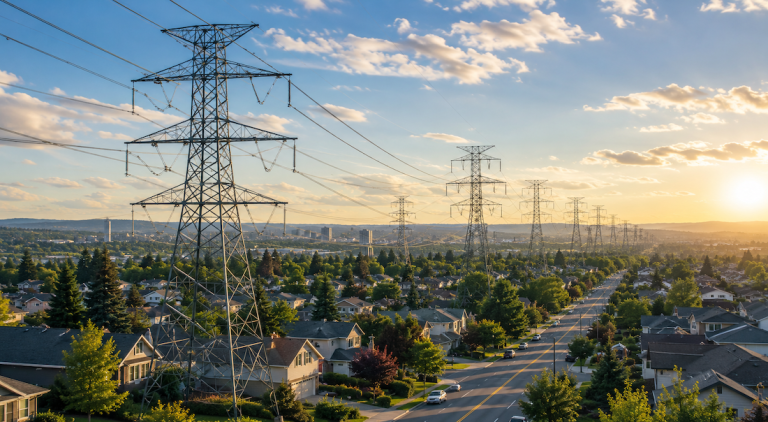
Banner photo: Image generated by OpenAI’s DALL·E via ChatGPT (2026)