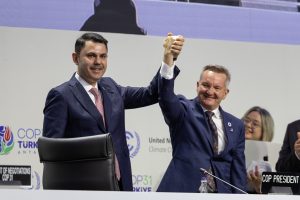
Australia and Türkiye are facing pressure to advance a global roadmap for transitioning away from fossil fuels as they prepare to lead the next phase of international climate negotiations under the COP31 presidency.
The roadmap, presented by Brazil’s COP30 presidency at a high-level session at the UN climate conference in Antalya on Tuesday, November 10, aims to help countries move away from fossil fuels in energy systems in a just, orderly and equitable manner, while accelerating action to achieve net-zero emissions by 2050.
The initiative builds on a commitment supported by more than 80 countries at COP30 in Belém last year. Its handover to the next presidencies comes amid growing calls from governments and climate advocates to turn political commitments into concrete national plans.
UN Secretary-General António Guterres said the roadmap recognised that countries would need different approaches to the energy transition, depending on their dependence on fossil fuels, economic circumstances and institutional capacities.
“The roadmap makes two essential points. First, there is no one-size-fits-all transition. Countries have different levels of dependence, different capacities, and different starting points. But all pathways must lead in the same direction,” he said.
He added that national action alone would not be sufficient, given the interconnected nature of global energy markets.
“In an interconnected global market, demand and supply must be managed together,” Guterres said.
The Netherlands, which co-hosted the first international conference on transitioning away from fossil fuels in Santa Marta earlier this year, called on the COP31 presidency to maintain momentum behind the initiative.
It also announced USD 600 million in new funding to support countries developing their own transition roadmaps through the Nationally Determined Contributions Partnership.
So far, Germany, the Netherlands and France have published national roadmaps, while other countries are considering how to translate the global initiative into domestic policies.
David Higgins, first assistant secretary of the International Climate and Energy Division at Australia’s Department of Climate Change, Energy and the Environment, thanked Brazil for developing the roadmap and said Canberra looked forward to continuing cooperation.
“I would like to again thank our Brazilian colleagues for the tremendous amount of work you have put into this roadmap as part of your many contributions to the COP process and the enormous legacy you’ve gifted us from COP30,” he said.
“We look forward to continuing to work with you this year and beyond.”
The transition presents particular challenges for developing economies that need to expand energy access and industrial capacity while reducing emissions.
Omotenioye Majekodunmi of Nigeria’s National Council on Climate Change said countries such as Nigeria had to balance their energy resources and development needs with climate objectives.
“As a developing country with significant energy resources, energy access challenges, and growing industrial ambitions, we must industrialise and decarbonise simultaneously,” she said.
Former UK climate minister Alok Sharma, who presided over COP26 in Glasgow in 2021, also urged governments to address the affordability of electricity as part of their transition plans.
While renewable energy has become the cheapest source of new electricity generation in many markets, he said households had yet to see the benefits reflected in lower energy bills.
“All of us know that renewables are the cheapest form of energy. But I want to speak from the perspective of the people that we represent who are not in this room, the voters in our countries, the populations in our countries,” Sharma said.
He noted that many consumers had experienced rising rather than falling energy prices in recent years, arguing that electricity market reforms would be necessary to make the transition more affordable.
“That has to change. We have to reform our electricity markets. And that, I hope, is something that will come through in these roadmaps in concrete terms,” he said.
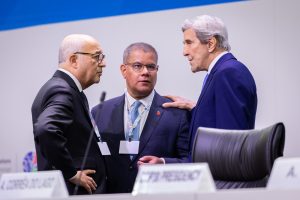
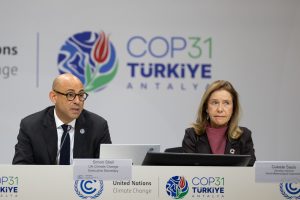
The high-level session brought together Guterres, UN Framework Convention on Climate Change Executive Secretary Simon Stiell, COP30 President André Corrêa do Lago, former UN climate chief Patricia Espinosa, former US Secretary of State John Kerry, Tuvalu Climate Minister Maina Talia and International Renewable Energy Agency Director-General Francesco La Camera.
With world leaders expected to arrive in Antalya for the high-level segment of COP31 on Wednesday and Thursday, countries supporting the initiative are seeking assurances that the fossil fuel transition will remain a priority under the Australian and Turkish presidencies.
The challenge for the incoming presidencies will be to maintain political support for the roadmap while helping countries translate its principles into practical policies, financing arrangements and nationally determined transition pathways. (nsh)
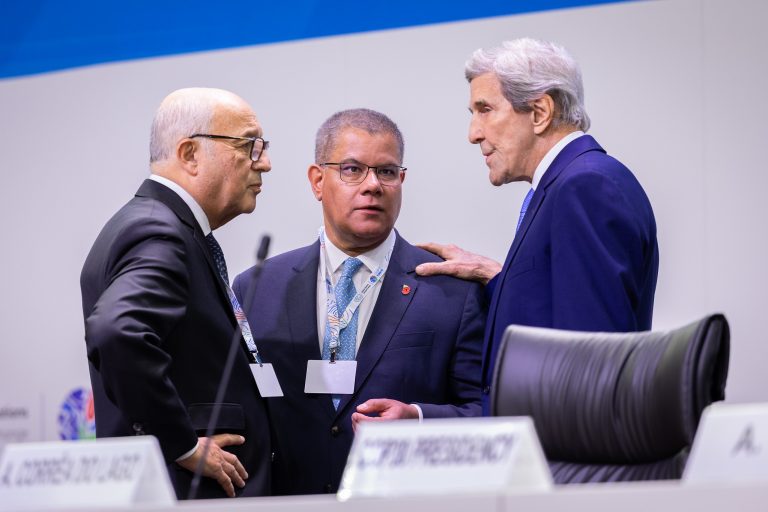
Banner photo: High-level dignitaries attend the COP30 Presidency on the Roadmap to Transition Away from Fossil Fuels (Photo: © UN Climate Change – Kiara Worth)