by Roffie Kurniawan
Indonesia expects growing data-centre investment to increase electricity demand in the coming years, adding pressure to expand generation and grid infrastructure while providing more renewable power sought by digital companies.
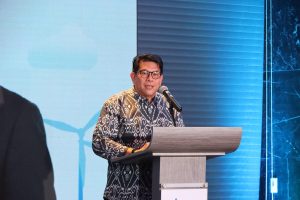
Energy and Mineral Resources Minister Bahlil Lahadalia is encouraging data-centre investors to build in Indonesia, arguing that the country’s solar, hydro, geothermal and other energy resources can support the industry’s growing electricity requirements.
“We know that in several countries, energy demand is already starting to come under pressure, especially for renewable energy,” Bahlil said at an energy conference in Tangerang. “There are so many data centres.”
“Investors don’t need to hesitate to build data centres in Indonesia,” he said at the Electricity Connect 2026 conference and exhibition, held by the Indonesian Electricity Society (MKI) and Enlit Asia, at ICE BSD, Tangerang, on September 22-24.
Indonesia plans to add 69.5 GW of generation and energy-storage capacity under state-owned electricity company PLN’s 2025-2034 electricity supply plan, with around 70 per cent coming from renewable sources.
The government is separately targeting 100 GW of solar capacity within three years, Bahlil said. It is also promoting large hydropower resources, including potential capacity of around 23 GW on Papua’s Mamberamo River and 12 GW on the Kayan River in Kalimantan.
Grid pressure
But rapidly increasing data-centre demand poses challenges beyond adding generation.
PLN sees a mismatch between where data-centre developers want to build and where electricity capacity and grid infrastructure are available.
“For the data centre, there is a mismatch between the demand of data centres and the readiness of capacity of [the] power system and readiness of infrastructure,” PLN Vice President Imam Makhfud said during a panel discussion.
A single large project could require 500 MW or even 1,000 MW, requiring PLN to conduct power-flow, short-circuit and stability studies and potentially invest substantially in new infrastructure.
PLN wants developers to provide detailed information on their expected loads one or two years in advance so the utility can prepare. The problem differs according to project size.
Imam cited discussions over an additional 1,000 MW of demand in East Java, where such a large load could put pressure on the region’s generation reserves.
For projects requiring around 30 MW to 100 MW, sufficient generation may exist, but transmission infrastructure can become the constraint. Procuring equipment to provide a new connection can take about a year, he said.
Location matters
The government is also considering directing data-centre investment toward areas where electricity and telecommunications infrastructure can better accommodate it.
Karawang, an industrial centre east of Jakarta, is already attracting significant data-centre interest, but its local electricity subsystem has limited additional capacity, Imam said.
“A lot of data centres want to build data centre infrastructure in the Karawang area. But the local subsystem in Karawang is limited,” he said.
Other nearby electricity subsystems have greater available capacity, meaning developers may need to be flexible about location.
The Ministry of Communication and Digital Affairs is separately preparing data-centre rules and considering locations outside established hubs such as Jakarta and Batam.
“If everything is in Jakarta and Batam, eventually the electricity will run out,” Denny Setiawan, director general for digital infrastructure at the ministry, told MLex.
Denny identified Surabaya, Makassar, Bali, Mandalika and Manado as possible locations. The government could encourage data centres to cluster in industrial or special economic zones where electricity and telecommunications infrastructure can be planned together.
Clean power
Renewable electricity will form another part of the equation because data-centre operators increasingly seek low-carbon power, according to Bahlil.
Olga Arfiandani, coordinator of electricity pricing at the Energy and Mineral Resources Ministry’s electricity directorate, said attracting data-centre investment will require more than simply having enough generation.
“Data centres are not simply [about] sufficient energy, but also capacity availability, power quality, scalability and predictability,” she said.
Competition for data-centre investment will increasingly depend on the ability to provide “reliable power, scalable power, low-carbon power and also fast connection,” Olga said.
Indonesia’s challenge will therefore be to expand renewable generation while ensuring new capacity and transmission infrastructure are available where increasingly power-hungry data centres want to locate.
Banner photo: Brett Sayles/Pexels.com