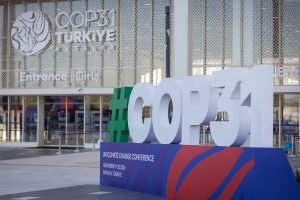
Developing countries are still struggling to secure funding to tackle the impacts of climate change. This inequality in access to finance was one of the key issues raised at the opening of the UN Climate Change Conference, or COP31, in Antalya, Turkiye, on Monday, November 9.
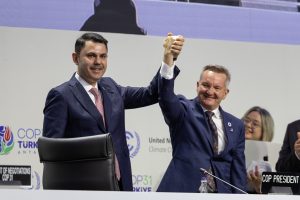
Chris Bowen, Australia’s Minister for Climate Change and Energy and President of Negotiations for the COP31, noted that the countries most in need of financial support are, in fact, the ones receiving the least. He therefore urged that international climate finance mechanisms be made faster, simpler and fairer.
“The countries most in need of climate finance are the ones receiving the least,” said Bowen in his opening address at COP31.
The conference, which took place from November 9 to 20, brought together delegations from various countries to discuss emissions reduction, climate change adaptation and the fulfilment of funding commitments to countries vulnerable to the impacts of the climate crisis.
The issue of funding is becoming increasingly urgent as the impacts of climate change continue to worsen, whilst economic capacity and access to technology remain uneven across countries. Developing countries face a need for substantial investment to build climate resilience whilst reducing their dependence on fossil fuels.
Bowen stated that the COP31 agenda comprises more than 160 items for discussion and 60 substantive negotiating mandates. Among the priorities to be negotiated are the implementation of the Just Transition Mechanism, the strengthening of the Mitigation Work Programme, the achievement of the Global Adaptation Goals, and the fulfilment of outstanding climate finance commitments.
He also highlighted the importance of maintaining the momentum of the clean energy transition. According to him, projections for global warming have fallen from nearly 4 degrees Celsius before the Paris Agreement to around 2.6 degrees Celsius. Meanwhile, renewable energy generation capacity has almost doubled since 2015.
Global investment in clean energy even reached around USD 2.2 trillion last year – almost double the investment in fossil fuels.
Nevertheless, these developments are not yet sufficient to ensure that the target for limiting global temperature rise is met. Bowen warned that the world still faces the risk of exceeding the 1.5-degree Celsius warming threshold set out in the Paris Agreement.
“We can still get back on track if we work together and act promptly, with solidarity and determination,” he said.
Promoting implementation of the COP
Murat Kurum, President of COP31 and Turkiye’s Minister for the Environment, Urbanisation and Climate Change, has made the implementation of commitments the main focus of this year’s conference. He wants COP31 to go beyond political agreements and produce concrete measures that the public can feel the benefits of.
Kurum stated that the climate crisis cannot be separated from geopolitical issues, economic uncertainty, supply chain disruptions, and food and energy security. Therefore, climate policy must be integrated with development agendas across various sectors.
“Current climate policy is also development policy. It is food policy. Energy policy. Urban policy. Health policy,” he said.
Turkiye is upholding three principles in the organisation of COP31: dialogue, consensus and action. The organisation is also committed to strengthening the involvement of developing countries, particularly Pacific island nations facing the threats of rising sea levels and climate-related disasters.
On the issue of funding, Kurum referred to the Baku Agreement, which sets out a target of mobilising at least 300 billion US dollars per year for developing countries by 2035. This commitment forms part of a broader target to increase climate finance to USD 1.3 trillion per year.
To match funding needs with the availability of investment and technology, Turkiye has introduced the Climate Implementation Bridge. This mechanism is designed to connect countries and projects in need of support with institutions and partners that have the necessary financing and technological capacity.
The organisation also launched the 35×35 Global Electrification Pledge. This initiative aims to increase the share of electricity in global final energy consumption to 35 per cent by 2035 through the development of renewable energy, the strengthening of electricity grids, energy storage, energy efficiency and clean transport.
“We want Antalya’s legacy to be a culture of cooperation, not just a list of decisions,” he said.
Accelerating climate solutions
The Executive Secretary of the United Nations Framework Convention on Climate Change (UNFCCC), Simon Stiell, also urged the countries participating in COP31 to shift their focus from merely setting targets to implementing solutions that can accelerate climate action.
According to him, increasing renewable energy capacity, strengthening the electricity grid and reducing methane emissions must be key elements of efforts to curb global warming.
Stiell is calling for a threefold increase in global renewable energy capacity by 2030, as well as accelerated reductions in methane emissions, particularly from the oil, gas and waste sectors.
He believes that controlling methane emissions and electrification could have a significant impact on reducing projected global warming by up to half a degree Celsius.
In addition to mitigation, increasing funding for adaptation is also a key priority. Stiell called on countries to ensure that the commitment to double adaptation funding can be realised without reopening previously negotiated agreements.
He pointed out that climate change and fluctuations in fossil fuel prices are putting pressure on households and the global economy. Conversely, the development of renewable energy generated savings of around 500 billion US dollars globally last year and a further 265 billion US dollars in the first half of 2026.
For Stiell, the energy transition cannot be measured solely in terms of reductions in emissions or growth in investment. Fairness in the distribution of benefits and support for the most vulnerable members of society must also be a priority.
“No COP is a silver bullet. No single conference can bridge the chasm between the science and reality,” he said.
He hopes that COP31 will yield tangible progress in international climate cooperation, particularly through practical measures capable of accelerating the energy transition and strengthening countries’ resilience to climate change. (Hartatik)
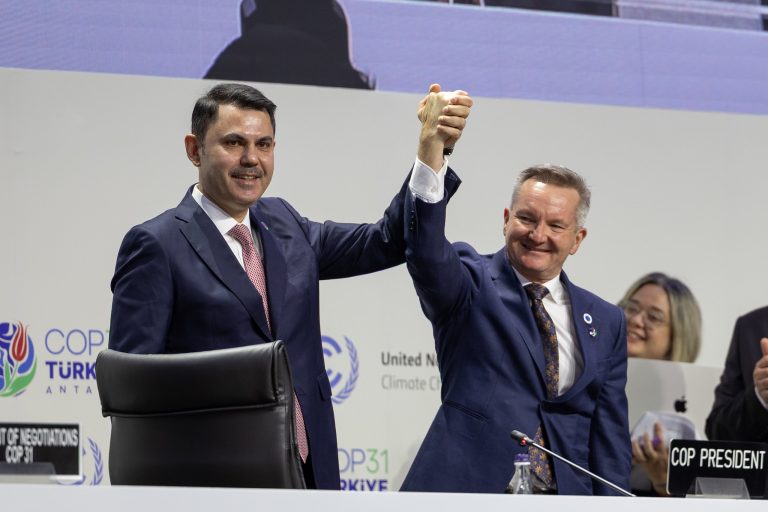
Banner photo: COP31 President Murat Kurum, Türkiye, and COP31 President of Negotiations Chris Bowen, Australia (Photo: © UN Climate Change – Kiara Worth)