More than 20 governments from Latin America, Europe, the Pacific and Asia have reaffirmed their commitment to transitioning away from fossil fuels, pushing back against a weak draft COP31 agreement that does not refer to fossil fuels.
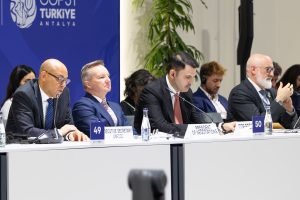
At a press conference on Friday, November 20, ministers from countries with diverse economic circumstances said they would continue accelerating the decarbonisation of their economies, arguing that the transition was essential to strengthening energy security, protecting industries and safeguarding communities from climate impacts.
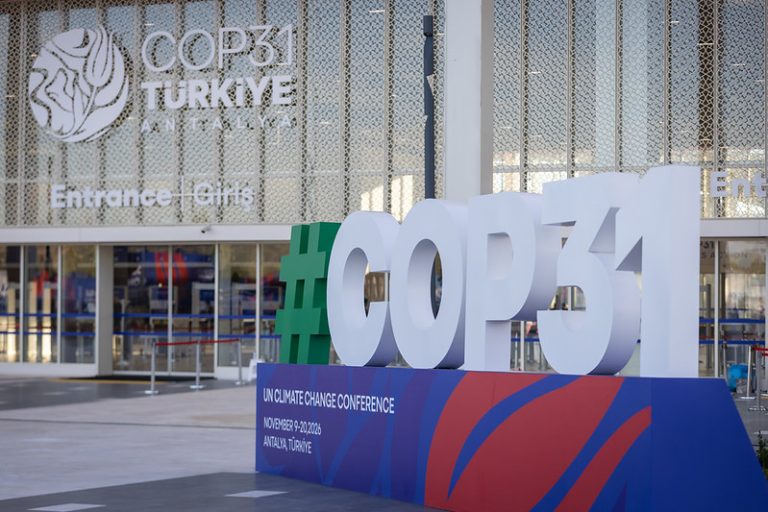
The show of support came on the final day of COP31 in Antalya, as negotiations over the conference’s cover decision continued without agreement on explicit language addressing the transition away from fossil fuels.
Since the beginning of the summit, six additional countries — Denmark, Tuvalu, Finland, Portugal, Luxembourg and Spain — have announced plans to develop national roadmaps for transitioning away from fossil fuels. This brings the total number of roadmaps either published or under development to 25.
Ana Toni, CEO of Brazil’s COP30 Presidency, which launched the international roadmap initiative last year, said the growing number of national commitments demonstrated that the movement was gaining momentum.
“On behalf of the COP30 Presidency, we’re really pleased to see how many countries now have national roadmaps. We came also with the international roadmap for transitioning away from fossil fuels. This is a movement that will not stop,” she said.
The roadmap initiative aims to help countries develop pathways for moving away from fossil fuels in a just, orderly and equitable manner, following the landmark commitment made at COP28 in Dubai in 2023.
For European governments, the transition is increasingly being framed as an economic and energy security priority.
Dutch Climate Policy and Green Growth Minister Stientje van Veldhoven said renewable energy offered significant benefits beyond emissions reductions, including greater energy independence and more affordable energy for consumers.
“The opportunities and rewards of a renewable energy system are enormous. It means greater control over our energy security. It means more options and flexibility for our households. And it means increasing affordability as renewable solutions are being scaled up—and, of course, dramatically lower emissions,” she said.
Germany’s Environment Minister Carsten Schneider described the country’s transition roadmap as a declaration of independence, arguing that renewable energy would strengthen its economy while contributing to global climate action.
“Our [roadmap is our] declaration of independence. Renewables make us independent. It’s good for our economy, and it’s good for the world,” he said.
Norwegian Climate and Environment Minister Sigrun Aasland said her country had established a timeline and plan to phase out fossil fuels across its economy, with progress reviewed annually.
“In Dubai, we agreed to transition away from fossil fuels, and in Norway we have a timeline and a plan for how we are going to phase out fossil fuels in every part of our economy, annually updating that,” she said.
Aasland called on negotiators to secure stronger language on the energy transition in the COP31 outcome.
Swiss Federal Councillor Albert Rösti also called for an explicit reference to transitioning away from fossil fuels and a roadmap in the conference’s cover decision. He said Switzerland would submit a comprehensive account of measures adopted by its government and parliament and approved by the Swiss population.
France’s Ecological Transition Minister Monique Barbut said incorporating the transition into national planning was a way to move beyond political declarations towards implementation.
“It is clear that by putting it in our national programming, we are moving beyond speeches and coming to action,” she said, urging countries to increase their efforts to reflect this ambition in the final cover decision.
For vulnerable countries, however, the issue is also one of climate justice and survival.
Guatemala’s Environment Minister Edwin Castellanos highlighted the disproportionate burden borne by Central American countries, which contribute relatively little to global emissions but face increasingly severe droughts, storms and extreme weather.
“The small countries of Central America contribute almost nothing to the problem, but we are bearing a very large proportion of the impacts through drought, storms, and extreme weather events,” he said.
He called for a shift away from oil consumption, arguing that the consequences of continued fossil fuel dependence were already costing lives across the region.
Pacific nations delivered an equally strong message. Vanuatu’s Climate Change Adaptation Minister Ralph Regenvanu announced that the Pacific was developing a regional roadmap, with plans to present it in July.
The region remains the world’s largest area free of fossil fuel extraction, he said, adding that Pacific governments wanted to preserve that status.
“We are still the largest area of territory in the world which is fossil-fuel-extraction-free—the whole of the South Pacific. We are hoping to maintain that status and have our roadmaps ready for presentation in July,” Regenvanu said.
For the Marshall Islands, the transition is inseparable from the country’s survival in the face of rising seas and intensifying climate threats.
“Transitioning away from fossil fuels, for the Marshall Islands and the Pacific Islands, is not a political choice. It is a matter of survival. It is a matter of survival,” said Jess Gasper Jr., Minister-in-Assistance to the President and Environment.
Panama’s Environment Minister Juan Carlos Navarro called on all countries participating in COP31 to endorse the 35-by-35 pledge, which seeks to accelerate the shift from fossil fuels towards renewable energy.
“We call for every country at this COP to subscribe to the 35-by-35 pledge, to move away from the slavery of fossil fuels into the freedom of renewables,” he said.
The ministers’ intervention adds pressure on the COP31 presidency to ensure that the final political agreement reflects the growing international support for a fossil fuel transition.
With the COP30 Presidency’s international roadmap now gaining support through national and regional initiatives, the immediate challenge is translating these commitments into a stronger multilateral framework.
Whether that momentum will be reflected in the final COP31 cover decision remains a key test of the summit’s outcome. (nsh)
Banner photo: © UN Climate Change – Kiara Worth