Jakarta – Indonesia’s National Research and Innovation Agency (BRIN) has developed two technologies aimed at strengthening efforts to prevent and fight forest and land fires, including on peatlands: a cassava-based firefighting agent and a cloud-seeding technology using ultra-fine salt particles, the state research agency announced on Tuesday, November 10.
The innovations, known as Singkong-APP and Dumakron, offer different approaches to tackling fires. While Singkong-APP is designed to extinguish fires and suppress underground peat combustion, Dumakron aims to increase the potential for rainfall in drought-prone areas through weather modification.
Both technologies were tested or deployed in Central Kalimantan in early November, as Indonesia seeks more effective ways to address recurring forest and land fires.
Cassava-based agent targets underground peat fires
Singkong-APP, developed by researchers at BRIN’s Molecular Chemistry Research Center, combines cassava starch, ammonium polyphosphate (APP) and a wetting agent known as APG.
The formulation aims to overcome a major challenge in peatland firefighting: fires can continue smouldering beneath the surface even after visible flames have been extinguished, potentially reigniting later.
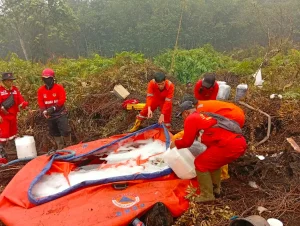
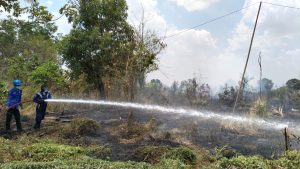
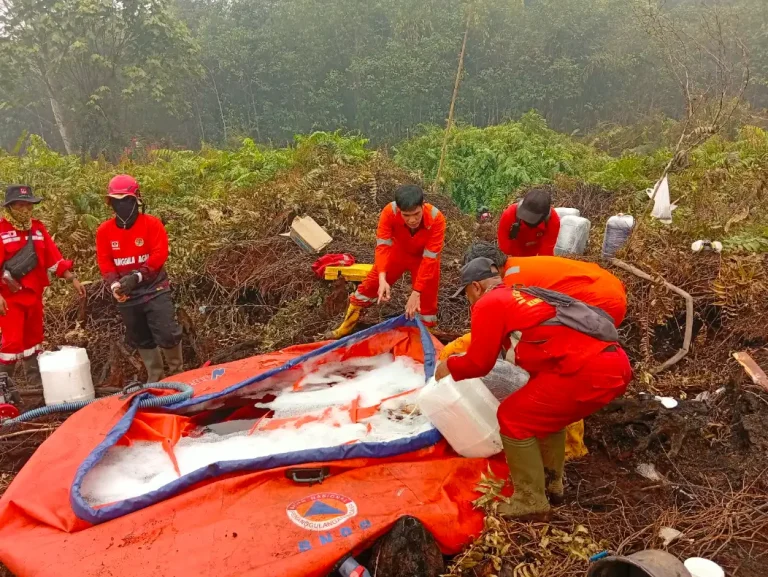
In a field test in Jabiren village, Pulang Pisau Regency, Central Kalimantan, on November 5, the cassava-based formulation extinguished all observed hotspots across four experimental plots, while conventional water treatment left seven hotspots.
The trial compared four firefighting agents: plain water, water mixed with APG, Singkong-APP and a commercial product called Flame Freez. Each treatment was applied to four plots measuring 2.5 metres by 2.5 metres, using 125 litres of material per plot. The agents were applied through surface spraying and direct injection into the peat.
Water mixed with APG left four hotspots, while Flame Freez left two.
Temperature measurements also indicated a significant difference. At a nominal depth of 60 centimetres, the average temperature in plots treated with Singkong-APP was around 31 degrees Celsius, compared with approximately 106 degrees Celsius in those treated with plain water.
BRIN researcher Julinton Sianturi said the formulation was developed to address the limitations of conventional firefighting methods, which may fail to reach all areas of burning peat.
In the formulation, water cools the burning material, while APG improves its ability to penetrate and wet the peat. Cassava starch and APP help inhibit combustion.
When exposed to high temperatures, APP can promote the formation of a protective carbon layer, or char, from the cassava starch. This layer can help limit heat transfer and reduce the fuel’s exposure to oxygen, suppressing the combustion process.
A separate 12-hour observation also showed promising results. No ongoing combustion was detected in material treated with Singkong-APP, which recorded a temperature of around 28 degrees Celsius. In contrast, material treated with plain water still contained embers reaching 650 degrees Celsius.
Julinton cautioned, however, that further monitoring and testing are needed to establish the technology’s long-term effectiveness, particularly across peatlands with different depths, moisture levels and fire intensities.
BRIN hopes the technology can eventually be developed into an affordable firefighting product using locally available agricultural resources, potentially reducing the environmental damage, greenhouse gas emissions and health impacts associated with peat fires.
Dumakron uses micro-salt particles for cloud seeding
BRIN’s second innovation, Dumakron, focuses on preventing fires by supporting rainfall through weather modification.
Developed by researchers at BRIN’s Climate and Atmospheric Research Center, the technology uses sodium chloride (NaCl) particles measuring just 2–5 micrometres, significantly smaller than the particles used in conventional salt-based cloud seeding, which generally measure 40 micrometres or more.
According to BRIN researcher Findy Renggono, the smaller particles allow a much greater number of cloud-seeding particles to be produced from the same amount of material.
Dumakron works by exploiting salt’s hygroscopic properties, allowing the particles to absorb water vapour. Under suitable atmospheric conditions, they act as cloud condensation nuclei, providing surfaces on which water vapour condenses into droplets that can grow and eventually form rain.
Findy explained that the technology does not create clouds from clear skies. Instead, it is designed to encourage rainfall from existing clouds that already contain sufficient moisture and meet the necessary meteorological conditions.
The technology was deployed in Palangka Raya, Central Kalimantan, on November 5.
One of its potential advantages is the possibility of using drones to distribute the particles, offering an alternative to conventional weather-modification operations that rely on manned aircraft.
Because the micro-sized salt produces more particles per unit of mass, the amount of material that needs to be transported could be reduced. This could make drone-based operations more practical and potentially lower operational costs.
Dumakron can also be used with ground-based generators, providing additional flexibility in distributing the seeding material.
Findy said drones could improve operational safety by eliminating the need for an onboard pilot. However, their limited flight range and carrying capacity remain challenges, particularly when operating across large areas. Multiple drones and strategically positioned operators may therefore be needed.
The technology could support peatland fire prevention by helping maintain soil moisture during prolonged dry periods, reducing the conditions that make peatlands more vulnerable to burning.
Findy stressed that cloud seeding remains dependent on the availability of suitable clouds and favourable atmospheric conditions. Increasing the number of condensation nuclei does not automatically guarantee higher rainfall.
He also said that potential savings in material and operational costs, as well as improvements in rainfall effectiveness, still need to be demonstrated through systematic field trials and operational evaluations.
Complementary approaches to fire management
The two BRIN innovations address different stages of forest and land fire management.
Singkong-APP is designed for direct firefighting, particularly to suppress underground combustion in peatlands, while Dumakron aims to support preventive measures by increasing the potential for rainfall in drought-affected areas.
Both technologies, however, require further testing before they can be considered ready for widespread operational use.
Singkong-APP needs broader field trials, long-term effectiveness assessments and environmental safety evaluations. Dumakron requires measurable operational assessments to establish its effectiveness under different atmospheric conditions and determine the feasibility of drone-based deployment.
Together, the innovations reflect efforts to develop locally adaptable scientific solutions to Indonesia’s recurring forest and land fire problem, particularly in peatland ecosystems where fires can be difficult to detect and extinguish completely. (nsh)
Banner photo: BRIN