Jakarta — Air pollution-related deaths in Indonesia surged by 42 per cent in September 2026, driven largely by smoke from forest and land fires, as the government faced mounting pressure to declare the worsening crisis a national disaster.
An estimated 5,310 people died from short-term exposure to fine particulate matter (PM2.5) in September, up from 3,740 in August, according to an assessment released by the Centre for Research on Energy and Clean Air (CREA) on Thursday, October 29.
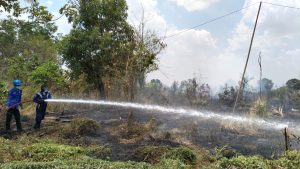
Forest and land fires, locally known as “karhutla”, accounted for an estimated 3,560 deaths in September, more than double the 1,700 attributed to fires in August. Chronic pollution from urban and industrial sources, including power generation and transportation, accounted for another 1,750 deaths.
The deterioration in air quality also exposed a record 57.8 million Indonesians to unhealthy, very unhealthy or hazardous air in September, a 40 per cent increase from August’s peak of 41.3 million, the report said.
Kalimantan and Sumatra bore the brunt of the fire-related pollution. In four Kalimantan provinces — West, South, Central and East Kalimantan — an estimated 1,470 people died from air pollution in September, more than twice the 700 recorded in August. Fire smoke accounted for between 94 and 99 per cent of the deaths in these provinces.
In Sumatra, deaths across South Sumatra, Riau, Lampung, Jambi and West Sumatra nearly doubled to 1,420 in September, from 760 a month earlier. Fire-related pollution accounted for more than 90 per cent of deaths in Riau, Jambi and West Sumatra.
Java, meanwhile, continued to suffer from chronic urban and industrial pollution. About 80 per cent of air pollution-related deaths in West Java, Central Java, Jakarta and Banten were attributed to non-fire sources, including industrial emissions, vehicle exhaust and waste burning.
National population-weighted PM2.5 concentrations averaged 36 micrograms per cubic meter in September, more than seven times the World Health Organization’s annual guideline of 5 micrograms.
Kalimantan experienced the sharpest deterioration, with average PM2.5 concentrations doubling from 57 micrograms per cubic meter in August to 120 in September. On Sept. 21, concentrations peaked at 196 micrograms per cubic meter.
In Palangka Raya, Central Kalimantan, and Pontianak, West Kalimantan, average daily PM2.5 levels reached 372 and 327 micrograms per cubic meter, respectively, exceeding the hazardous threshold of 300 micrograms.
The health impact was also reflected in the rising number of acute respiratory infection (ARI) cases. The Health Ministry recorded 333,470 cases across seven provinces affected by forest and land fires as of Oct. 21, up from 50,891 cases during July and August.
Children under five accounted for nearly a quarter of the reported cases, or 75,172 infections.
CREA cited Indonesian Pediatric Society pediatric respiratory specialist Wahyuni Indawati as warning that PM2.5 particles from forest fires could be up to 10 times more dangerous to developing lungs.
The report also highlighted the scale of the fires, with activity in Kalimantan, Sulawesi and Papua surpassing levels recorded during the 2015 fire season.
Despite the worsening situation, the National Disaster Mitigation Agency (BNPB) has faced significant budget constraints. Its allocation for 2026 was cut by 75 per cent, from Rp2 trillion (USD 110.5 million) in 2025 to Rp491 billion (around USD 27 million), limiting resources for emergency response.
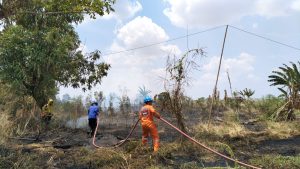
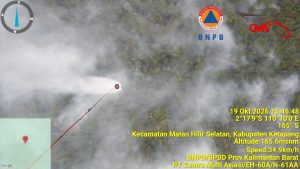
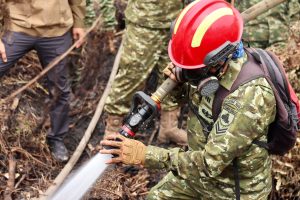
Between August and October, BNPB said it had deployed more than 54,000 personnel, conducted aerial water-bombing operations and carried out artificial rain operations over drying peatlands.
The Health Ministry also deployed 2,106 medical personnel and distributed more than three million medical-grade face masks, oxygen concentrators and other medical supplies in response to rising respiratory infections.
However, the fires continued. On October 12, President Prabowo Subianto held a closed-door meeting with his cabinet, during which BNPB reported that 639 hectares of land remained burning across six key provinces. A week later, the agency’s dashboard recorded 1,024 hectares of burning land in the preceding 24 hours.
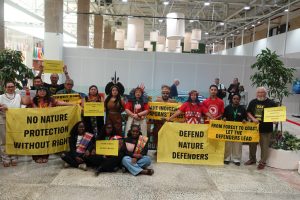
Calls for the government to declare the fires a national disaster intensified during protests marking the second anniversary of the Prabowo-Gibran administration on October 20, with demonstrators in Jakarta, Central Kalimantan and other areas demanding stronger action to protect public health.
Despite mounting pressure from lawmakers and environmental advocates, the government had not declared a national emergency at the time of CREA’s report.
Officials have argued that regional governments had not experienced a complete collapse of their capacity to respond to the fires and that local task forces remained operational.
CREA, however, warned that the government’s reluctance to declare a national emergency risked leaving affected provinces to manage the crisis with inadequate resources.
The research organisation also called for a shift from reactive firefighting to stronger peatland restoration, stricter enforcement against illegal land clearing and tougher penalties for those responsible for fires.
It urged Indonesia to establish a comprehensive clean air law requiring nationwide air quality monitoring, public access to pollution data, binding ambient air quality standards and stronger accountability for corporate polluters and regional authorities.
The assessment estimated deaths attributable to short-term exposure to ambient PM2.5 using daily pollution data from Tsinghua University’s Tracking Air Pollution system, adjusted against measurements from 186 ground monitoring stations across 118 Indonesian cities.
The estimates distinguish between pollution from landscape fires and non-fire sources, using population data and provincial mortality figures. (nsh)
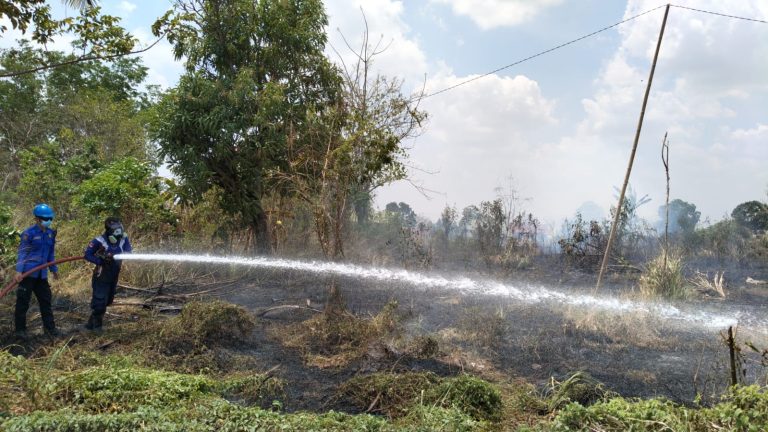
Banner photo: A joint team extinguishes a fire that has engulfed one hectare of land in Mojong Village, Watan Sidenreng Sub-district, Sidenreng Rappang District, South Sulawesi Province, on 1 November 2026. Source: Sidenreng Rappang District Disaster Management Agency (BPBD).