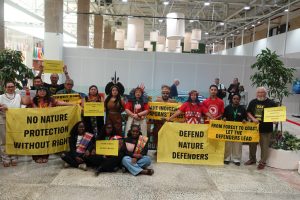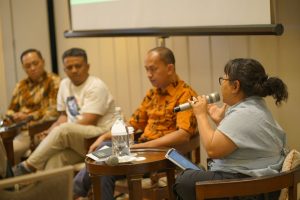
Jakarta — Indonesian civil society groups have urged the government to strengthen forest protection, reform financing linked to deforestation and ensure Indigenous peoples have a meaningful role in biodiversity policymaking, warning that the country’s environmental record could undermine its ambition to host the next United Nations biodiversity summit.
The calls came during the 17th Conference of the Parties to the Convention on Biological Diversity (COP17 CBD), held in Yerevan from October 19 to 30, 2026, as Indonesia considers hosting COP18. Environment Minister Jumhur Hidayat has expressed interest in hosting the summit, but Indonesia has yet to formally submit its candidacy, according to civil society groups. Ethiopia, Panama and Ecuador have submitted official bids.
Forest Watch Indonesia (FWI) reported that the country lost approximately 1.06 million hectares of natural forest in 2024–2025, a 37 per cent increase from the previous period. Of Indonesia’s 88.43 million hectares of natural forest, 70.3 million hectares remain in intact forest landscapes, including 26.5 million hectares in Papua.
FWI also found that 40 per cent of national deforestation occurred within forestry, plantation and mining concessions, while approximately 160,000 hectares of forest loss occurred within Key Biodiversity Areas. Another 4.59 million hectares of these biodiversity-rich areas overlap with concessions.
“Protecting forests, protecting biodiversity, and protecting the rights of Indigenous peoples and local communities are the same agenda,” said Agung Ady Setiyawan, an FWI campaigner, calling on the government to halt deforestation and strengthen protections for primary and intact forests.
The consequences are particularly concerning for the Tapanuli orangutan, the world’s rarest great ape. Recent surveys estimate that only around 716 individuals remain in three separated population blocks in North Sumatra. Land-cover analysis indicates that natural forest cover in the Batang Toru ecosystem declined, while open land increased by 239.4 hectares, or 21.93 per cent, between 2013 and 2023.
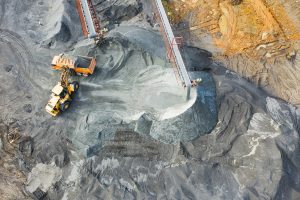
Seven industrial activities, including oil palm plantations, gold mining and hydropower projects, operate within or around the ecosystem. Civil society groups say vegetation clearing has disrupted orangutan corridors, increasing the isolation of already vulnerable populations. Ecological disasters are estimated to have affected as many as 58 Tapanuli orangutans, equivalent to about 11 per cent of the species’ population.
Sadam Afian Richwanudin, a senior campaigner at Satya Bumi, called on the government to stop issuing new permits for mining, plantations, logging and large-scale infrastructure in Batang Toru, alongside consistent law enforcement.
Civil society groups also pointed to the role of financial institutions in driving environmental damage. Research by TuK INDONESIA and the Forests & Finance Coalition found that more than USD 100 billion flowed to forest-risk sectors associated with Indonesia between 2020 and September 2026.
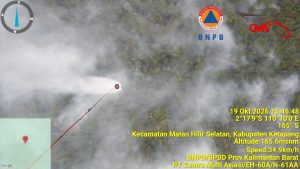
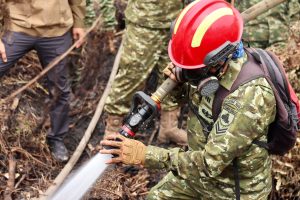
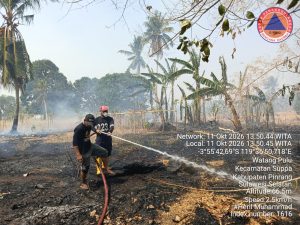
Separately, TuK INDONESIA cited satellite monitoring by Nusantara Atlas that recorded 1,146,209 hotspots and 1,916,588 hectares of burned land nationwide as of October 20, 2026. The organisation identified 14 corporate groups in the palm oil and pulp and paper sectors linked to fires this year, collectively controlling approximately 7.6 million hectares of land in Indonesia.
These groups received around USD 53.4 billion in credit between 2020 and September 2026, according to TuK INDONESIA, with financing concentrated among a small number of major companies. The organisation said Indonesian banks accounted for about 60 per cent of the credit.
TuK INDONESIA Executive Director Linda Rosalina called for binding financial regulations requiring environmental and human rights due diligence, restrictions on financing companies linked to deforestation, and meaningful penalties for violations.
“Banks are not neutral observers because their financing decisions help determine which economic activities continue,” Linda said, urging negotiators to turn biodiversity commitments into enforceable rules for the financial sector.
Beyond financing, groups highlighted weaknesses in Indonesia’s legal framework for biodiversity protection. Although the government has adopted a National Biodiversity Strategy and Action Plan for 2025–2045, the plan lacks a formal position in Indonesia’s legal hierarchy, according to Giorgio Budi Indrarto of Yayasan MADANI Berkelanjutan. He warned that biodiversity objectives could lose out when they conflict with legally stronger mining, plantation and spatial-planning regulations.
Indigenous participation has also emerged as a point of contention at COP17. Indonesian negotiators questioned the inclusion of Indigenous peoples and local communities in the leadership structure of the convention’s permanent Subsidiary Body on Article 8(j), which addresses traditional knowledge and sustainable practices related to biodiversity.
Torry Kuswardono, executive director of Yayasan Pikul, described the position as a setback from COP16 in Cali, Colombia, where Indonesia supported establishing the permanent body. He argued that Indigenous peoples and local communities should participate fully and effectively in decisions affecting biodiversity, rather than being consulted only when governments deem it necessary.
The body’s role is advisory: it develops recommendations for consideration by the conference of the parties, while governments retain decision-making authority. Civil society representatives said meaningful participation would strengthen biodiversity governance rather than threaten national sovereignty.
As negotiations continue, civil society groups say Indonesia’s bid to host COP18 should be matched by concrete domestic reforms, including stronger forest protection, accountable financial flows and recognition of Indigenous rights.
They argue that hosting the summit would carry little weight without action to halt biodiversity loss and ensure that conservation commitments translate into enforceable policies and protection on the ground. (nsh)
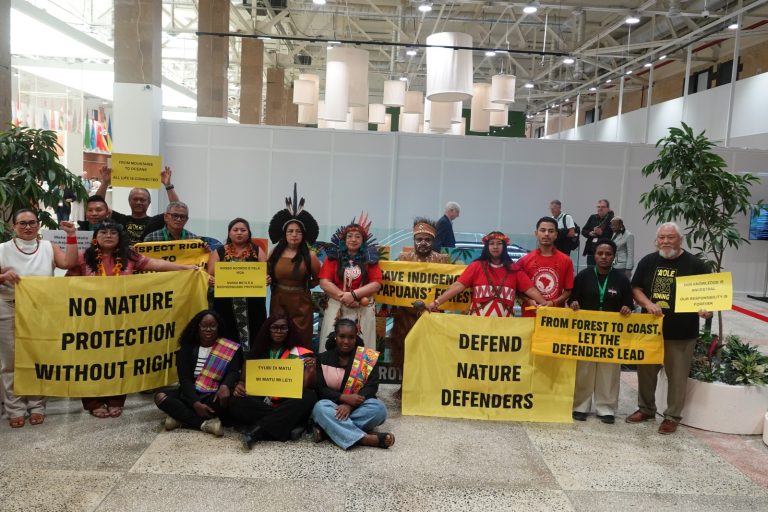
Banner photo: JustCOP