By Roffie Kurniawan
Dr. Karmele Llano Sánchez cradles a baby orangutan named Irene, whose frail body reflects the toll of Indonesia’s forest fires. Nearby, the infant’s mother lies sedated and severely weakened, possibly after weeks without enough food.
“No baby should have to go through this,” said Llano Sánchez, a Spanish wildlife veterinarian and co-founder and chief executive of Yayasan Inisiasi Alam Rehabilitasi Indonesia (YIARI), also known as International Animal Rescue Indonesia.
In Ketapang, West Kalimantan, conservation authorities and YIARI rescued 51 orangutans affected by fires between August 6 and October 16, according to Kompas. Thirty were found in areas belonging to oil palm companies. Some were injured, dehydrated or severely underweight.
Two young orangutans, Lusi and Riri, were found without their mothers. Lusi was particularly weak and had open wounds. Their mothers’ fate remained uncertain.
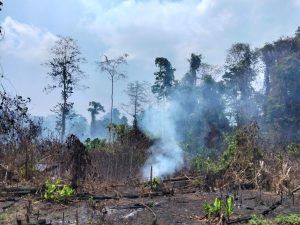
“The forest is vanishing right before our eyes. The flames have reduced the forest to ashes, leaving orangutans and countless other species without a home,” Llano Sánchez said.
YIARI’s satellite analysis found that more than 90% of a high-conservation-value area within one company’s concession burned between Aug. 1 and Sept. 25. Research cited by the organisation estimated that the area supported about 150 Bornean orangutans. Forestry authorities have been investigating, and an orangutan skull was reportedly found in the same concession in October.
The findings raise questions about how effectively wildlife habitats are protected inside commercial concessions and whether companies are being held accountable for fires.
Rescue cannot replace a forest
The consequences can last long after the flames disappear. Llano Sánchez has treated orangutans with severe injuries and chronic illnesses, including Jojo, a 17-year-old male with severe rickets, deformed legs and chronic pneumonia. Unable to return to the wild, he now lives in a two-hectare enclosure.
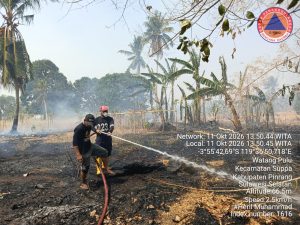
Rescue centres can provide urgent treatment but cannot replace a functioning forest. Orangutans depend on connected habitats for food, shelter and movement. When forests burn, surviving animals may enter plantations or villages in search of food, increasing the risk of conflict with people.
The damage extends to communities. Smoke from forest and peatland fires disrupts schools and livelihoods and exposes people to hazardous air pollution. Peat fires can smoulder underground and reignite after surface flames have disappeared. Haze has also affected neighbouring countries, prompting offers of assistance from Malaysia and Singapore.
Government promises tougher action
President Prabowo Subianto has promised to crack down on companies proven to have violated the law. At a cabinet meeting on October 21, he described deliberate burning as “environmental terrorism” and “a crime against humanity”.
“We cannot take this lightly. We will now handle this on a massive scale, and we will investigate it thoroughly,” Prabowo said, adding that permits would be revoked where evidence of violations was clear.
He directed the National Police, Attorney General’s Office and Forestry Ministry, with military assistance, to investigate companies suspected of involvement.
National Police Chief General Suyudi Ario Seto said on October 19 that 98 corporate-related reports had advanced to the investigation stage. Separately, the Forestry Ministry said it had imposed administrative sanctions on 32 companies, including suspensions, revocations and ecosystem-restoration orders.
Administrative sanctions and investigations are not criminal convictions. The challenge is to establish responsibility through evidence, including where corporate ownership and control extend beyond individual permit holders.
WALHI traces corporate links to fire hotspots
A report released on October 14 by Indonesian environmental organisation WALHI, titled “Siapa di Balik Api?” (“Who Is Behind the Fires?”), examined 30 companies with the highest concentrations of fire hotspots recorded from January to August 2026: 15 oil palm companies and 15 forestry permit holders. WALHI combined satellite analysis with research into ownership, directors, shareholders and ultimate beneficial owners.
The organisation identified links between nine companies with high hotspot counts and ownership structures connected to Singapore, Malaysia, Hong Kong, the British Virgin Islands and Samoa. It said the ultimate beneficial owner of PT Mayawana Persada could not be identified because its ownership structure led to two such jurisdictions.
WALHI also traced 93 companies suspected of links to forest and land fires to business groups in Singapore and Malaysia, including Sinar Mas, Wilmar, Musim Mas and First Resources.
The report highlighted business connections involving five figures WALHI described as close to Prabowo. These included Iwan Bomba, also known as Setiawan Ichlas, the president’s special envoy for economic and banking affairs, in relation to PT Golden Blossom Sumatera; Aburizal Bakrie in relation to PT Monrad Intan Barakat; and Edhy Prabowo, Widjono Hardjanto and Benny Pangbin in relation to PT Kiani Lestari and associated companies.
These are findings and allegations reported by WALHI, not proof that the named individuals or companies committed arson. Hotspot detections and ownership links require further investigation and field verification before responsibility can be established.
WALHI also recorded 807 hotspots in the Merauke food and energy development area in South Papua from January 1 to August 31. Of these, 133 were found across six Energy Estate entities affiliated with First Resources and Wilmar International. Another 674 were recorded in four Food Estate clusters overseen by government institutions, including the Coordinating Ministry for Food Affairs and the Agriculture Ministry.
The organisation also cited Jhonlin Group’s involvement in land clearing for parts of the Food Estate programme, while saying links between specific activities and individual hotspots needed verification. WALHI argued that scrutiny should include government institutions overseeing land-development projects as well as private operators.
Campaign coordinator Uli Arta Siagian called for ownership information to be disclosed and investigations to reach parent companies, controlling groups and decision-makers where evidence warrants it.
“There must be no impunity, even for companies affiliated with people close to the president or major players in the palm oil and forestry industries,” Uli said, urging Prabowo to fulfil his pledge.
WALHI national executive director Boy Jerry Even Sembiring said enforcement must go beyond extinguishing fires or sanctioning a single permit holder. He cited Articles 76 and 77 of Indonesia’s Environmental Protection and Management Law and Article 72 of the Forestry Law as tools for stronger action.
Land expansion raises further concerns
The accountability debate comes as the government considers expanding land for food and energy production. The Clean Transition Coalition, a group of Indonesian civil society organisations, said in a September 25 statement that the government was considering allocating one million to two million hectares for an E20 ethanol fuel blend by 2029, using potential feedstocks such as sugar cane, cassava and corn.
The proposal is separate from Indonesia’s B50 biodiesel programme, which uses palm oil. There is no evidence that either programme caused the fires discussed here. Environmental groups warn, however, that expanding plantations and energy crops could increase pressure on forests and land rights without adequate safeguards.
“When hundreds of thousands of hectares of land are burning and communities are facing the consequences, the government is talking about plans to exploit millions of hectares of new land,” said Andi Muttaqien of Satya Bumi, a coalition member.
Greenpeace Indonesia campaigner Refki Saputra has raised concerns about a food, energy and water self-sufficiency project in South Papua. He cited an estimated 2.7 million hectares allocated to the programme, including 637,420 hectares for 10 sugar-cane concessions.
“Papua is not a warehouse of land and energy to meet every national need. Papua is home to Indigenous communities, forests, wetlands, rivers, food sources and ecosystems,” he said.
Forest Watch Indonesia estimates that oil palm plantations cover about 17.3 million hectares nationally. It has linked oil palm expansion between 2021 and 2024 to the conversion of 225,461 hectares of natural forest, and estimated that 41,707 hectares of forest were lost in energy plantation forest concessions between 2022 and 2024.
The Clean Transition Coalition has urged the government not to clear or designate new land for E20 until assessments address ecological risks, fire prevention, food security and land rights.
From firefighting to prevention
Indonesia’s immediate priorities are to extinguish fires, protect communities and wildlife, and provide firefighters with adequate equipment, funding and coordination. Lasting progress also requires transparent investigations, ecosystem restoration and consequences for those proven responsible.
WALHI’s findings underline the need to scrutinise corporate ownership structures and the role of public institutions in land development, while ensuring enforcement is grounded in evidence.
For orangutans such as Irene, Lusi and Riri, delayed action means injury, hunger and lost habitat. Rescuing individual animals can save lives, but preventing the next tragedy depends on protecting the forests on which wildlife and local communities rely.
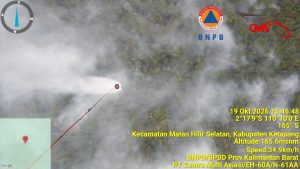
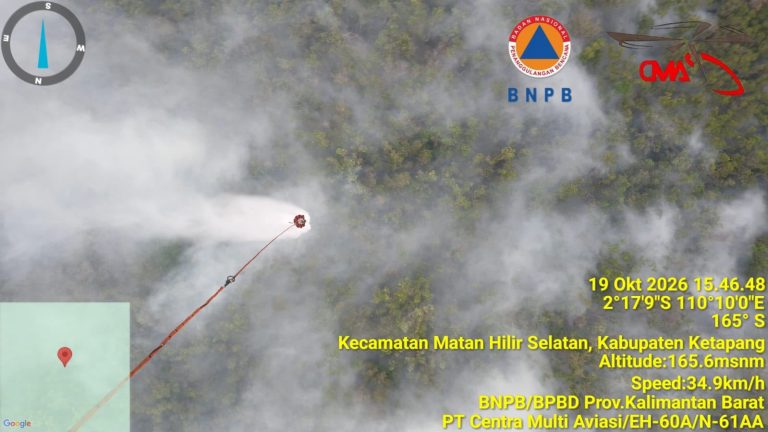
Banner photo: BNPB deployed a water-bombing helicopter to extinguish a fire in Ketapang Regency, West Kalimantan Province, on Monday, 19 October 2026. Photo source: BNPB