Jakarta — Indonesian civil society groups have urged the government to give legal force to its national biodiversity strategy, warning that weak implementation and environmentally destructive investments threaten the country’s conservation commitments ahead of a global biodiversity summit.
The JustCOP (Justice Coalition for Our Planet) coalition called for the Indonesian Biodiversity Strategy and Action Plan (IBSAP) 2025–2045 to be incorporated into binding legislation, arguing that its current status limits its influence over development planning, sectoral policies and business licensing.
“Indonesia has a good biodiversity strategy reference, but it lacks strong authority. IBSAP should determine the direction of development,” said Giorgio Budi Indrarto, an executive board member of MADANI Berkelanjutan, at a media briefing in Jakarta on Friday, October 9.
Biodiversity loss, climate change and economic development must be addressed together, he said, rather than treated as separate issues.
Andi Muttaqin, executive director of Satya Bumi, said the strategy’s aspirations risk being undermined by projects that damage ecosystems if government agencies are not required to follow it.
Syahrul Fitra, a senior forest campaigner at Greenpeace Indonesia, added that the strategy was not binding on regional governments and lacked the authority to serve as a mandatory benchmark for sectoral ministries.
The coalition’s call comes as Indonesia prepares for the 17th Conference of the Parties to the U.N. Convention on Biological Diversity (COP17 CBD), scheduled to take place in Yerevan, Armenia.
Indonesia’s seventh national report to the convention describes the country’s biodiversity efforts as on track. But JustCOP said the convention’s global assessment shows that countries collectively remain off track to meet the targets of the Kunming-Montreal Global Biodiversity Framework.
The framework includes a goal of protecting 30% of the world’s land and marine areas by 2030, known as the 30×30 target. Cindy Julianty, coordinator of the Working Group ICCAs Indonesia, said an emphasis on expanding protected areas could distract from the underlying drivers of biodiversity loss.
Unilaterally designating protected areas can trigger land conflicts and fail to ensure effective management, she said, citing Tesso Nilo National Park in Riau, where oil palm plantations have encroached on protected land.
“What must be targeted is not merely conservation acreage, but the root drivers of biodiversity loss, namely extractivism,” Cindy said.
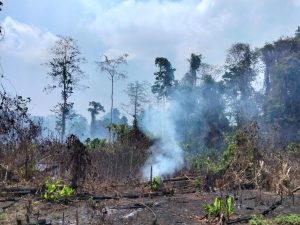
Satya Bumi presented examples of mounting pressures on wildlife and ecosystems, including a reported 6.6% decline in the critically endangered Tapanuli orangutan population in North Sumatra, where habitat faces pressure from the Batang Toru hydropower project, the Sarulla geothermal project and corporate concessions.
In West Kalimantan, the group highlighted overlap between Bornean orangutan habitat and the timber plantation concession of PT Mayawana Persada, which it identified as a major driver of deforestation in the province. Camera traps have recorded orangutans moving through cleared areas, it said.
On Kabaena Island in Southeast Sulawesi, mining concessions cover about 70% of the island’s land area, according to the coalition, threatening coastal Bajo communities and local fisheries. The groups called for restrictions on mining similar to those applied to nearby Wawonii Island.
Funding and land rights are also central to the coalition’s demands. Indonesia’s annual biodiversity funding needs are estimated at 75 trillion rupiah to 100 trillion rupiah, while the coalition said international financing remains insufficient to meet conservation goals.
Under the global framework’s Target 19, developed countries were expected to mobilise at least USD 20 billion annually for biodiversity in developing countries by 2025. Syahrul said Indonesia must also reform domestic fiscal policies rather than rely primarily on external assistance.
The coalition called for the government to redirect subsidies and tax incentives that support environmentally harmful activities, including fossil fuels and deforestation, and to address trade misinvoicing and illicit financial flows that drain public revenue.
It also urged governments to ensure that at least 20% of biodiversity funding goes directly to Indigenous Peoples and Local Communities, giving them greater control over how the money is allocated.
Recognition of customary land rights remains limited. Of the 36 million hectares of customary territories mapped across Indonesia, only 7.5 million hectares have received formal recognition, the coalition said. Of 28 million hectares identified as potential customary forests, only about 300,000 hectares have been officially designated.
Customary forests are also excluded from the government’s calculations for the 30×30 target, Cindy said, arguing that conservation policy remained overly centralised and inequitable.
The coalition further called for legislation on access to and benefit-sharing from genetic resources and protection for 9 million hectares of natural forest outside designated protected areas.
Indonesia is exploring a bid to host COP18 in 2028. JustCOP said the government should demonstrate stronger domestic implementation before seeking to lead the international process.
“If Indonesia wants to host COP18, be a good host that finishes its homework,” Giorgio said.
The coalition urged the government to make the biodiversity strategy legally binding, accelerate recognition of customary territories, reform harmful subsidies and align climate and biodiversity policies so that energy transition investments, including bioethanol and nickel processing, do not drive further forest destruction.
“Indonesia must stop playing lip service and lead by example,” Syahrul said. (nsh)
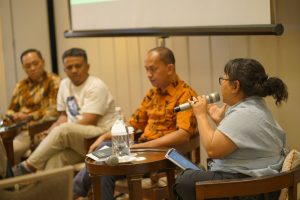
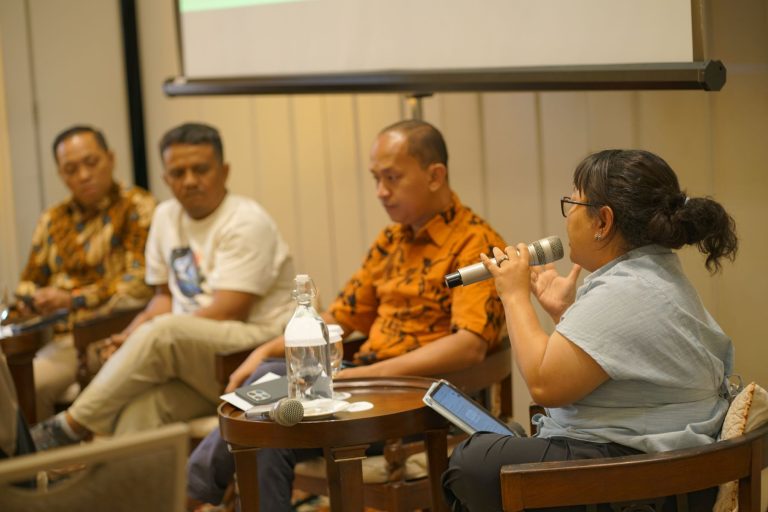
Banner photo: From left to right: Giorgio Budi Indrarto, MADANI Executive Board Sustainability; Syahrul Fitra, Senior Forest Campaigner at Greenpeace Indonesia; Andi Muttaqin, Executive Director of Satya Bumi; and Cindy Julianty, Executive Coordinator of the Indonesian ICCAs Working Group (WGII) at a media event Briefing: The Road to COP17 of the CBD: Assessing Indonesia’s Commitment to Conservation Biodiversity and the Rights of Indigenous Peoples and Local Communities in Jakarta, Friday 9 October 2026. (Photo credit: MADANI Berkelanjutan).