By Roffie Kurniawan
Jakarta — Indonesian President Prabowo Subianto has urged ministers to contain forest and peatland fires as thick haze disrupts schools and threatens public health across Indonesia and neighbouring countries. However, the government has rejected calls to declare a national disaster, saying it can still manage the crisis.
Coordinating Minister Dudung Abdurachman told reporters after a limited cabinet meeting on Monday that the government could still handle the fires. “Not yet. We are still able to handle it,” he said when asked about declaring a national disaster.
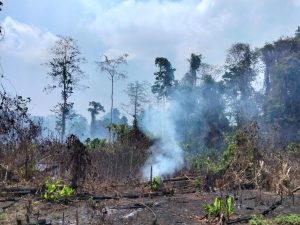
Dudung said Prabowo wanted the fires contained as quickly as possible. According to a report from Indonesia’s National Disaster Management Agency (BNPB), six provinces have been affected, including Central Kalimantan and South Sumatra, with particular concern focused on Tanjung Puting National Park.
BNPB reported that 639.23 hectares remained affected by active fires, including 513.89 hectares inside the park, which is home to an estimated 6,000 orangutans and contains deep peat deposits.
“Even when flames appear to be extinguished, heat and embers can remain underground and reignite later,” BNPB spokesman Berton Panjaitan said.
Dudung said helicopters had been deployed, but dense smoke made aerial operations difficult, leaving ground crews to carry out most firefighting work. Prabowo had also instructed the government to set aside 70,000 forest police personnel to address forest-related problems, he said.
Volunteers demand urgent assistance
Public pressure has grown after videos circulated on social media showing tourism volunteers in Tanjung Puting struggling to fight fires with limited resources.
One volunteer said firefighting capacity was insufficient to contain the raging fires and called for large-scale operations, water-bombing aircraft and logistical support. The volunteer estimated that 54,000 hectares had burned, but the figure differs substantially from the area of active fires reported by BNPB and requires further clarification.
During a hearing with Forestry Minister Raja Juli on Monday, October 12, Daniel Johan, a member of the House of Representatives’ Commission IV, urged the government to take stronger action.
“Three months of forest and land fires is like living in hell for affected communities,” he said, arguing that the government should declare a national disaster.
Forestry Minister Raja Juli said 26 companies had been targeted for sanctions, with another five or six potentially facing permit suspensions or revocations. “Not only small companies, even large ones — if we find violations, we will act,” he said.
He warned that significant rainfall might not arrive in some parts of Indonesia until mid-November or December.
Haze crosses borders, schools close
Haze from Indonesia’s fires has disrupted education and affected air quality across Southeast Asia.
In West Kalimantan, hundreds of schools reportedly suspended in-person classes, affecting around 200,000 students. The Jakarta Globe reported that 1.43 million students at 12,874 schools across six provinces switched to online learning as the Air Pollution Standard Index exceeded 200. Save the Children reported that around 12,800 schools had closed.
In Malaysia’s Sarawak state, the Air Pollutant Index reached 408 in Serian and 407 in Kuching, well above the emergency threshold of 300. Authorities closed 647 schools, affecting nearly 200,000 students, and advised children to stay indoors.
Singapore’s Pollutant Standards Index reportedly reached 192 on October 9, while haze travelled more than 800 kilometres to the Philippines, Reuters and Business Mirror reported.
Malaysia and Singapore offered assistance to Indonesia. Malaysian Prime Minister Anwar Ibrahim said on October 8 that he had offered help to President Prabowo Subianto, while Singapore offered support under the ASEAN Agreement on Transboundary Haze Pollution. Malaysian Deputy Prime Minister Ahmad Zahid Hamidi said Kuala Lumpur was awaiting Jakarta’s official response.
Asked by Antara whether the offers had been discussed at Monday’s cabinet meeting, Dudung said they had not.
Health risks and corporate accountability
In affected Indonesian communities, persistent smoke and dust have heightened public health concerns. Images circulating on social media have shown roads in Pontianak, West Kalimantan, covered in fine ash.
Health figures cited by Reuters indicate that more than 12.5 million people have been exposed to the haze. Reported respiratory illness cases rose to 113,336 by September 9 and later exceeded 170,000.
The Global Fire Monitoring Center has warned that fine particles in peat-fire smoke can penetrate deep into the lungs.
Environmental group WALHI has also criticised the handling of the fires, arguing that the crisis reflects deeper problems in land management and enforcement. In a statement released on September 3, WALHI said: “Transboundary haze must no longer be treated as a seasonal disaster but an ecological crisis leading to ecocide.”
According to WALHI, 74% of recorded fire hotspots in Kalimantan were located within corporate concessions. The organisation cited 10,739 hotspots in oil palm plantation areas covered by cultivating rights, 7,880 in mining concessions and 6,905 in forestry concessions.
In a press statement on October 7, WALHI urges the Indonesian National Police to play a more active, transparent, and accountable role in law enforcement regarding forest and land fires. This call follows the identification of 372 corporate entities whose concession areas showed indications of burning across eight provinces between January 1 and September 6, 2026.
The group said these findings serve as preliminary indications requiring verification, rather than automatic proof that the companies themselves set the fires.
The Ministry of Forestry has also stated that the presence of hotspots does not immediately prove the identity of the perpetrator. Therefore, on-the-ground verification is crucial, and this is where the Police’s role as investigators is decisive.
“The Police do not need to wait for public reports. Data on hotspots and permits is already available at the relevant ministries and should be proactively accessed to serve as a basis for investigation. Field inspections (ground checks) must be conducted immediately, as evidence of forest and land fires disappears quickly,” said Teo Reffelsen, Legal and Advocacy Manager at WALHI National.
Could the fires rival the 2015 disaster?
The scale of the current fire season has raised concerns that it could approach the devastating 2015 disaster.
According to Carbon Brief, citing fire researcher Guido van der Werf, fires in Indonesia had produced an estimated 76 million tonnes of carbon by September 7, 2026.
Hotspot counts also raised alarm. Between August 1 and September 8, 13,443 hotspots were recorded, compared with 9,454 during the same period in 2015, according to the figures cited in the report.
The Global Fire Monitoring Center reported that the 2015 fires burned approximately 2.61 million hectares and released an estimated 333 million tonnes of carbon.
The current figures do not establish that 2026 will reach the same scale. However, persistent peat fires and delayed rainfall have heightened concerns that the crisis could worsen if dry conditions continue.
Indonesia’s Meteorology, Climatology and Geophysics Agency (BMKG) has warned of dry conditions associated with El Niño, with the rainy season delayed in many areas.
Pressure mounts for stronger action
Monday’s cabinet meeting reaffirmed the government’s stated priorities: contain the fires quickly and protect Tanjung Puting National Park.
Yet questions remain over whether the response matches the scale of the crisis. The government has not declared a national disaster, and offers of international assistance were not discussed at the meeting, according to Dudung.
Meanwhile, volunteers continue to call for more resources as communities face hazardous air, disrupted education and growing health concerns.
With haze crossing national borders, Indonesia faces a challenge that extends beyond extinguishing flames. It must also protect public health, enforce environmental regulations and address the underlying causes of recurring fires.
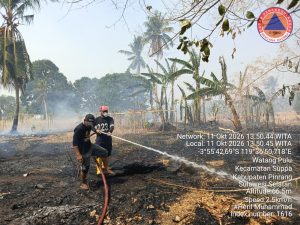
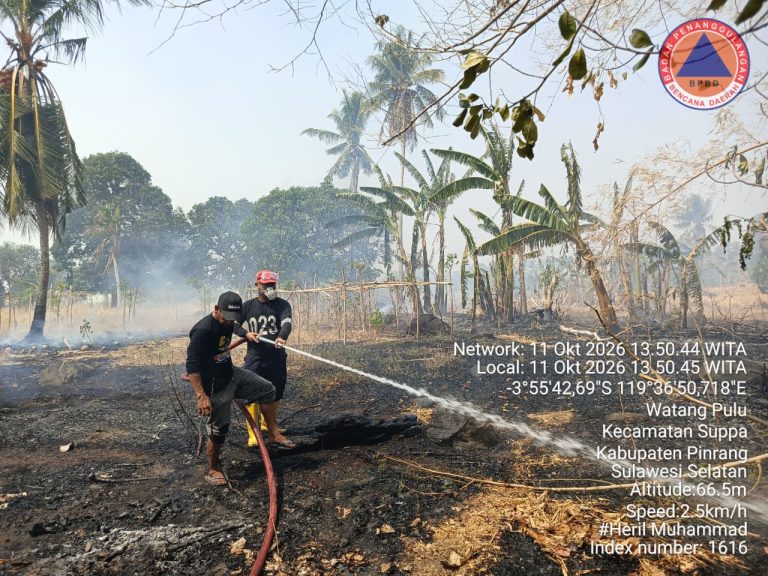
Banner photo: Pinrang Regency regional disaster management agency (BPBD) personnel and firefighters extinguishing a forest and land fire on Sunday, October 11, 2026. Photo credit: Pinrang Regency BPBD.
Update 14 Oct. 2026; 21:19 – revising the correct position of BNPB spokesperson