by Nabiha Shahab
After decades of demands for a stronger legal framework to address land inequality and agrarian conflict, the House of Representatives approved the Agrarian Reform Regulation Bill on Tuesday, September 22, marking a potentially important new chapter in Indonesia’s long-running agrarian reform debate.
For the millions of farmers, Indigenous communities, fishers and others whose livelihoods depend on access to land and natural resources, the law could provide an important new framework. But that opportunity needs scrutiny.
The Consortium for Agrarian Reform (Konsorsium Pembaruan Agraria, KPA), one of Indonesia’s largest agrarian advocacy groups, has welcomed the law as a historic achievement. It argues that the legislation provides stronger foundations for resolving agrarian conflicts, redistributing land, restoring rights and addressing excessive concentration of land ownership.
KPA also points to provisions establishing a dedicated institution for agrarian reform under the president, mechanisms for conflict resolution and land redistribution, support for beneficiaries after redistribution, and greater recognition of groups including farmers, Indigenous peoples, fishers, women and other marginalised communities.
The group has stressed, however, that the law is not the end of the struggle: implementation will determine whether it delivers meaningful change.
That distinction is important. The government and parliament have themselves presented the legislation as an instrument to address structural land inequality and long-running conflicts. These are significant commitments. But there is another side to the story that should not be dismissed.
Concerns over how the law was made
Before the law was passed, the Indonesian Legal Aid Foundation (YLBHI) and a broader civil-society coalition urged parliament and the government to delay the legislation.
Their concern was not that agrarian reform was unnecessary. Quite the opposite. They argued that a law meant to correct decades of inequality and conflict should itself be produced through a transparent and meaningful process.
The coalition questioned the speed of the legislative process, saying the bill moved from its inclusion in the legislative programme in late August to parliamentary approval in September. It argued that affected communities had insufficient time to examine the final text and respond to changes made during the closing stages of deliberations. Those concerns were also raised publicly after the law was passed.
The coalition also raised substantive concerns, including whether the final law provides sufficiently strong mechanisms to limit excessive land concentration, restore rights lost through past conflicts, protect communities facing criminalisation, and resolve conflicts involving state institutions or state-owned assets.
These concerns matter because agrarian reform is not simply a question of issuing land certificates or creating another government programme. It is fundamentally about who controls land, who has access to it, whose rights are recognised, and what happens when those interests collide.
The real test is implementation
There is therefore a reasonable middle ground between celebrating the law as a historic solution and dismissing it as inadequate from the outset. The most important question now is whether the government will use the new framework to tackle the conflicts and inequalities that have persisted for decades.
The first test will be institutional. If the law requires a dedicated institution for agrarian reform, that institution needs sufficient authority to work across ministries and agencies. Agrarian conflicts rarely fit neatly within one bureaucratic jurisdiction. A new institution that merely adds another administrative layer will not solve that problem.
The second test will be transparency. The public should be able to see how the law is being implemented: which conflicts are being prioritised, which areas are designated for redistribution, how claims are assessed, how competing rights are resolved and how decisions can be challenged.
This is particularly important because some of the concerns raised by civil-society groups relate precisely to the relationship between the new agrarian reform framework and existing sectoral regimes governing state assets, forests, plantations and other land uses.
The third test will be participation. The people most affected by agrarian policy cannot be treated simply as beneficiaries of government programmes. Farmers, Indigenous communities, fishers, women and other affected groups need meaningful opportunities to participate in decisions concerning their land and livelihoods.
Watch what happens to land concentration
Perhaps the most consequential question is whether the new law can address the concentration of land ownership and control. A reform programme that redistributes small parcels while leaving the underlying structure of excessive concentration largely unchanged would have limited transformative effect.
The legislation will need implementing regulations. Those regulations will determine many of the practical details: how land is classified, which land becomes eligible for redistribution, how maximum holdings are determined, how state assets and concessions are treated, how conflicts are resolved and how beneficiaries are protected after receiving land.
This is where the public conversation should now move. The debate should not end with the passage of the law. It should intensify around the regulations and institutions that will give the law practical meaning.
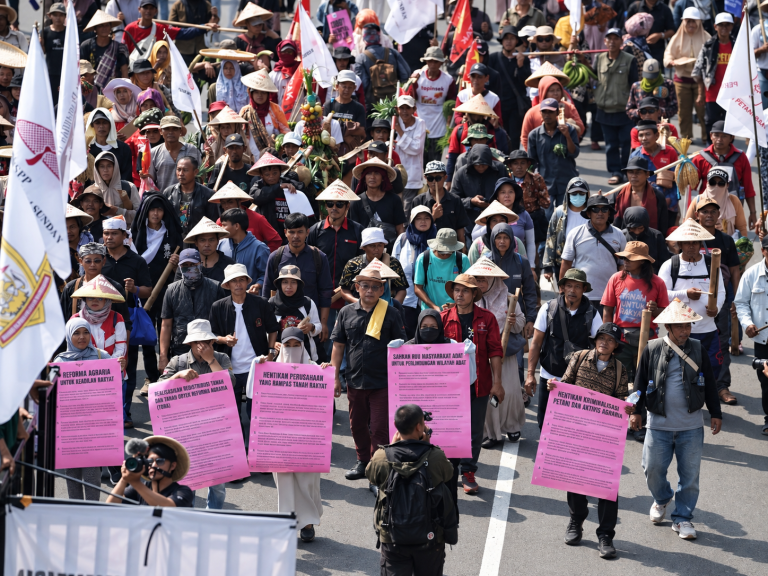
Banner photo: On 24 September 2026, 10,000 farmers from various regions held a national rally in Jakarta to mark National Farmers’ Day 2026 and to welcome the passing of the Law on Agrarian Reform. Source: Agrarian Reform Consortium (KPA)