Jakarta — The recent blackouts across Sumatra were not simply the result of isolated technical failures—they exposed deeper structural weaknesses in Indonesia’s power system, particularly its vulnerability to extreme weather and cascading outages, according to Hariadi Aji, a doctoral candidate at Delft University of Technology and a PLN-affiliated researcher.
Speaking at a recent webinar organised by the Institute for Essential Services Reform (IESR), Hariadi said the most urgent priority is strengthening grid resilience through infrastructure upgrades, better operational planning, and resilience-based investment.
“Sumatra’s case shows that infrastructure hardening, network reconfiguration, and stronger materials are among the most relevant solutions,” Hariadi said. He also highlighted the need for advanced technologies such as flexible AC transmission systems (FACTS), battery storage, improved demand forecasting, and disaster prediction systems.
At the policy level, he stressed that grid operators need to move beyond conventional contingency planning.
Traditionally, power systems are designed to withstand the failure of a single component. But climate-related risks, he argued, increasingly involve multiple failures happening simultaneously within the same geographic area.
“With climate-based contingencies, several pieces of equipment may trip at once because they are exposed to the same hazard,” Hariadi said. “Operators need to anticipate this and prepare accordingly.”
Why the Sumatra blackouts happened
Hariadi explained that the recent outages in Sumatra must be understood through the lens of grid stability and cascading failure.
He pointed to three major incidents in Sumatra over the past year: a transmission tower collapse in Aceh on November 26, a conductor failure near Jambi on May 22, and another tower collapse in North Sumatra in June. Among these, the May 22 incident had the most severe system-wide impact.
According to Hariadi, the blackout was triggered by what power engineers call an “initiating event”—a disruption such as a line trip or tower collapse that begins destabilising the network.
In simpler cases, the system can quickly recover by isolating the disturbance and restoring operations. But the Sumatra blackout was different.
“What happened in Sumatra on May 22 was a non-simple disturbance that caused instability and led to a cascading outage,” he said.
A cascading outage occurs when one failure triggers another in rapid succession. As transmission lines trip and power flows shift unpredictably, the system can split into disconnected sections, eventually resulting in widespread blackout.
This appears to be what happened in Sumatra: a localised disturbance escalated into a regional system failure.
Why Sumatra is especially vulnerable
Hariadi’s research suggests Sumatra faces higher climate-related power risks than many other regions in Indonesia.
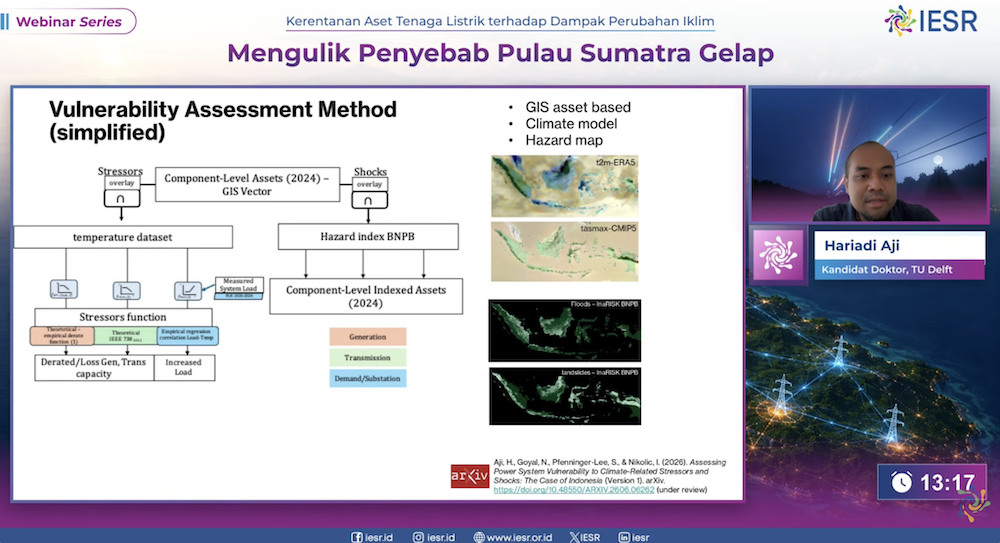
Using geographic information system (GIS) mapping and overlay analysis, his team assessed how climate hazards intersect with power infrastructure such as generators, substations, and transmission lines. Their findings show Sumatra ranks among Indonesia’s most vulnerable regions to climate-related shocks, particularly floods and landslides.
“Sumatra as an island has a high vulnerability index,” Hariadi said. “It is highly exposed to hazards such as flooding and landslides.”
That exposure matters because extreme weather can physically damage transmission infrastructure, causing outages that are difficult to restore quickly.
Recent incidents in Sumatra illustrate this risk. Heavy rainfall, landslides, and unstable ground conditions can weaken towers, damage conductors, or inundate substations, forcing operators to cut electricity supply to prevent further damage.
Climate change is compounding grid stress
Beyond physical destruction, climate change is also creating “stress” on the power system even during normal operations.
Hariadi categorised climate impacts into two types: stress and shock.
Stress refers to long-term conditions, such as rising temperatures that gradually reduce system performance. Higher temperatures lower the efficiency of power plants and transmission systems, reducing their maximum output. At the same time, electricity demand rises as households and businesses increase air conditioner use.
Shock refers to sudden extreme weather events such as floods, landslides, and storms that can directly damage infrastructure and trigger outages.
According to his research, rising temperatures could reduce generator capacity by around 3–4 per cent. While this may sound modest, the absolute impact is significant, equivalent to several gigawatts of lost capacity nationwide.
Combined with more frequent extreme weather, this creates mounting pressure on grids already operating with limited flexibility.
Scientists expect climate-related extreme events to become more frequent and intense, increasing the likelihood of future disruptions.
A warning for Indonesia’s energy transition
The Sumatra blackouts offer a broader warning for Indonesia’s energy transition.
As electricity demand grows and the country moves toward a more complex, interconnected, and renewable-heavy grid, resilience becomes just as important as generation capacity.
For Hariadi, building a climate-resilient grid requires action on three fronts: reliable energy supply, stronger infrastructure, and institutions capable of managing emerging risks. That means utilities, regulators, market operators, and suppliers must work together to adapt the grid for a future shaped increasingly by climate uncertainty.
He said preventing future blackouts will require more than fixing damaged towers. It will require redesigning the power system to withstand the growing risks of a warmer and more volatile climate. (nsh)
Banner photo: Image generated by OpenAI’s DALL·E via ChatGPT (2026)