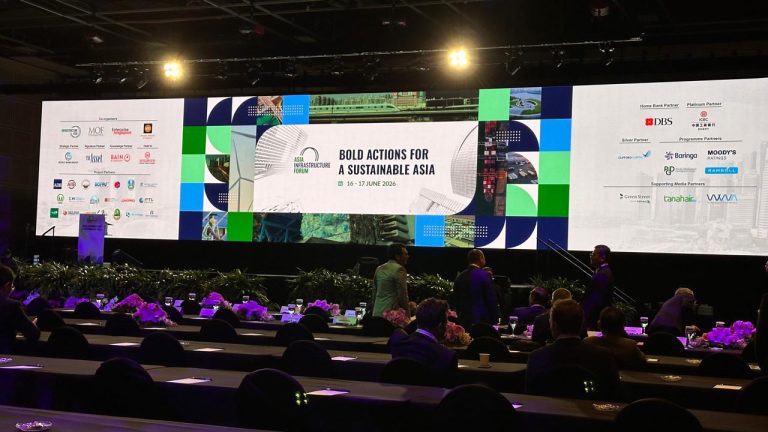
Singapore – Against a backdrop of heightening geopolitical uncertainty and escalating climate risks, the fifth edition of the Asia Infrastructure Forum (AIF) 2026 opened on Tuesday, June 16, at the Suntec Singapore Convention and Exhibition Centre. Themed “Bold Actions for a Sustainable Asia,” the two-day event has gathered over 800 government leaders, investors, and project developers to bridge a massive regional investment gap and move infrastructure projects from “ambition to delivery”.
The forum arrives at a pivotal time for the region. Recent global shocks, ranging from energy price volatility and supply chain reconfigurations to extreme climate events, have exposed the limitations of incremental infrastructure planning.
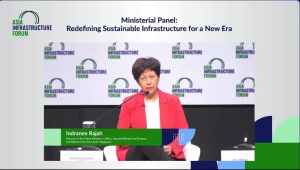
In her keynote address, Indranee Rajah, Singapore’s Minister in the Prime Minister’s Office and Second Minister for Finance and National Development, said that infrastructure is no longer just about basic development. “Infrastructure has become even more critical,” Minister Rajah stated. “Beyond basic development goals, it is clear that infrastructure plays a key role in securing countries’ strategic interests as well as ensuring economic security and resilience”.
She urged regional leaders to move beyond reactive measures, noting that “acting boldly means building ahead for the future, even in uncertain times” and that nations must remain “proactive” in the face of destructive climate events.
Bridging the trillion-dollar gap
The scale of the challenge is immense. Current estimates suggest that USD106 trillion in infrastructure investment will be needed globally through 2040, with Asia accounting for two-thirds of that demand. Despite this need, a significant shortfall persists; for instance, the IMF estimates that developing Asian nations need USD 1.1 trillion annually for climate mitigation alone, yet actual investment stands at only USD 333 billion.
Lavan Thiru, Executive Director of Infrastructure Asia, highlighted that the forum’s primary objective is to translate these vast needs into tangible, bankable opportunities. He said that this year’s theme, reflects the growing urgency for decisive and coordinated collaboration across the public and private sectors to translate infrastructure opportunities into investable and implementable projects.
He further noted that the current global landscape demands progress that does not come at the cost of the environment: “Today, we gather in uncertain times… [The theme] encourages us to push ahead with building our economies and communities in a way that doesn’t sacrifice our planet’s health, despite the challenges abound”.
Tangible opportunities: USD16 billion in projects
The forum serves as a direct marketplace for regional development, showcasing more than 15 upcoming projects with a combined estimated value of over USD16 billion. These priority projects span critical sectors, including the USD2.95 billion Metro Manila Subway Project in the Philippines and the Hanoi Urban Railway Masterplan in Vietnam. In the renewable energy sector, featured projects include the Madhya Pradesh Battery Energy Storage System in India and solar park initiatives in Bangladesh. The circular economy segment highlights waste-to-energy projects such as the Intermediate Treatment Facility Sunter in Indonesia.
To support these ambitions, Infrastructure Asia announced four landmark Memorandums of Understanding (MoUs) with the World Bank Group, the Private Infrastructure Development Group (PIDG), and agencies from Indonesia and the Philippines. These agreements are designed to improve project bankability, exchange best practices, and unlock innovative financing mechanisms like blended finance.
Minister Rajah concluded that while the hurdles are greater than ever, they are also a catalyst for closer cooperation: “It is imperative that countries in the region take bolder steps to secure their infrastructure needs, through the public and private sector working more closely together”.
*tanahair.net is an official media partner of the Asia Infrastructure Forum 2026.