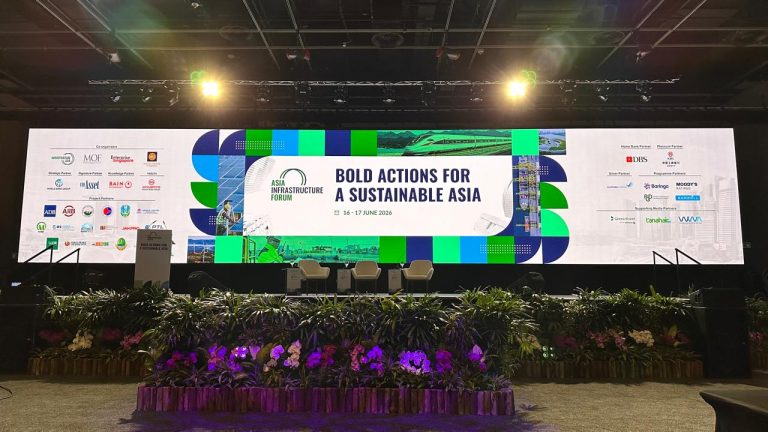
Singapore – The biggest obstacle to closing Asia’s infrastructure financing gap is not a shortage of capital but a lack of investable markets, according to a senior official at the Asian Development Bank (ADB).
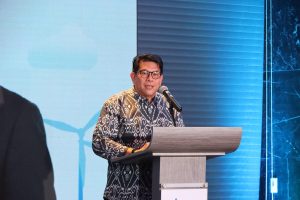
Speaking at the Asia Infrastructure Forum 2026 in Singapore on Wednesday, June 17, Jackie Surtani, ADB’s Regional Director and Head of Singapore Office, said global investors are eager to deploy capital. Still, many infrastructure opportunities remain difficult to finance because they lack predictable regulatory frameworks, manageable risk structures and scalable investment platforms.
“If there is one clear lesson from ADB’s work across Asia and the Pacific, it is that the constraint is not capital; it is markets,” Surtani said.
“There is abundant global capital, even in this crisis that we are in today. But it is simply not flowing at the scale we need it to because too many markets are still not investable.”
The remarks reflect a growing shift among multilateral development banks from funding individual infrastructure projects towards creating systems that can attract long-term private investment.
From projects to platforms
Surtani argued that investors are increasingly looking beyond standalone projects.
“They are looking for platforms. No longer just projects, but opportunities that can be scaled, replicated, and exited sustainably,” he said.
He cited the landmark Monsoon Wind project, which exports electricity from Laos to Vietnam, as an example of the challenges facing infrastructure development in the region.
“We did the Monsoon Wind project, which was a great wind project from Laos to Vietnam. But that took 14 years to conceptualise and close. Fourteen years,” he said. “We can’t wait another 14 years for the next Monsoon.”
The solution, he said, lies in developing platforms that can streamline project preparation, reduce transaction costs and create repeatable investment opportunities.
“This is why at ADB, our focus is moving from financing not only projects, but to making markets investable.”
ASEAN Power Grid takes centre stage
Energy connectivity remains one of ADB’s top priorities as electricity demand surges across Southeast Asia, driven by urbanisation, industrialisation and the rapid growth of digital infrastructure.
“The challenge is how to meet this demand sustainably, securely, and affordably,” Surtani said.
ADB has placed significant emphasis on the ASEAN Power Grid (APG), a regional initiative aimed at linking national electricity systems across Southeast Asia.
“At its core, building the APG is about connecting national systems into a regional network for 700 million people, so countries can trade electricity across borders, optimise resources, and accelerate decarbonization.”
Despite strong political support, Surtani acknowledged that turning the vision into reality requires overcoming major regulatory and commercial hurdles.
“Translating that ambition into bankable projects requires building markets on a huge scale, aligning regulation, and solving a range of complex cross-border challenges.”
ADB has pledged USD10 billion towards ASEAN Power Grid projects over the next decade as part of a broader USD50 billion regional energy connectivity initiative. The programme aims to connect 22,000 kilometres of transmission lines, integrate 20 gigawatts of renewable energy and create hundreds of thousands of jobs.
Digital infrastructure for 650 million people
Surtani also highlighted digital connectivity as a critical pillar of future infrastructure investment.
ADB recently launched a USD20 billion digital connectivity initiative designed to expand broadband access, improve regional digital infrastructure and attract private investment into scalable projects.
“Our goal is to reach 650 million people by 2035,” he said.
Under the initiative, 200 million people are expected to gain broadband access for the first time, while another 450 million will benefit from faster and more reliable internet connections. The programme also aims to provide digital skills training to three million people, particularly women and young people.
Catastrophe bonds offer new financing model
Among the most innovative developments highlighted by Surtani was ADB’s recent issuance of catastrophe bonds covering earthquake and flood risks in the Kyrgyz Republic and Tajikistan.
Listed on the Singapore Exchange last month, the bonds are designed to provide rapid post-disaster financing to vulnerable communities. “These bonds will provide critical post-disaster support to vulnerable communities when they need it the most,” he said.
The issuance marked a global first. “They also represent a world’s first: the first catastrophe bonds to cover extreme precipitation risk.”
The bonds transfer disaster risk from governments to capital market investors, offering a new model for climate adaptation and resilience financing. Singapore’s Insurance-Linked Securities Grant Scheme played a key role in enabling the transaction.
Surtani said the successful issuance demonstrated that innovative financial instruments can attract private capital when risks are properly structured and understood.
Blue economy gains attention
While energy and digital infrastructure dominated discussions at the forum, Surtani also drew attention to the role of oceans and marine ecosystems in supporting sustainable development.
About 30 of ADB’s developing member countries border oceans, seas or major river systems that support the livelihoods of more than three billion people.
To support sustainable marine development, ADB launched its Oceans and Blue Economy Action Plan in 2019 and later issued the world’s first dual-tranche blue bond to finance ocean-positive projects across Asia and the Pacific.
“So whether it’s power grids, data corridors, capital markets, or marine ecosystems, the objective is the same: to create connected, investable systems that underpin growth and serve people,” Surtani said.
He concluded by noting that Asia already has many of the ingredients needed for infrastructure development, but stronger connections between governments, investors and project developers are still required.
“In this very room, we have capital looking for projects, we have governments looking for financing, we have developers looking for certainty, and we have innovators looking for scale,” he said. “And yet, these pieces don’t always connect.” (nsh)
*tanahair.net is a media partner of the Asia Infrastructure Forum 2026