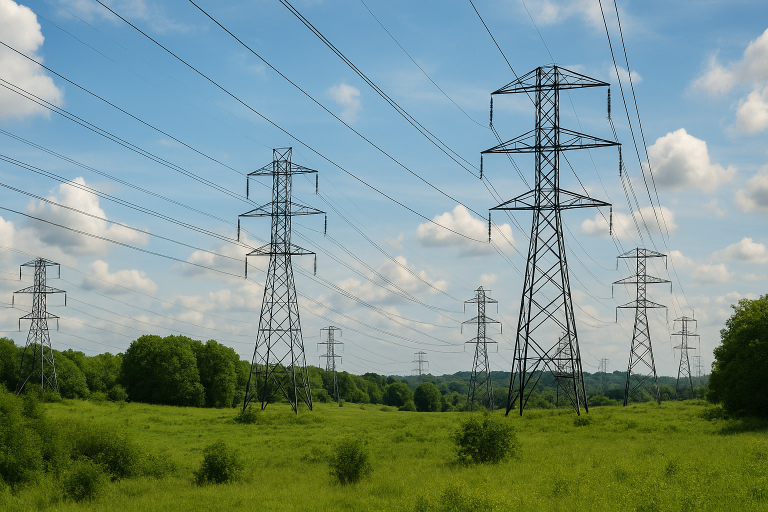
Jakarta – A massive blackout recently paralysed major portions of Sumatra, reigniting concerns over the stability and financing of Indonesia’s ageing electrical infrastructure. On Friday, May 22, 2026, a disruption in the 275 kV transmission line between Muara Bungo and Sungai Rumbai in Jambi, likely triggered by severe weather, created a “domino effect” that crippled power plants across the island. This systemic failure impacted approximately 13.1 million customers and knocked out over 5,300 MW of load.
In a press release dated May 23, 2026, the Ministry of Energy and Mineral Resources (ESDM) demanded that PT PLN (Persero) maximise recovery efforts to return social and economic activities to normal. Vice Minister ESDM Yuliot emphasised that the government is conducting a comprehensive technical investigation to identify the root cause and prepare mitigation steps to prevent future “blackouts”.
Furthermore, Minister ESDM Bahlil Lahadalia directed PLN to prioritise the reliability of the Sumatra backbone through the construction of 500 kV/275 kV lines and the preparation of “blackstart” infrastructure for faster recovery during future emergencies.
Financing mismatch
While the Sumatra incident highlights immediate operational vulnerabilities, a recent report from the Institute for Energy Economics and Financial Analysis (IEEFA) suggests that the root of Indonesia’s grid instability lies in a structural financing mismatch. According to the report released just weeks before the blackout, Indonesia’s grid expansion is being throttled by how transmission is funded rather than a lack of policy ambition.
Currently, transmission investment must compete internally within PLN’s vertically integrated structure against fuel procurement and generation costs.
The IEEFA analysis points out a stark investment gap: while the 2025–2034 Electricity Supply Business Plan (RUPTL) requires USD 2.4 billion in annual transmission investment, the realised average since 2019 has been only USD 1.4 billion. This shortfall is attributed to the fact that transmission—historically a low-risk, stable asset—is being financed as a high-risk asset because it is embedded within PLN’s consolidated balance sheet, which absorbs volatile fuel prices and foreign exchange risks. Consequently, while transmission entities globally often raise debt at rates near sovereign levels, PLN faces a high cost of funds (~8.5%) against a low return on equity (~2%).
To resolve this, IEEFA proposes the creation of a PLN transmission subholding through financial ring-fencing. This model would move Indonesia from mere functional separation to full financial separation, allowing the grid to raise its own long-tenor capital. Such a move would align with the role of Danantara, Indonesia’s new sovereign investment holding company, which could then invest in grid expansion on terms that reflect a standalone risk profile.
IEEFA highlights successful international precedents for this model in India and Vietnam. In India, the Power Grid Corporation of India (PGCIL) operates as a standalone utility, raising approximately USD 800 million annually and maintaining a 15% regulated return on equity to self-finance expansion. While in Vietnam, the National Power Transmission Corporation (EVNNPT) achieved record capital investment in 2023 despite its parent company suffering billion-dollar losses, proving that financial separation protects grid development during broader energy crises.
Crucially, IEEFA emphasises that this restructuring does not imply privatisation or market liberalisation. Transmission would remain a regulated state-owned monopoly, consistent with Indonesia’s Constitution. However, by establishing transparent transmission tariffs, Indonesia could unlock the USD 30 billion investment needed for high-profile projects, such as the proposed renewable electricity export to Singapore, while finally providing the reliable backbone necessary to prevent the kind of chaos recently seen in Sumatra. (nsh)
Banner photo: Image generated by OpenAI’s DALL·E via ChatGPT (2025)