Jakarta — Indonesia became the first country in the world to mandate the use of B50 biodiesel, marking a major milestone in its decades-long effort to reduce dependence on imported fossil fuels and strengthen energy security.
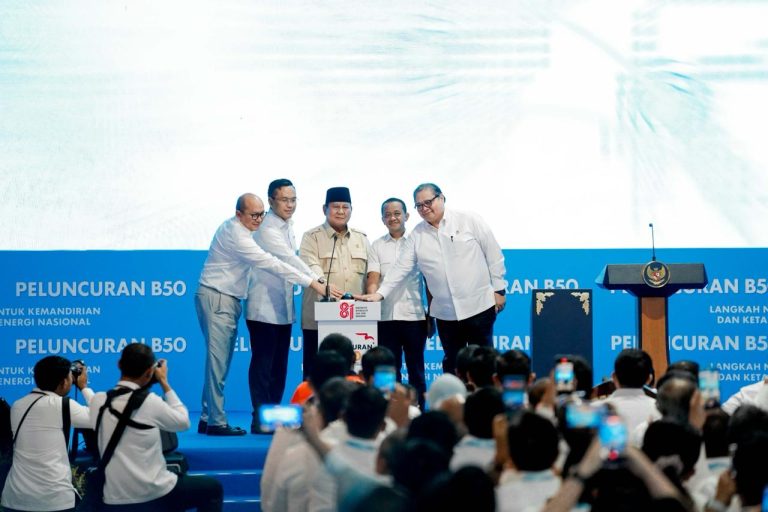
President Prabowo Subianto, on Thursday, July 9, officially launched the mandatory B50 biodiesel program in Karawang, West Java, describing the policy as a historic achievement that demonstrates Indonesia’s ability to harness its own natural resources for national development.
“Indonesia has officially become the first country in the world to implement mandatory B50 biodiesel,” Prabowo said. “This is not merely a technological achievement. It is proof that Indonesia is capable of utilising its own natural wealth for the benefit of its own people. This is a very important milestone on our journey toward energy independence.”
The B50 mandate raises the proportion of palm oil-based fatty acid methyl ester (FAME) blended into diesel fuel from 40% to 50%, making Indonesia the global leader in biodiesel adoption. The government projects the policy will eliminate diesel imports while increasing demand for domestically produced palm oil.
Prabowo said energy sovereignty, alongside food and water security, is essential to Indonesia’s long-term resilience. He noted that while he had initially wanted to launch B100 biodiesel, technical assessments concluded that B50 would be sufficient to eliminate diesel imports.
The President also challenged state-owned energy company Pertamina and his ministers to develop B60 biodiesel by 2028, while reiterating the government’s broader ambition to expand renewable energy, including plans to build 100 gigawatts of solar power.
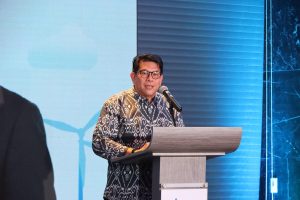
Energy and Mineral Resources Minister Bahlil Lahadalia said the launch reflected more than an increase in biodiesel blending levels, calling it “a historic milestone” in Indonesia’s pursuit of energy independence and sovereignty.
“We interpret the President’s directive not merely as a B50 program, but as a matter of sovereignty, self-reliance and national dignity, enabling us to produce our own energy,” Bahlil said. He added that with B50 implementation, “Indonesia will no longer need to import diesel fuel.”
According to the Ministry of Energy and Mineral Resources, the B50 program is expected to increase annual foreign exchange savings from Rp133.3 trillion under B40 to around Rp170 trillion. It is also projected to create 2.1 million jobs, raise the value added of Indonesia’s crude palm oil industry from Rp20.92 trillion to Rp23.49 trillion, and cut carbon dioxide emissions by 44.46 million tonnes annually.
The government estimates B50 will require between 16.7 million and 18 million kilolitres of biodiesel annually, using approximately 15.2 million to 16.3 million tonnes of crude palm oil. Officials say the increased domestic demand will provide a more stable market for oil palm farmers while supporting downstream processing industries.
Bahlil also said six months of field testing demonstrated that B50 performed better than B40 across multiple transport and industrial applications. Vehicle trials showed fuel filters remained functional for up to 40,000 kilometres, compared with the typical replacement interval of 10,000 to 20,000 kilometres under previous blends. The ministry said the fuel has been tested in passenger vehicles, heavy-duty trucks, mining equipment, agricultural machinery, railways, ships and power plants, and meets both government specifications and vehicle manufacturers’ standards.
Indonesia’s biodiesel program began with a mandatory B2.5 blend in 2008 before gradually expanding to B10, B15, B20, B30, B35 and B40. The government says the nearly two-decade rollout has been supported by stronger regulations, expanded production capacity, improved fuel quality standards and investments in distribution infrastructure.
Prabowo acknowledged the continuity of the program across successive administrations, crediting former presidents Susilo Bambang Yudhoyono and Joko Widodo for laying the groundwork. He described his administration’s role as completing the next stage of a national relay toward energy independence. (nsh)
Banner photo: Ministry of Energy and Mineral Resources