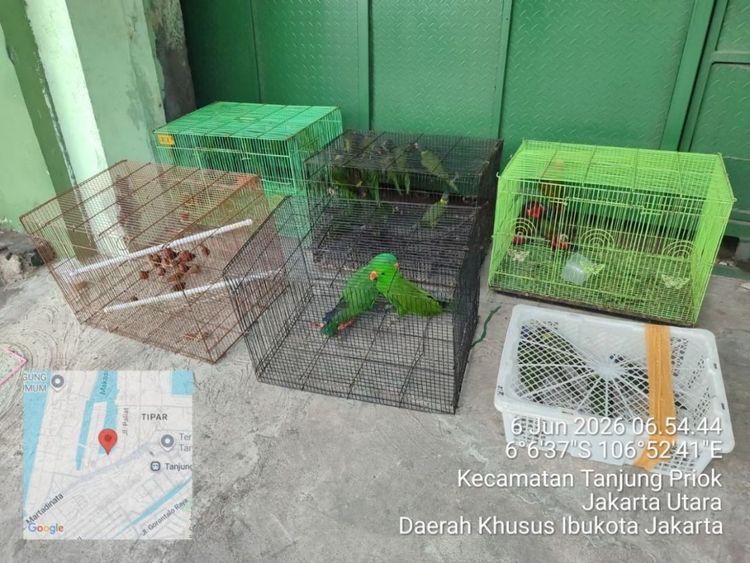
Jakarta — Indonesian authorities have foiled an attempt to illegally traffic 100 protected wild animals from Papua through Jakarta’s Tanjung Priok Port, the Ministry of Forestry said Saturday, June 13, underscoring ongoing efforts to crack down on wildlife trafficking networks operating across the archipelago.
The operation, conducted on June 6–7, involved a joint task force comprising the Directorate General of Forestry Law Enforcement under the Ministry of Forestry, the Criminal Investigation Agency of the National Police, and the Military Police Centre. The animals were seized before entering illegal distribution channels and have since been transferred to a wildlife rescue centre in Jakarta for treatment and health assessments.
Authorities said the operation followed intelligence gathering and surveillance on the movement of protected wildlife via maritime transportation routes to Jakarta. Investigators intercepted the shipment at Tanjung Priok Port and launched further inquiries into the individuals and networks involved.
The rescued animals included several protected and endemic bird species from Papua, among them four eclectus parrots (Eclectus roratus), two sulphur-crested cockatoos (Cacatua galerita), 19 black-capped lories (Lorius lory), six black lories (Chalcopsitta atra), 14 Victoria crowned pigeons (Goura victoria), three magnificent fruit doves (Ptilinopus magnificus), 19 crimson finches (Neochmia phaeton), two Pesquet’s parrots (Psittrichas fulgidus), three brown lories (Chalcopsitta duivenbodei), and 28 rainbow lorikeets (Trichoglossus haematodus).
Two individuals identified by their initials, BI and ZF, both reportedly members of the security apparatus, were detained for questioning. Investigators found that some of the animals lacked valid ownership or transport permits.
Rudianto Saragih Napitu, Director of Forestry Criminal Enforcement, said authorities were prioritising both the welfare of the seized animals and the integrity of the criminal investigation.
“These animals are living evidence. Their handling must be swift, orderly and properly documented,” he said. “We ensure that the animals are placed in the care of the PPS (animal rescue centre), whilst securing the relevant documents, statements and distribution channels. This allows us to see who played what role, who sent them, who collected them and who took them in. We are pursuing this case step by step and will not stop at those who transported them.”
The case is being investigated under Indonesia’s conservation law, which prohibits the trade and transportation of protected wildlife. Violators face prison sentences ranging from three to 15 years and substantial fines.
Director General of Forestry Law Enforcement Dwi Januanto Nugroho said wildlife trafficking has evolved into an organised business that exploits logistics networks and often extends beyond national borders.
“The pattern is cross-regional and can be linked to international networks,” he said. “We are strengthening financial investigations with the Financial Transaction Reports and Analysis Centre and, where necessary, will pursue international cooperation, including through Interpol.”
The Ministry of Forestry said it would continue tightening surveillance at major logistics hubs while strengthening enforcement efforts and investigations aimed at dismantling trafficking networks. It also urged the public not to buy, keep, or trade protected wildlife and to report suspected trafficking activities.
Indonesia is home to some of the world’s richest biodiversity, including many endemic species found only in Papua. Conservation authorities warn that illegal wildlife trade remains one of the most significant threats to the survival of these species in the wild. (nsh)
Banner photo: Ministry of Forestry