Carbon capture, utilisation and storage (CCUS) technology is still considered necessary in efforts to achieve net-zero emissions targets, in line with limiting global temperature rise to 1.5 degrees Celsius. This need applies particularly to industrial sectors where it is difficult to reduce emissions through electrification or other low-carbon technologies.
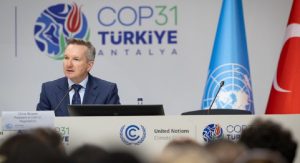
Chris Bowen, COP31 Chief Negotiator and Australia’s Minister for Climate Change and Energy, said that the Intergovernmental Panel on Climate Change (IPCC) and the International Energy Agency (IEA) have included CCUS as part of their scenarios for achieving net-zero emissions by 1.5 degrees Celsius.
“Both the IPCC and the IEA have said we are going to need CCUS as part of the net-zero 1.5 scenario, and particularly in hard-abated sectors,” said Bowen in an interview with journalists on the sidelines of COP31 in Antalya, Türkiye, on Friday 20 November.
The statement was made when Bowen was asked about the possibility of using CCUS as a compromise in negotiations to include the electrification agenda in the text of the COP31 agreement.
Whilst acknowledging the need for such technology, Bowen emphasised that CCUS must not be used as an excuse to delay emissions reductions. That principle, he said, has also been reaffirmed in the draft negotiating text for COP31.
“I understand that’s not many people’s first choice. As the draft text said, it shouldn’t be used as an excuse to delay emissions reductions,” he said.
The debate on CCUS is taking place against a backdrop of conflicting interests amongst the COP31 participating countries regarding the future of fossil fuels. Previous draft negotiating texts did not include any reference to fossil fuels, prompting criticism from a number of countries seeking a stronger commitment to the energy transition.
Bowen was unwilling to disclose the details of the negotiating position regarding the use of CCUS or the final wording on fossil fuels. However, he emphasised that efforts to transition away from fossil fuels would continue.
According to Bowen, electrification is one of the key tools for accelerating the transition away from fossil fuels. This measure must go hand in hand with the accelerated development of renewable energy.
“Electrification is the key to transitioning away from fossil fuels. Electrification is the how. Electrification, we know, will deliver two-thirds of what we need to do to keep the world at 1.5 degrees of warming by 2035,” he said.
He believes that accelerating electrification and the transition to renewable energy are key priorities for preventing global warming from exceeding the 1.5-degree Celsius threshold. Therefore, discussions at COP31 should not be limited to differences of opinion regarding fossil fuels.
Bowen acknowledged that multilateral climate negotiations are never easy. However, he believes there is still a willingness amongst the participating countries to reach an agreement, even though each has its own interests and red lines in the negotiations.
“There is still a spirit of making it work. People have strong views, of course. I’m not stepping away from that. But no one has said to me, “Let’s give up and go home.” People are working. Sleeves are all up. I’ve got some more meetings to get the job done,” he said.
COP31 in Antalya served as an important forum for bringing together the various national interests in formulating the next steps in tackling the climate crisis. For Bowen, the success of the negotiations is measured not only by the achievement of an agreement, but also by the ability of countries to strengthen their commitments to electrification, renewable energy and emissions reduction. (Hartatik)
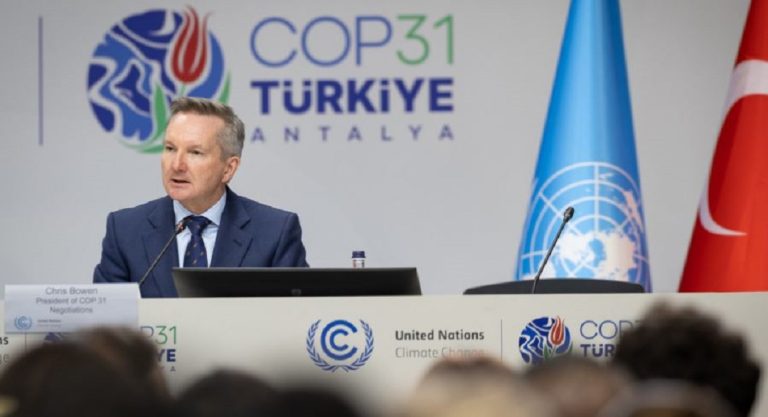
Banner photo: COP31 President of Negotiations Chris Bowen spoke to journalists on Friday, November 20, 2026, at COP31 in Antalya, Türkiye. (Photo: Kiara Worth|UN Climate Change)