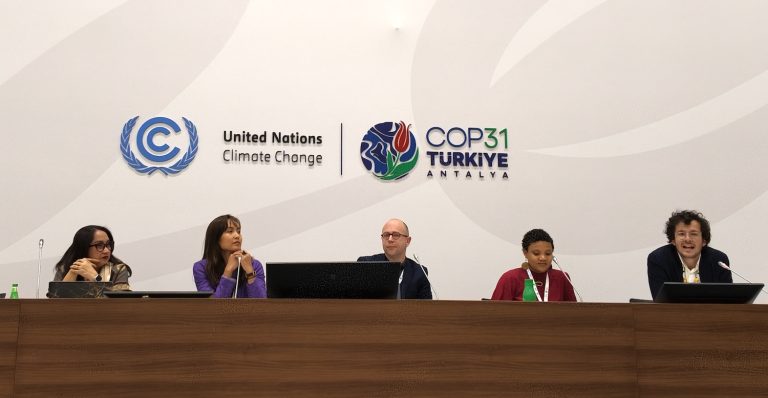
The degradation of tropical rainforests, which is often overlooked in global climate policies, could undermine efforts to limit global warming to 1.5°C, environmental organisations warned at a COP31 event on Thursday, November 19.
A global review by Rainforest Foundation Norway (RFN) found that only about one-third of the world’s original tropical rainforests remain intact, while another third has been lost and the remaining third has suffered degradation.
The findings suggest that emissions from forest degradation have now surpassed those caused by deforestation, highlighting a significant gap in international efforts to protect forests, the organisation said.
“Only around one-third of the original tropical rainforest remains intact, one-third has been lost, and another third has been degraded,” said Anders Haug Larsen, advocacy director at RFN, during a side event titled *Addressing the Loss and Degradation of Tropical Rainforests – The Missing Link in Keeping 1.5°C Alive*.
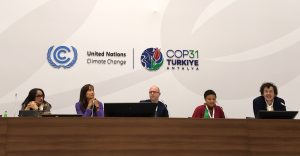
The event, organised by RFN and Plant-for-the-Planet alongside MADANI Berkelanjutan, Fern, the Natural Resources Defense Council (NRDC) and the UN Environment Programme (UNEP), brought together experts to discuss forest degradation and financing gaps.
Matt Williams, senior advocate for forest protection at NRDC, warned that degradation was also being overlooked in northern countries, where large-scale logging and bioenergy expansion were often excluded from deforestation records.
He cautioned that forests in North America and Europe could shift from carbon sinks to sources of emissions in the second half of the century if degradation continued unchecked.
Meanwhile, Katrina Borromeo of UNEP’s UN-REDD Programme highlighted the significant funding gap for forest protection. Although protecting forests in high-risk areas could prevent an estimated US$84 billion in annual disaster losses, private-sector contributions account for only around 10% of forest finance.
She said global funding needs were estimated at USD 300 billion, calling for landscape-based approaches that balance forest conservation with local food security and community needs.
Discussions also focused on the proposed Tropical Forest Forever Facility (TFFF), a global financing mechanism intended to reward countries for keeping tropical forests standing.
Tyala Ifwanga, forest finance and governance campaigner at Fern, said the facility offered an important opportunity, including through its proposed allocation of at least 20% of funding directly to Indigenous Peoples and local communities.
However, she warned that relying primarily on fire data to measure forest degradation would fail to capture damage caused by human activities such as logging. The facility should also prevent investments in industries that contribute to forest destruction and ensure communities have direct access to funding.
Indonesia’s forest classification under scrutiny
In Indonesia, the debate over forest degradation has taken on added significance amid government plans to expand biofuel production.
Nadia Hadad, executive director of MADANI Berkelanjutan, said the country’s forest and land fires in 2026 should not simply be attributed to the El Niño-related dry season but also reflected shortcomings in prevention efforts and inadequate response funding.
MADANI’s Indicative Burned Area Model estimated that approximately 2.5 million hectares of land burned between January and September 2026, substantially exceeding official government figures.
Hadad also questioned government plans to source feedstock for biodiesel targets of B50 to B100 from 12.7 million hectares classified as degraded forest.
She warned that the classification could include natural forests, peatlands and social forestry areas, potentially exposing ecologically important landscapes and Indigenous communities to conversion.
In Merauke, MADANI’s assessment found that only around 0.2% of the nearly two million hectares designated for a National Strategic Project qualified as critical land. The remaining areas included natural forests and wetlands that serve as living spaces for Indigenous communities.
“Without consistent definitions and community consent through Free, Prior and Informed Consent (FPIC), forests burned today risk being converted into energy plantations in the future,” Hadad said.
The coalition called for five policy measures: prohibiting the commercial conversion of burned forests and prioritising ecosystem restoration; verifying degraded land classifications with local and Indigenous communities; assessing bioenergy targets against environmental carrying capacity; accelerating recognition of Indigenous land rights and protecting forest defenders; and improving TFFF degradation indicators beyond fire data.
The organisations also urged the TFFF to exclude investments in extractive industries that contribute to forest destruction, warning that forest finance mechanisms must not inadvertently support activities that undermine their conservation objectives. (nsh)
Banner photo: Speakers from MADANI Berkelanjutan, UNEP, NRDC, Fern, and RFN during a COP31 side event titled “Addressing the Loss and Degradation of Tropical Rainforests – The Missing Link in Keeping 1.5°C Alive,” held in Antalya, Türkiye, on Thursday, November 19, 2026. Photo: MADANI Berkelanjutan