The fight over the timing of the next major climate science assessment and the funding of the Intergovernmental Panel on Climate Change (IPCC) has emerged as a contentious issue at the UN climate conference in Antalya, Türkiye, exposing growing political divisions over the role of science in global climate negotiations.
At the centre of the dispute is the IPCC’s Seventh Assessment Report (AR7), which governments need to inform the second Global Stocktake (GST2) under the Paris Agreement in 2028. While many countries want the report completed in time for the stocktake, others oppose the proposed timeline, citing concerns over developing countries’ capacity to review the scientific findings.
The disagreement has developed into a broader confrontation over climate science, with concerns that political objections to the assessment schedule could jeopardise the IPCC’s work and financial resources.
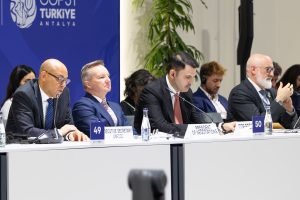
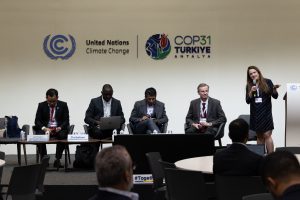
Mary Robinson, former president of Ireland and former UN High Commissioner for Human Rights, during a media gathering at the sidelines of COP31 on Tuesday, November 17, said that the international community could not afford to undermine the IPCC at a time when climate science increasingly faces political attacks and disinformation.
“The world just cannot either undermine or indeed lose the IPCC. It is vital to the multilateral climate regime,” she said at COP31.
What is the dispute about?
The disagreement centres on whether the IPCC should align the publication of its AR7 reports with the second Global Stocktake, which will conclude in 2028.
The Global Stocktake is a five-year assessment mechanism established under the Paris Agreement to measure collective progress towards limiting global warming and strengthening climate action. Its findings are intended to inform countries as they update their climate commitments and policies.
At COP28 in Dubai in 2023, governments recognised the importance of IPCC assessment reports in informing the first Global Stocktake and invited the panel to align its future assessment cycles with subsequent stocktakes.
However, IPCC member governments have been unable to agree on a publication schedule for AR7 for more than three years.
The European Union, many small island developing states (SIDS) and other governments support aligning the reports with the stocktake. Saudi Arabia, Russia, China, India and Kenya have opposed the proposed timeline, although their positions are not necessarily motivated by the same concerns.
A common argument among opponents is that a compressed publication schedule could disadvantage lower-income countries, which need sufficient time and resources to review the reports and contribute to the scientific assessment.
However, supporters argue that delaying the reports would deprive vulnerable countries of essential scientific information when they need it most.
Why does the IPCC timeline matter?
The IPCC assesses scientific knowledge on climate change, its impacts and risks, and possible responses. Its reports, produced by thousands of scientists worldwide, provide a common scientific foundation for international climate negotiations and national policymaking.
The sixth assessment cycle (AR6) played a significant role in informing the first Global Stocktake, which concluded at COP28. The same scientific foundation is needed for the second stocktake in 2028.
“We need the seventh assessment report in time for the next global stocktake,” Robinson said, arguing that countries cannot properly assess collective progress without the latest scientific evidence.
She highlighted the importance of AR7 for countries with limited scientific and institutional capacity, particularly least developed countries and small island states.
Robinson said representatives from the Maldives, Nepal and the Marshall Islands had personally expressed their desire to see the report delivered on time.
“They don’t have the capacity to have separate reports. They rely on this report,” she said, referring to vulnerable developing countries.
AR7 is also expected to address loss and damage and incorporate indigenous and traditional knowledge and science, areas Robinson described as increasingly important amid worsening climate impacts.
Is the IPCC facing a funding crisis?
The disagreement over the publication schedule has also affected discussions about the IPCC’s finances.
At its 65th plenary session in Addis Ababa, Ethiopia, in October, governments failed to reach agreement on either the AR7 timeline or the organisation’s 2027 budget. The meeting was suspended, leaving both issues unresolved.
The financial uncertainty has raised concerns that the IPCC could struggle to continue its work, including meetings that enable scientists and government representatives from developing countries to participate.
More than 200 scientists contributing to AR7 have issued an open letter pledging to continue their work.
Robinson argued that the budget dispute was being used as political leverage in the disagreement over the assessment timeline.
“It’s not a huge amount of money, but the point is the budget is being used as a kind of tactic,” she said.
She acknowledged legitimate concerns among African countries about capacity building but argued that these should be addressed separately rather than used to hold up the IPCC’s work.
Governments are scheduled to resume discussions virtually on December 1–3.
Is the dispute also about the legitimacy of climate science?
Beyond the disagreement over AR7, the confrontation reflects a wider political struggle over which scientific assessments governments are willing to recognise in climate negotiations.
One example is UNEP’s report on climate overshoot, which examines the implications of temporarily exceeding the 1.5°C warming threshold and options for bringing temperatures back down.
The report has faced criticism from countries questioning its scientific status because it was not formally reviewed by governments through the UN climate process.
Laurence Tubiana, chief executive of the European Climate Foundation and one of the architects of the Paris Agreement, has warned against attempts to dismiss uncomfortable scientific findings.
Speaking about the overshoot report, she said it “tells us a truth some would rather hide”.
“We are on course to exceed 1.5C and limiting how far and for how long is a matter of survival for us all,” she said.
Tubiana has also called on governments to defend scientific assessments and the scientists behind them.
Robinson similarly criticised attempts to undermine scientific institutions, arguing that the IPCC’s legitimacy comes from its inclusive process involving governments and scientists worldwide.
She also expressed concern about the growing influence of fossil fuel interests at climate negotiations, arguing that governments should focus on phasing out fossil fuels rather than relying on expensive technological solutions.
What happens if governments fail to agree?
There are three possible scenarios for how scientific evidence could inform the second Global Stocktake: first, “full alignment”, where all three AR7 Working Group reports are completed and adopted in time for GST2; second, “partial alignment”, where some reports, potentially the physical science assessment under Working Group I, are ready in time, while others follow later; and third, “alternative assessments”, where the stocktake draws on the best available scientific evidence compiled by other UN agencies.
The third scenario would not leave the stocktake without scientific evidence. Publications from the World Meteorological Organization and UNEP, including the Emissions Gap and Adaptation Gap reports, could still inform the process.
However, these assessments would not fully replace the IPCC’s comprehensive scientific review.
The COP31 presidency has an opportunity to help break the deadlock by securing political support for the IPCC timeline before governments resume discussions in December. A reference in the conference’s final decision could provide an important political signal.
The dispute goes beyond publication dates and institutional budgets. It raises fundamental questions about the role of science in climate policymaking and the ability of vulnerable countries to participate in global decision-making.
As governments prepare to assess progress under the Paris Agreement, the stakes are clear: weakening the IPCC risks undermining one of the most important foundations of international climate cooperation just when credible scientific evidence is needed most. (nsh)
Banner photo: Francesco Ungaro/Pexels.com