By Nabiha Shahab
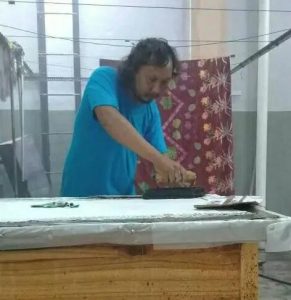
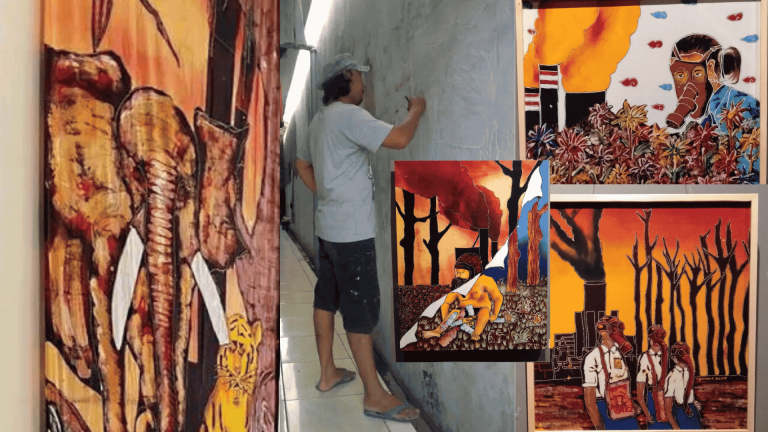
Agus Prasetyo, or Miki as he is familiarly called, views art not merely as an aesthetic expression but as a powerful medium for interpreting social reality. Drawing on the tradition of batik, he transforms fabric-dyeing techniques into a contemporary visual language: colourful, symbolic and often satirical. In his work, batik is no longer merely a cultural heritage, but a tool for critique. A “visual headline” that voices the anxieties of the times.
Miki’s journey as an artist is inextricably linked to his background in activism. He has volunteered with environmental organisations such as Greenpeace and WALHI Bali, experiences that have shaped the thematic sensibilities evident in his work. Ecological issues, social inequality and political absurdity serve as the primary fuel for his creative process. In this context, his works can be read much like journalistic reports—yet conveyed through symbols, colours and the deformation of forms that are more emotionally charged.
Together with Hafida Akuwati Putri, Miki initiated an exhibition themed “11 Years of Caring for Mother Earth”, which arose from a sense of empathy towards the increasingly evident environmental and social crises. Although its implementation was delayed due to the withdrawal of a sponsor, the exhibition was intended not only to showcase artworks but also to foster a space for dialogue between artists and the public—using art as a means of education and collective reflection.
“Portrait of This Country”: A Critique in Batik
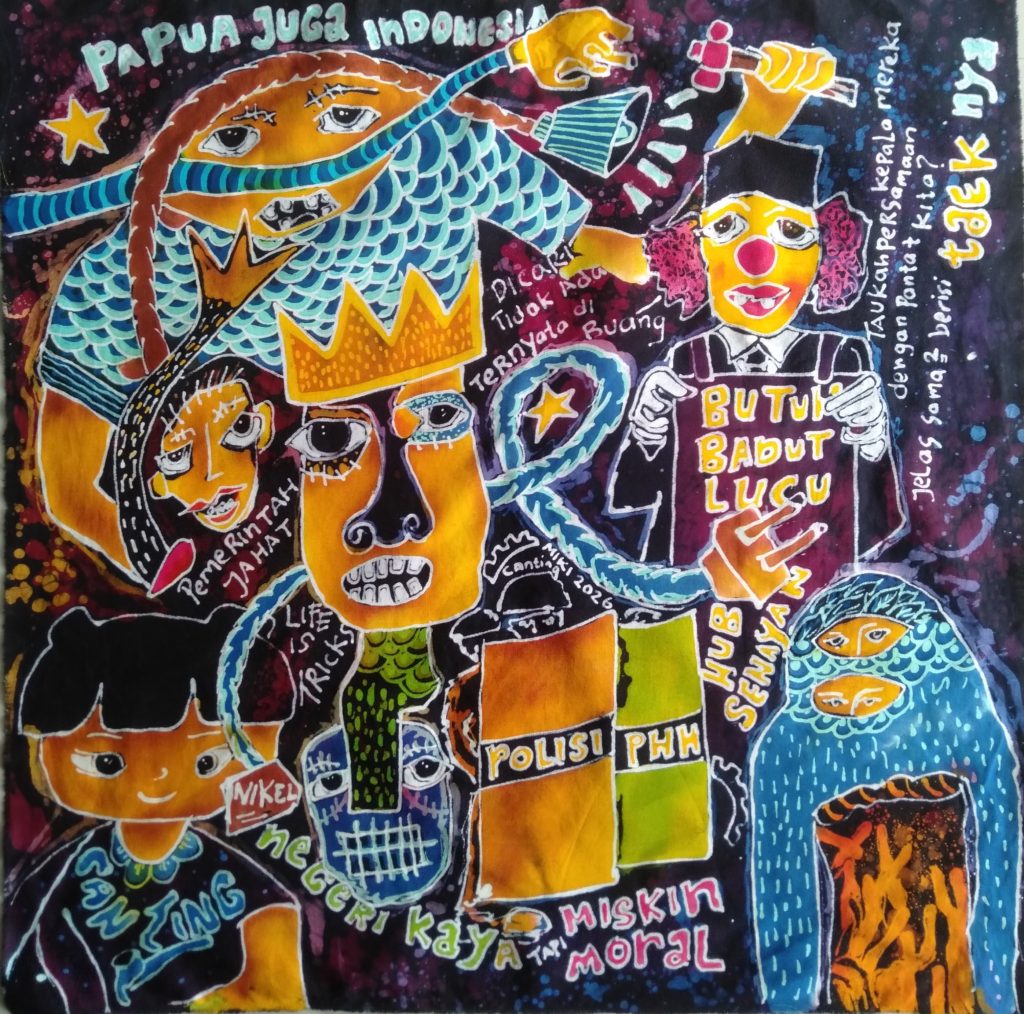
One of Miki’s recent works, created in collaboration with Canting Gupita P, is a piece entitled “Potret Negri Ini”, or “Portrait of This Country”. In this batik painting on cotton fabric, Miki has created a vibrant visual collage that is rich in layers of meaning.
Distorted figures, contrasting colours, and text scattered across the fabric’s surface create an impression of chaos, reflecting unstable socio-political conditions. Elements such as state officials, symbols of power, and ordinary citizens coexist side by side, seemingly without a clear hierarchy, illustrating the blurring of boundaries between protector and perpetrator.
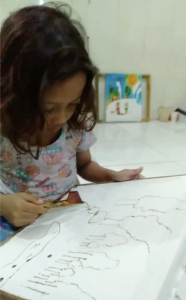
In this collaborative work, the creative process unfolded in an intimate yet dialogic manner. Miki began by formulating the overarching concept and main narrative, which was then translated by Canting, Miki’s nine-year-old daughter, into visual form through the depiction of several characters. These initial sketches were subsequently developed directly by Canting during the batik-making process, as she applied the lines of the drawings onto the fabric to form the foundation of the work. Miki then adds textual elements, some of which stem from their conversations, making this work not merely a technical collaboration, but also a space for the sharing of ideas across generations. Thus, *Portrait of This Country* speaks not only of social conditions, but also of the process of passing on ways of seeing and responding to the world.
The description of the work reinforces this message: “forests cleared for mining, peatlands forced to make way for oil palm expansion”, and an environment that is “sacrificed in the name of growth.” This critique does not stand alone; it is linked to corrupt practices cloaked in the rhetoric of “the people’s interests.” Here, Miki highlights not only the ecological destruction but also the power structures that enable it to occur.
The most powerful aspect of this work is the question it leaves us with: what will we pass on to the next generation? Concerns about the future form a common thread, namely that children may grow up in a country that has lost the meaning of ‘sustainability’, cut off from a connection with nature and social empathy.
Art as an alternative “source of news”
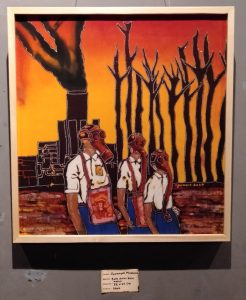
In a media landscape often constrained by format, agenda or even censorship, Miki’s work offers an alternative path: art as a form of visual journalism. He does not present data or quotes, but rather conveys experiences, emotions, anger and anxiety—feelings that are often felt more directly.
In Miki’s hands, batik becomes a kind of social archive. Every stroke of hot wax and every colour is not merely decoration, but a narrative of inequality, exploitation and hope. If the news records events, then Miki’s work captures the inner spirit of an era.
Thus, Agus “Miki” Prasetyo works not only as an artist, but also as a social observer, or indeed, in many ways, as a “reporter” who works with canvas and canting.