The agenda for energy transition and tackling the climate crisis risks creating new problems for indigenous communities if it is not accompanied by protection of their rights to land and the territories they manage. Rather than providing a solution, a number of projects carried out in the name of clean energy actually have the potential to increase pressure on indigenous territories.
These concerns were raised by the Alliance of Indigenous Peoples of the Archipelago (AMAN) on Saturday, 21 November, following the United Nations Climate Change Conference (COP31) in Antalya, Türkiye, which concluded on Friday. The organisation believes that the energy transition agenda does not yet fully guarantee justice for the communities that have long safeguarded the forests and the environment.
Abdi Akbar, Director of Public Participation and Indigenous Peoples’ Empowerment at AMAN’s National Executive Board, said that indigenous peoples continue to face land loss, forest destruction and even criminalisation when defending their rights. This situation is exacerbated by various projects carried out in the name of climate solutions, including large-scale energy infrastructure development.
In his view, emissions reduction must not be used as a pretext for taking over customary lands through projects involving the extraction of critical minerals, geothermal energy or the development of other energy infrastructure.
“In essence, we are demanding that Indigenous Peoples be recognised as rights-holders and political actors with the authority to determine their own future, rather than merely beneficiaries of policies determined by others,” said Abdi.
AMAN believes that this issue demonstrates that the energy transition has not yet been carried out in a fully equitable manner. Climate policy must not merely pursue emission reduction targets, but must also ensure that the communities affected have a say in determining the future of their regions.
During the COP31 negotiations, AMAN also highlighted the potential for a weakening of recognition of the legal status and collective rights of indigenous peoples in the draft presidential decision. Abdi rejected any wording that could potentially obscure the rights of indigenous peoples, including the right to self-determination and the right to free, prior and informed consent (FPIC).
On the other hand, AMAN believes that discussions on climate finance have not yet addressed the needs of indigenous peoples. To date, funding mechanisms have largely been controlled by donors and intermediary organisations. Indigenous peoples are more often positioned as beneficiaries or project implementers, rather than as parties with the authority to determine how the funds are used.
AMAN therefore advocates for a change in the governance of climate finance through direct funding mechanisms. Under such a scheme, indigenous communities can set priorities, make decisions and manage resources in accordance with their traditional governance systems.
Call for the enactment of the Indigenous Peoples Act
As well as calling for changes to energy transition policies and climate finance, AMAN is bringing demands for the recognition and protection of the collective rights of indigenous peoples to COP31.
Abdi said that such protection primarily concerns rights to land, customary territories and natural resources. In the Indonesian context, one of the urgent steps that the government and the House of Representatives must take is to pass the Indigenous Peoples Act without delay.
According to AMAN, legal certainty is needed to ensure that indigenous communities are not left in a vulnerable position when faced with development projects or policies on the management of natural resources.
AMAN also criticised the outcome of COP31, which it deemed to have failed to demonstrate the courage of nations to take concrete decisions to tackle the climate crisis. Debates on reducing dependence on fossil fuels, climate finance, mitigation, adaptation and a just energy transition continue to be hampered by conflicting interests amongst nations.
In fact, the latest draft decision from COP31 is said to omit any explicit reference to fossil fuels. This situation highlights the continuing wide gap between global ambition to tackle climate change and the political will of nations to take concrete action.
I believe that climate conferences must not merely result in new pledges and commitments without clear implementation mechanisms.
“We are disappointed with the outcome of COP31; we do not need a climate conference that merely produces new promises. We need decisions that can be implemented, measured and held to account,” he said.
For AMAN, the success of climate action is determined not only by the extent to which emissions can be reduced, but also by the extent to which such policies respect the rights of indigenous peoples as guardians of their territories and ecosystems. An energy transition that comes at the expense of indigenous peoples is seen as actually running counter to the environmental protection objectives it seeks to achieve. (Hartatik)
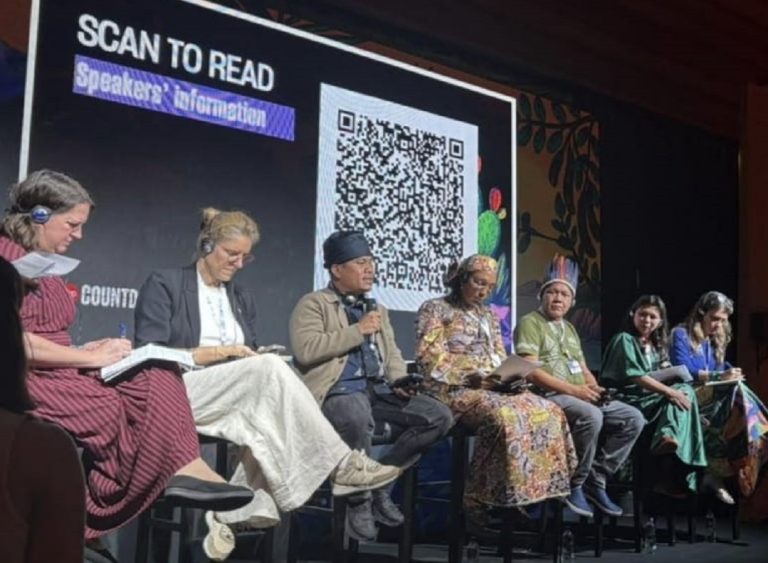
Banner photo: AMAN delegate Abdi Akbar (third from the left) is sharing his views whilst speaking as a panellist at one of the discussion forums at COP31 in Türkiye. Source: AMAN