Jakarta – Indonesia’s ambition to secure funding from the Tropical Forests Forever Facility (TFFF) is at odds with the expansion of domestic development projects, civil society groups said. National Strategic Programmes (PSN) that convert forest areas for food and energy development risk accelerating deforestation while potentially reducing the financial incentives Indonesia could receive through the global funding scheme.
On Tuesday, 17 November, the MADANI Berkelanjutan Foundation warned that Indonesia risks suffering a double loss if it fails to curb the clearing of natural forests. In addition to losing carbon-sequestering ecosystems, the country also faces the risk of losing some of the funding benefits from the TFFF due to the penalty mechanism imposed on countries that fail to maintain forest cover.
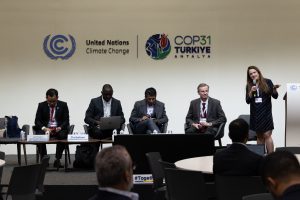
This risk came to the fore after the government reaffirmed its commitment to contribute USD 1 billion to the TFFF at the Leaders’ Summit on Forests during the 31st United Nations Climate Change Conference (COP31) in Antalya, Turkey, on 15 November 2026.
Nadia Hadad, Executive Director of MADANI Berkelanjutan, said that this funding commitment must be accompanied by consistent domestic forest protection policies. This is because Indonesia’s success in securing benefits from the TFFF depends heavily on its ability to maintain tropical forest cover.
According to MADANI Berkelanjutan’s spatial analysis, 8.78 million hectares of natural forest are in the area designated as a national strategic project for food and energy reserves. Meanwhile, the total area of natural forest outside the Indicative Map for the Moratorium of New Permits (PIPPIB) in 2024 amounts to 37.3 million hectares, including 8.17 million hectares of primary natural forest.
The data highlights the extent of pressure on the remaining forest areas. Large-scale food production schemes, infrastructure development, downstream mining activities and energy projects are among the development activities that have the potential to alter land cover.
“If domestic land-based PSN projects continue to clear natural forests to the point of exceeding the 0.5 per cent deforestation threshold, the potential funding that Indonesia should receive from the TFFF will be entirely eroded by penalties. Indonesia actually risks suffering a double loss: losing its own forest ecosystems whilst failing to reap the financial benefits of a global funding facility that it has helped to finance,” Nadia said.
Unlike conventional grant schemes, the TFFF is designed as a performance-based financing instrument. This blended finance mechanism aims to raise up to USD 125 billion through contributions from sponsoring countries and private investment.
The funds raised will be invested in a global bond portfolio. The returns from this investment will then be used to provide incentives to countries with tropical forests that have successfully maintained their forest cover. The proposed payment is approximately USD 4 per hectare per year.
However, the disbursement of these financial incentives is contingent on countries meeting forest conservation targets. Participating countries must keep their annual deforestation rates below the 0.5 per cent threshold. Forest loss, degradation and large-scale forest fires, meanwhile, may result in reduced payments.
Under the design outlined by MADANI Berkelanjutan, penalties could range from USD 100 to 800 for every hectare of lost or degraded forest. This mechanism means that the expansion of land-based projects must be assessed not only in terms of economic investment, but also in terms of the potential loss of conservation funding.
Nadia believes the government should make forest protection a top priority rather than merely highlighting the scale of Indonesia’s financial contribution at international forums.
“Indonesia’s greatest and most invaluable contribution to efforts to stem the global climate crisis is not the USD 1 billion in cash, but the ecosystem services provided by our approximately 90 million hectares of standing tropical forest cover. The government must take care to ensure that diplomatic ambitions on the global stage do not obscure our primary priority of saving the remaining forests at the grassroots level,” she said.
According to Nadia, the allocation of USD 1 billion to global financial instruments also has implications for domestic budget priorities. The government still requires funding to strengthen the management of conservation areas and protected forests, support climate change adaptation amongst coastal communities, and accelerate the recognition and demarcation of indigenous forest territories.
MADANI Berkelanjutan therefore calls on the government to ensure that Indonesia not only acts as a contributor to the TFFF, but also derives the maximum benefit as a developing country with extensive tropical forest areas.
The organisation has proposed three measures to mitigate these risks. Firstly, the government must ensure that the proceeds from the management of the TFFF funds are reinvested in the protection of natural forests and the empowerment of communities living near forests.
Secondly, the government needs to impose a permanent moratorium on the clearing of remaining natural forests and peatlands, whilst also reviewing PSN projects that have the potential to damage critical ecosystems and exacerbate deforestation.
Thirdly, the government is being urged to guarantee indigenous peoples and local communities direct access to funding. MADANI Berkelanjutan proposes allocating at least 20 per cent of total TFFF funds directly to community groups that have long served as guardians of the forests.
Nadia emphasised that the success of Indonesia’s commitment to global forest financing must ultimately be measured by the state of forest cover within the country, not merely by the amount of funding pledged at international forums.
“Indonesia’s major commitments at COP30 in Belém and COP31 in Antalya will ultimately be judged not by the trillions of rupiah pledged, but by how green our natural forest cover appears when monitored by global satellites,” she concluded.
MADANI Berkelanjutan will also raise the issues of tropical forest conservation and climate finance schemes at a side event during COP31 on 19 November 2026. The discussion, entitled “Addressing the Loss and Degradation of Tropical Rainforests – Key to Mitigation and Adaptation”, will examine research findings on the state of tropical rainforests, as well as policy and funding instruments to strengthen their protection. (Hartatik)
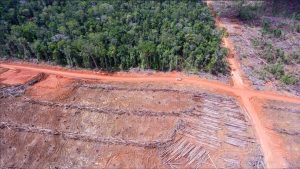
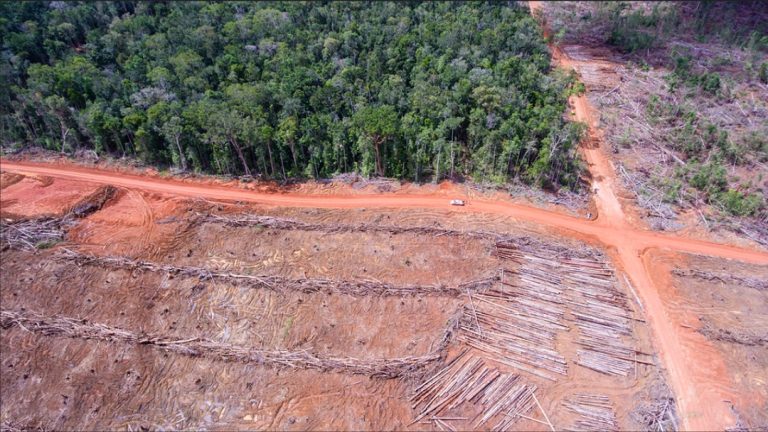
Banner photo: An aerial photograph showing the boundaries of the forest area that has been, and will continue to be, cleared for PT Papua Agro Lestari’s oil palm plantation concessions in Ulilin District, Merauke Regency, South Papua, in 2026. Photo: Mighty Earth / Auriga Nusantara