Jakarta – Civil society organisations urge the government to ensure that the Indonesian delegation to international climate negotiations is free from the influence of the extractive and fossil fuel industries.
In a statement on Wednesday, November 11, the groups argue that the involvement of businesses with interests in sectors that damage the environment risks undermining climate diplomacy whilst also steering government policy away from the principles of climate justice.
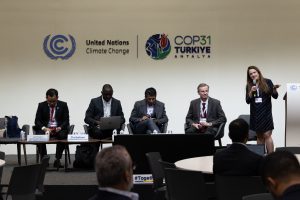
This call arose after Hashim Djojohadikusumo led the Indonesian delegation and officially opened the Indonesian Pavilion, entitled “Indonesia: Home of Climate Solutions”, at the 31st United Nations Climate Change Conference (COP31) in Antalya, Turkey, on 9 November 2026.
Civil society has further called for Hashim to step down from his role as the President’s Special Envoy for Climate Change. They believe that appointing a businessman from the extractive and fossil fuel sectors as the head of climate diplomacy risks creating a conflict of interest.
Firdaus Cahyadi, Programme Officer for Natural Resources and Climate Justice at the TIFA Foundation, said that the business interests associated with the delegation’s leaders could undermine Indonesia’s credibility in international negotiations.
“The appointment of businesspeople from the extractive and fossil fuel sectors as heads of the climate diplomacy delegation risks triggering a genuine conflict of interest, which would weaken Indonesia’s bargaining position in international negotiations,” he said.
The Indonesia Country Manager for 350.org, Sisilia Nurmala Dewi, also called on the Ministry of the Environment to review the composition of the delegation. In her view, the climate delegation should represent the interests of workers, the public and the environment, rather than safeguarding the profits of companies that contribute to environmental damage.
“For far too long, the Indonesian delegation has been bringing in people whose business interests harm the environment, rather than the climate,” said Sisilia.
He believes this situation is becoming increasingly unacceptable as Indonesia continues to face disasters linked to the climate crisis. The government is therefore urged to remove from the delegation any representatives of fossil fuel companies and firms involved in forest fires.
Criticism of the delegation’s composition goes hand in hand with civil society’s assessment of the government’s climate policy direction. They believe that an approach which relies too heavily on market mechanisms has failed to address the fundamental issue, namely the protection of the rights of indigenous peoples and local communities who have long safeguarded the ecosystem.
The Secretary-General of the People’s Coalition for Fisheries Justice (Kiara), Fikerman Saragih, believes that the climate commitments outlined by Hashim do not yet reflect the circumstances of coastal communities and those living on small islands. Yet these groups are among the most vulnerable to the impacts of climate change.
In his opening speech at the Indonesian Pavilion, Hashim stated that the government is determined to translate its climate ambitions into concrete action. According to him, climate action must go hand in hand with economic development, food and energy security, and improvements in people’s welfare.
“We will ensure that climate resilience and benefits reach the communities that need them most,” said Hashim.
However, Fikerman observes that coastal communities are still often treated merely as implementers of conservation programmes, rather than as the primary holders of rights over their territories and natural resources. As a result, these communities are forced to adapt to the conservation standards set by the government, and even lose the freedom to manage the ecosystems within their own living spaces.
According to him, these conditions have the potential to trigger conflict whilst also threatening people’s livelihoods. In North Sulawesi, for example, coastal communities face restrictions on managing the mangrove ecosystem, which the government claims falls within the Bunaken National Park. The construction of a sea dyke stretching from Banten to East Java is also seen as a threat to the livelihoods of fish farmers and traditional salt farmers.
“Effective conservation requires communities to be able to safeguard their living spaces, have free access to resources and sustain their livelihoods in the face of the climate crisis,” said Fikerman.
A similar issue also arises in forested areas. The Indonesian Forum for the Environment (WALHI) notes that around 70 per cent of forest cover in the best condition is found in customary territories and community-managed areas. However, the communities safeguarding these areas are deemed not yet to have received adequate recognition or benefits from climate policies or funding.
Uli Arta Siagian, National Executive Campaign Coordinator at WALHI Indonesia, said that the government has not given commensurate recognition to the community’s contribution to climate change adaptation and mitigation efforts.
One of the issues is evident in the distribution of climate finance, which has not yet reached forest-guardian communities directly. On the contrary, it is argued that the economic benefits are flowing more towards those engaged in activities that damage the environment.
“When people talk about climate finance, the money never reaches those who are protecting the environment. Instead, it flows to those who are destroying it,” said Uli.
Criticism has also been directed at the development of carbon credits, which was one of the key points in Hashim’s speech. The government views carbon resources, including tropical rainforests, as a means of helping to control greenhouse gas emissions. However, civil society organisations have warned that carbon trading mechanisms risk opening the door to new concessions, which could in turn trigger deforestation and land-grabbing conflicts.
Agung Budiono, Executive Director of CERAH, believes the government needs to reassess its reliance on carbon market mechanisms. In his view, achieving tangible emissions reductions, particularly in the energy sector, must be a priority through the development of renewable energy.
“Carbon resources are no longer a viable solution for tackling the climate crisis. The most effective way to cut emissions in the energy sector is through the development of renewable energy,” said Agung.
He highlighted the discrepancy between clean energy development targets and the expansion of coal-fired power stations to meet industrial demand. The government aims to build solar power stations with a capacity of 100 gigawatts peak (GWp) by 2029. However, the nickel industry still relies on captive coal-fired power stations to supply electricity to factories and industrial estates, including smelters.
CERAH reports that the capacity of captive coal-fired power stations currently in operation stands at 19.3 gigawatts and has the potential to exceed 31 gigawatts. There are concerns that the expansion of these power stations will lock the industry into a dependence on coal, even as renewable energy capacity continues to increase.
CERAH therefore urges the government to halt coal-fired power station projects and ensure that its commitment to energy transition is realised through tangible changes in the industrial sector.
Giorgio Budi Indrarto, Deputy Director of MADANI Berkelanjutan, added that climate justice had not yet become a central theme in Hashim’s speech. In his view, environmental protection policies must not stop at conservation projects and targets, but must also acknowledge the impacts of the climate crisis and safeguard communities’ traditional leadership and knowledge.
“It is high time the government recognised the impact of the climate crisis on communities. This recognition must be accompanied by protection for community leadership, traditional knowledge and living spaces. Climate justice must be upheld in Indonesia,” he said.
The coordinator of Climate Rangers Indonesia, Ginanjar Aryasuta, also emphasised that the younger generation rejects an energy transition controlled by those who continue to profit from the ecological crisis.
“Young people reject promises of an energy transition controlled by those who are still profiting from the ecological crisis. We demand climate leaders who are free from business interests, so that climate justice can be realised for future generations,” he said.
During COP31, civil society organisations pledged to monitor the Indonesian delegation’s negotiating stance. They urged the government to advocate for a phased-out use of fossil fuels, expand the use of affordable clean and renewable energy, and push for grant-based funding for adaptation and disaster recovery from developed countries.
In the run-up to COP32, they called on the government to replace the head of the climate delegation with a figure who has experience in international negotiations and is free from ties to the extractive industries. Removing extractive industry executives and fossil fuel lobbyists from the delegation is also part of the demands for reforming Indonesia’s climate diplomacy. (Hartatik)
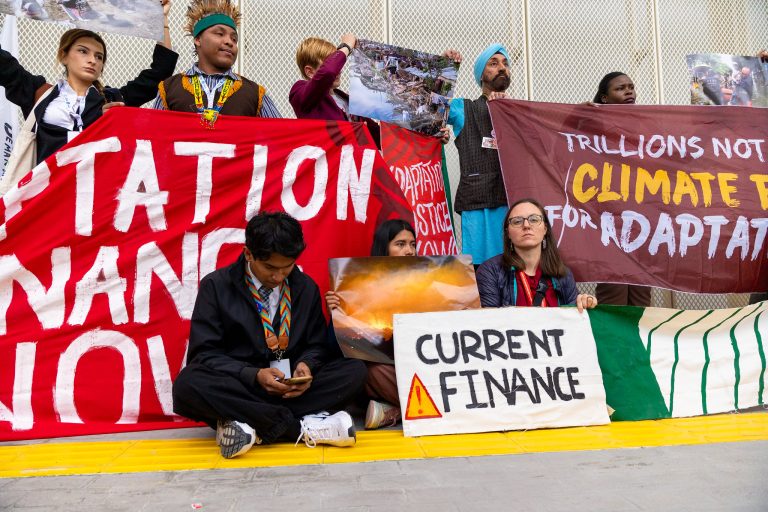
Banner photo: Members of civil society demonstrate in the corridors (Photo: © UN Climate Change – Kubilay Ciftci)