Jakarta — Indonesia’s Ministry of Forestry has imposed administrative sanctions on 32 companies linked to forest and land fires that burned nearly 12,927 hectares, while criminal proceedings are under way against 125 individuals and corporate entities suspected of involvement, the ministry said on Monday, October 19.
The enforcement measures come as communities across the country continue to face fires and smoke, prompting the energy think tank Institute for Essential Services Reform (IESR) to call for emergency action to protect public health and address fuel shortages affecting livelihoods.
The Forestry Ministry said on Monday that the number of companies sanctioned had risen from 26. Of the 32 companies, 19 face administrative sanctions involving permit suspensions and mandatory forest ecosystem restoration, covering 9,546 hectares of burned land. Eight other legal entities have been ordered to restore 2,211 hectares, while five have had their permits revoked.
The companies operate across seven provinces, including West Kalimantan, which has nine sanctioned companies, Central Kalimantan with seven, and South Sumatra and South Kalimantan with five each. The remaining companies are in Jambi, East Kalimantan and North Kalimantan.
Separately, the ministry’s Directorate General of Forestry Law Enforcement is pursuing criminal cases against 125 legal subjects, including individuals and corporations. Forty-four cases remain at the preliminary investigation stage, while 79 are under investigation. Authorities have named 12 individuals and one corporation as suspects, and two corporate cases have reached the stage of transferring suspects and evidence to prosecutors, the ministry said.
Dwi Januanto Nugroho, the ministry’s director general of forestry law enforcement, said investigations would seek to establish accountability for suspected violations, including by tracing the beneficial owners of companies operating in areas affected by fires.
“Handling forest fires must reach the parties responsible,” he said, adding that investigators were developing evidence of alleged permit violations alongside ongoing firefighting efforts.
The ministry said it could also pursue compensation for forest ecosystem damage if investigations establish a legal basis for such claims. It is continuing to monitor compliance with restoration orders while investigating suspected criminal offences.
Fire continues to burn across the country
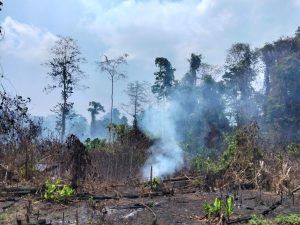
The enforcement drive comes amid continuing fires in several regions. Indonesia’s National Disaster Management Agency (BNPB) reported on Monday that fires had burned land in Central Sulawesi, South Sulawesi and the Bangka Belitung Islands over the preceding days.
In Central Sulawesi’s Parigi Moutong district, a fire on Sunday burned about two hectares of cocoa and clove plantations. Another two hectares were affected in Tojo Una-Una district, where fires spread through vegetation and undergrowth. No casualties were reported in either incident.
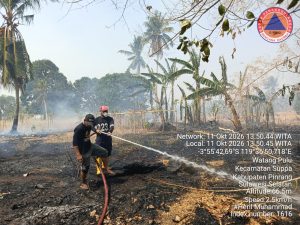
In South Sulawesi’s Sidenreng Rappang district, about one hectare burned. The district remains under an extended emergency status for drought and forest and land fires through Nov. 1.
In East Belitung district, Bangka Belitung Islands, fires affected about 2.22 hectares across Padang and Selingsing villages. Authorities said the fires had been extinguished and no casualties were reported.
The latest incidents add to concerns about the wider effects of fires and smoke on public health and economic activity.
Civil society demands emergency status
IESR said on Monday that communities were facing a double burden from smoke pollution and fuel shortages in several areas. Children, pregnant women, older people and those with respiratory conditions were particularly vulnerable to poor air quality, while shortages were disrupting the work of drivers, fishermen, farmers and small businesses.
The organisation urged President Prabowo Subianto’s government to declare emergency-response status in affected areas, mobilise ground and aerial firefighting resources, distribute N95 masks, provide clean-air spaces and free health services, and publish air-quality data regularly.
It also called on the government and state energy company Pertamina to increase allocations of subsidised and assigned-price fuels, disclose stock levels and the causes of shortages, prioritise distribution to the worst-affected areas, and act against hoarding and fuel diversion.
IESR chief executive Fabby Tumiwa said the government should provide the public with clear plans, deadlines and named officials responsible for responding to the crises. The organisation also called for emergency assistance for vulnerable workers and small businesses.
Beyond immediate relief, IESR said the crises highlighted vulnerabilities associated with dependence on imported fuels and weaknesses in land management. It urged the government to accelerate transport electrification, renewable energy development and measures to prevent fires at their source.
The forestry ministry said Indonesia was also strengthening its response to transboundary haze under the ASEAN Agreement on Transboundary Haze Pollution, which it signed in 2002 and ratified in 2014.
The agreement commits regional governments to cooperation on preventing and addressing haze pollution. The ministry said Indonesia’s response combined administrative sanctions, criminal proceedings and potential claims for ecosystem damage to strengthen accountability and reduce the risk of fires recurring. (nsh)
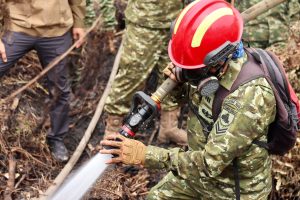
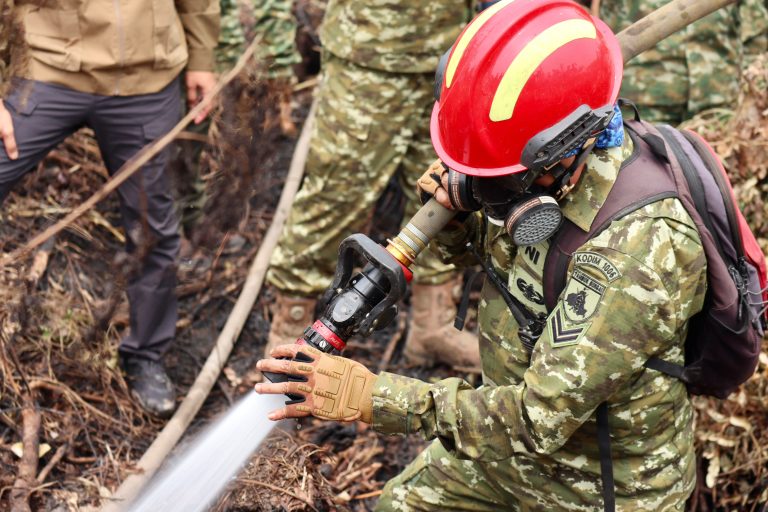
Banner photo: Efforts to tackle forest and land fires at the Pulang Pisau Regency Regent’s Office, Central Kalimantan, on Monday, 19 October 2026. Source: BNPB