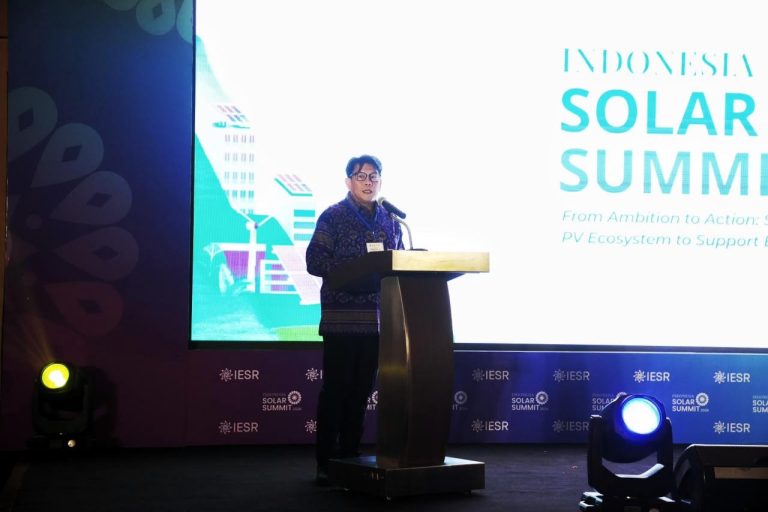
Jakarta — Indonesia must accelerate the deployment of solar energy to meet rising electricity demand, strengthen energy independence, and support low-carbon economic development, the Institute for Essential Services Reform (IESR) said at the opening of the Indonesia Solar Summit (ISS) 2026.
Held in Bali from July 14–16, the annual summit is taking place outside Jakarta for the first time, bringing together national and regional leaders to discuss the expansion of solar power and Indonesia’s green energy transition.
The event featured governors from Bali, West Nusa Tenggara (NTB), and East Nusa Tenggara (NTT), all of whom have pledged to achieve net-zero emissions ahead of the national target. Bali aims to reach net zero by 2045, while NTB and NTT are targeting 2050.
Bali Governor Wayan Koster said the province plans to significantly expand its electricity capacity by 2030 through large-scale solar projects, including rooftop and floating solar installations. He highlighted plans to transform Nusa Penida into a “Green Island” powered entirely by renewable energy by 2030, with all transportation using battery-electric vehicles.
IESR Executive Director Fabby Tumiwa said Indonesia’s regions have different strengths that should shape their renewable energy development strategies. Bali could become a model for low-carbon tourism powered by solar energy. At the same time, NTB could develop a solar manufacturing and energy storage ecosystem, and NTT—with an estimated solar potential of 369 gigawatt-peak (GWp)—could emerge as a national renewable energy hub.
During the summit, IESR also launched a roadmap for developing Indonesia’s domestic solar photovoltaic supply chain. The report argues that Indonesia has significant potential to build an integrated solar manufacturing industry but warns that inconsistent regulations, limited domestic demand, and fragmented supply chains remain major obstacles.
Fabby called on the government to provide stable policies, expand demand for locally produced solar components, strengthen manufacturing capacity, invest in workforce development, and boost research and innovation. He also urged more consistent local content (TKDN) regulations and faster permitting to improve investor confidence.
The roadmap recommends strengthening solar module and cell production by 2030, integrating wafer and polysilicon manufacturing by 2040, and developing next-generation solar technologies and recycling systems by 2060.
The summit also recognised organisations advancing solar energy adoption through its Solar Awards. West Java received the award in the regional government category, Gadjah Mada University was honoured for its solar research and education efforts, and Danone Indonesia was recognised for using solar power to decarbonise its operations.
Meanwhile, NTB Governor Lalu Muhammad Iqbal said the province is prepared to contribute around 10 GW to the national target of installing 100 GW of solar power, building on four existing 5-megawatt solar power plants and several smaller installations across Lombok and the Gili Islands.
NTT Governor Emanuel Melkiades Laka Lena said expanding solar power, combined with battery storage, would help replace diesel generation across the province’s small islands while supporting agriculture, fisheries, tourism, clean water access, and small businesses. He said NTT’s abundant solar resources provide a strong foundation for accelerating the region’s clean energy transition. (nsh)
Banner photo: IESR