Semarang — The transition to clean energy is not only a major priority for the government, but its tangible benefits are also beginning to be felt by both the industrial sector and rural communities in Central Java. The use of renewable energy has proven capable of improving production cost efficiency, reducing carbon emissions, and enhancing the quality of life for local communities.
Arie Wicaksono, Utility Manager at PT Phapros Tbk., said that his company has begun utilising solar energy as part of its energy efficiency strategy and as part of efforts to improve the company’s environmental performance. The pharmaceutical company, which is part of the state-owned pharmaceutical holding company, has been installing solar panels since 2019 as part of its green energy and green manufacturing initiatives.
According to Arie, this move was also driven by the company’s aim to achieve a high ranking in the Corporate Environmental Performance Rating Programme (Proper), particularly in the Proper Green category.
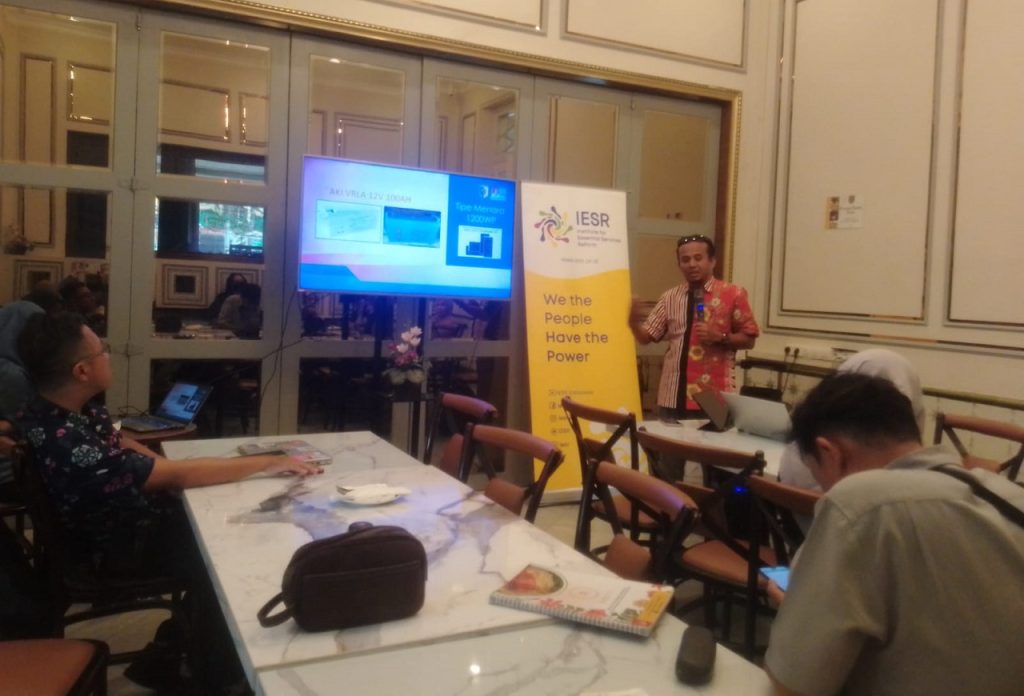
“The use of clean energy was initially driven by the need for production efficiency, as well as the company’s efforts to achieve Green Proper status,” said Arie during a media dialogue with IESR Central Java at Rosti Cafe on Saturday, 14 March.
PT Phapros has invested approximately Rp 1.2 billion in the procurement of solar panels with a capacity of 80 kWp, equivalent to an energy output of around 403 kWh. The use of solar energy has been shown to reduce carbon emissions by around 790 tonnes per year.
As well as having an impact on the environment, the use of solar panels also brings economic benefits to the company. Arie noted that the system is capable of increasing energy efficiency by up to 12.9 per cent each year.
“The use of solar panels also reduces electricity consumption from PLN, enabling the company to save around Rp 15 million to Rp 20 million per month, or approximately 20 to 30 per cent of its previous electricity usage,” he said.
With these savings, the company’s investment in clean energy is expected to reach the break-even point (BEP) in less than 10 years.
Meanwhile, renewable energy is also being utilised at the village level to meet the community’s basic needs. The Head of Banjarsari Village, Haryanto, explained how his village is harnessing wind and solar energy through the construction of a hybrid power plant (PLTH).
The solar power plant is used to power streetlights along a 700-metre stretch of road between hamlets, comprising a total of 17 light points. The installation is situated along the route connecting Glodak Bridge to Genderuwo in Banjarsari Village, Sayung Sub-district, Demak.
Haryanto said that for decades, the road had been unlit, meaning it was often a hotspot for crime at night. This situation was a cause for concern as many residents, particularly women, used the road when returning home from work at the factory.
“For years, that road was pitch-black and quite dangerous. Yet many residents, particularly women, used to walk along it at night on their way home from work at the factory,” he said.
In light of this situation, in 2023, Haryanto, together with several lecturers from Semarang University (USM), initiated the construction of a solar power plant as a clean-energy-based solution for street lighting.
The construction of the solar power plant was funded using village funds amounting to Rp 84 million. The system is capable of generating approximately 3,600 watts per hour and can power 700-watt lights at each point for around 12 hours every night.
The Central Java Provincial Government recognised the innovation. In 2024, Banjarsari Village was awarded the title of ‘Energy-Self-Sufficient Village’ at the entry-level category.
However, Haryanto revealed that the long-term management of these energy facilities faces challenges. To date, the maintenance costs for the PLTH are still covered by village funds, amounting to between Rp 7 million and Rp 8 million per year.
“Maintenance is still funded by village funds, but we are concerned about the future because of the central government’s fiscal efficiency policy, which could affect the allocation of village funds,” he said.
Meanwhile, Nurul Fadilah, a sub-national project officer at the Institute for Essential Services Reform (IESR) in Central Java, believes that Central Java has enormous potential for the development of renewable energy.
She said that the innovations implemented by Banjarsari Village demonstrate that the use of renewable energy does not necessarily have to involve the construction of large-scale power stations.
According to Nurul, small community-based projects can actually provide direct benefits to the community whilst raising awareness of the importance of clean energy.
“Initiatives such as those undertaken by Banjarsari Village demonstrate that renewable energy can deliver tangible benefits to communities without the need to build large-scale power stations,” she said.
Nurul added that the success of renewable energy development at the village level also depends heavily on community involvement. Therefore, residents need to be encouraged to take ownership of the energy infrastructure built in their local area.
“Village communities need to be encouraged to take ownership of renewable energy infrastructure, for example, by contributing to its operation and maintenance, whether through their time, effort or financial support for further innovation,” she said. (Hartatik)
Banner photo: Image generated by OpenAI’s DALL·E via ChatGPT (2024)