by: Azam Hawari*
Since 2024, the House of Representatives (DPR) has included the revision of the Forestry Law in the 2024–2029 Priority National Legislative Program. The Working Committee aims to conclude deliberations in the first parliamentary session of 2026, with discussions currently underway with experts and stakeholders. The revision offers a timely opportunity to address forest governance gaps that continue to fuel tenure inequality, land conflicts, and environmental degradation.
The urgency of reform is evident. Natural disasters in Sumatra in late 2025 highlighted how forest degradation and unresolved tenure issues undermine environmental resilience and public safety. These events underscore that revising the Forestry Law is not merely a legislative exercise, but a political test of Indonesia’s commitment to addressing structural problems in forest governance.
Social forestry has been promoted as one pathway to address these challenges. By positioning Indigenous Peoples and local communities (IPLCs) as key actors, social forestry recognises the role of communities in managing forests sustainably. IPLCs hold long-standing knowledge and practices such as agroforestry and community-based reforestation. When supported by adequate capacity, resources, and legal certainty, social forestry programmes can contribute to reducing deforestation and strengthening local livelihoods.
However, implementation of these policy objectives remains uneven. As of September 2025, approximately 8.4 million hectares had been allocated under social forestry schemes – well below the government’s target of 12.7 million hectares.
Regulatory complexity, budget limitations, capacity gaps, and institutional fragmentation continue to pose practical challenges. Similar constraints affect the recognition of customary forests. The current Forestry Law requires formal recognition of Indigenous law through regional regulations as a prerequisite for customary forest designation. In practice, this requirement has become a major obstacle. The process is costly, politically complex, and often beyond the capacity of IPLCs to pursue without external support.
Institutional fragmentation also remains a concern. Customary territories are addressed through different policy frameworks, including social forestry and agrarian reform, even though such territories often transcend administrative boundaries. In addition, data inconsistencies across government agencies persist. Although the One Map Policy represents an important step forward, overlapping land claims remain widespread; as of 2024, an estimated 47 million hectares were still subject to overlapping designations.
At the international level, Indonesia has reaffirmed its commitment to strengthening customary forest recognition. During the COP30 UNFCCC meetings in 2025, the Minister of Forestry announced a target to recognise 1.4 million hectares of customary forests over the next four years. This commitment was followed by the establishment of a Task Force on Customary Forest Recognition in 2025, involving civil society organisations. While welcomed, this commitment raises a critical question: can such targets be met without reforming the underlying legal framework?
Subsequently, the Forestry Law revision provides a crucial opportunity to align such commitments with domestic legal frameworks. The revised law should address the structural barriers limiting IPLCs’ access to forests. This requires a shift in approach: placing IPLCs as rights-holders and active managers of forests, rather than as passive recipients of state-granted rights.
Recognition of Indigenous Peoples must be declaratory, affirming rights that already exist rather than constitutive in nature. It needs to function as a streamlined administrative process, rather than a burdensome legal precondition. Requirements such as regional regulations could be simplified, allowing flexibility in the use of various legal instruments for administrative purposes.
Indonesia can also draw lessons from regional experience. The ASEAN Guiding Principles on Effective Social Forestry for Effective Social Forestry Legal Frameworks, developed by the ASEAN Working Group on Social Forestry with the support of ClientEarth and RECOFTC, offer useful guidance on strengthening legal frameworks and implementation. These principles demonstrate that workable legal options already exist and can be adapted to national contexts.
Ultimately, the core challenge is not the lack of legal pathways, but the political will to use them. Strengthening IPLCs’ rights in the Forestry Law is not only a matter of justice, but also a strategic investment in Indonesia’s climate goals.
Forests underpin community livelihoods, protect ecosystems, and preserve local knowledge essential for long-term resilience. Whether this revision becomes a turning point or another missed opportunity will depend on whether IPLCs are truly placed at the centre of forest governance reform.
*The author is a lawyer with ClientEarth Asia, working on the Food, Oceans and Land Use (FOLU) program.
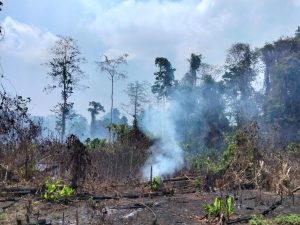
Banner photo: Khun Ta/shutterstock.com