International Energy Agency (IEA) Executive Director Fatih Birol has expressed optimism that countries will support a proposed global electrification target at COP31, saying the commitment could send an unmistakable signal to energy markets and investors about the direction of the world’s energy future.
Speaking at a press conference at the UN climate summit on Friday, November 13, Birol said countries’ responses to the Iran war, particularly concerns over energy security, had strengthened the case for electrification as a strategic policy response.
“When I look at the countries’ responses to [the] Iran War, especially in the context of energy security, I can say that many countries have turned to electrification as their strategic response to the Iran war as an important energy security policy,” he said.
Birol said increasing electricity’s share of global energy consumption from the current 23-25% to 35% by 2035 could also deliver significant emissions reductions, even under existing policy settings.
“If it happens, even with the current policy settings, I underline this: even with the current policy settings, we are going to see significant amounts of emissions reductions,” he said.
Although negotiations are ongoing, Birol said securing broad international support for the proposed target would influence investment decisions and provide greater certainty about the future of energy.
“If it is signed, in my view, it will give an unmistakable signal to the energy markets, to the investors and financial institutions where the world’s energy future lies, which is, in my view, electrification,” he said.
He added that discussions with government leaders in recent weeks had given him reason to be optimistic about the outcome, although it remained unclear whether the commitment would appear in COP31’s cover decision or its action plan.
Different pathways towards a common target
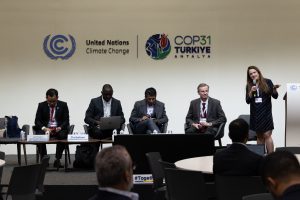
Experts attending a COP31 media briefing cautioned that a global electrification target must reflect countries’ different starting points and economic circumstances.
Dr Ajay Mathur, India’s lead negotiator at the Paris climate summit and former director general of the International Solar Alliance, said achieving higher electrification would require governments to address both energy supply and demand.
Expanding renewable energy capacity alone would not be sufficient without shifting transport, industry and cooking away from fossil fuels. This would require subsidies for technologies such as heat pumps and electric motors, alongside support for renewable energy generation.
Mathur said increasing India’s electrification rate by 2035 was achievable, but applying an identical target to every country would be difficult because of differences in their starting positions.
Madhura Joshi, Asia Programme Lead for Global Clean Power at E3G, similarly said the proposed 35% target should not be interpreted as requiring every country to reach the same level.
Instead, it should be understood as a collective effort to advance the energy transition, following previous COP commitments on renewable energy, energy efficiency, storage and electricity grids.
Joshi identified affordable financing and investment in grid infrastructure as critical conditions for accelerating electrification. Grid infrastructure has historically struggled to attract investment, while renewable energy financing remains concentrated in a limited number of countries.
Reducing financing costs and developing more resilient supply chains would therefore be essential to enabling countries to pursue their electrification ambitions.
Financing remains a major obstacle for Africa
For African countries, the challenge extends beyond replacing fossil fuels with electricity to providing access to energy for communities that remain underserved.
Dr Dola Oluteye, Senior Fellow for Energy and Transport Policy at University College London, said Africa possessed approximately 60% of the world’s solar potential but continued to struggle to attract renewable energy investment at the necessary scale.
The main obstacle was the high cost of capital, which makes projects difficult to finance and less attractive to investors.
Oluteye said the cost of capital for renewable energy projects in Australia and parts of Asia and Europe could be as low as 3-5%, compared with 21-22% in Africa.
“At that cost of capital, investors are simply not going to put money into African electrification or industrialisation,” she said.
She called for international finance to flow towards regions such as Africa, where renewable energy could be developed on a substantial scale.
Oluteye also highlighted the different meaning of electrification across regions. While developed countries largely focus on replacing existing fossil-fuel-based energy systems, many African communities still lack electricity and depend on firewood.
Consequently, affordability and access must be addressed alongside the transition to renewable electricity.
China unlikely to oppose target
China’s negotiating position could also influence the outcome of the proposed global target.
Li Shuo, Director of the China Climate Hub at the Asia Society Policy Institute, said Beijing was unlikely to actively champion the proposal but was also unlikely to oppose it.
He said achieving a 35% electrification rate by 2035 would be relatively easy for China given its domestic progress in renewable energy and electrification.
China’s position reflects its preference for COP negotiations to focus on implementing existing commitments rather than introducing new international targets.
Shuo said Beijing could support the proposed target provided countries retained the flexibility to determine their own approaches in line with national circumstances.
He highlighted the contrast between China’s cautious negotiating position and its increasingly influential role in the global clean energy transition.
China supplies an estimated 70-80% of what the world needs to decarbonise, he said, while its substantial and growing solar and wind capacity is driving domestic electrification.
Shuo also pointed to concerns over the implementation of previous international commitments, including targets to triple renewable energy capacity and double energy efficiency, as well as the unmet $300 billion climate finance goal.
Electrification could halve global energy demand
New research published by the University of Oxford has further strengthened the case for electrification, finding that a global energy system powered primarily by clean electricity could require approximately half as much energy as today’s fossil-fuel-based system to deliver the same heating, transport and industrial output.
Jan Rosenow, professor of energy and climate policy at the University of Oxford and lead author of the research, described the proposed increase in electricity’s share of global energy consumption from 23% to 35% by 2035 as potentially the world’s largest efficiency programme.
“Our research shows the world currently wastes twice as much energy as it uses. Electrify, and that waste falls by more than 60%. No other climate policy comes close,” he said.
The findings highlight electrification’s potential to deliver both emissions reductions and substantial energy efficiency gains.
With negotiations continuing at COP31, the challenge will be translating the growing political and economic case for electrification into an international commitment that countries are willing and able to implement. (nsh)
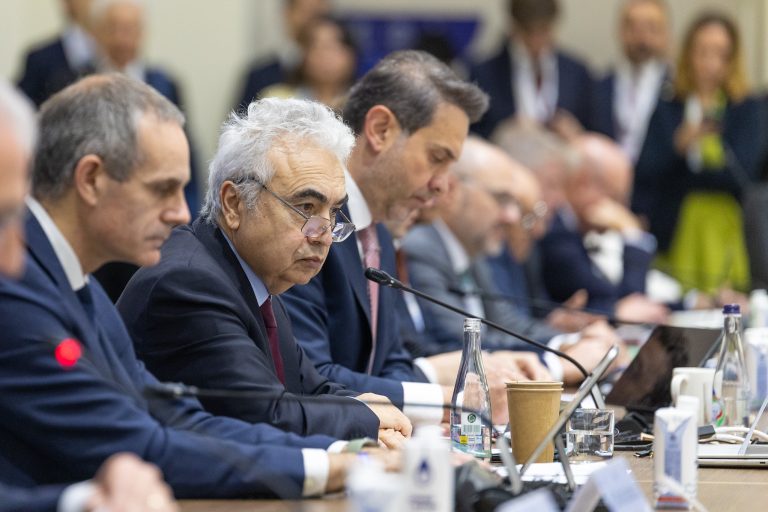
Banner photo: Fatih Birol (centre) and other participants discussing the global energy transition. (Photo: © UN Climate Change – Kubilay Ciftci)