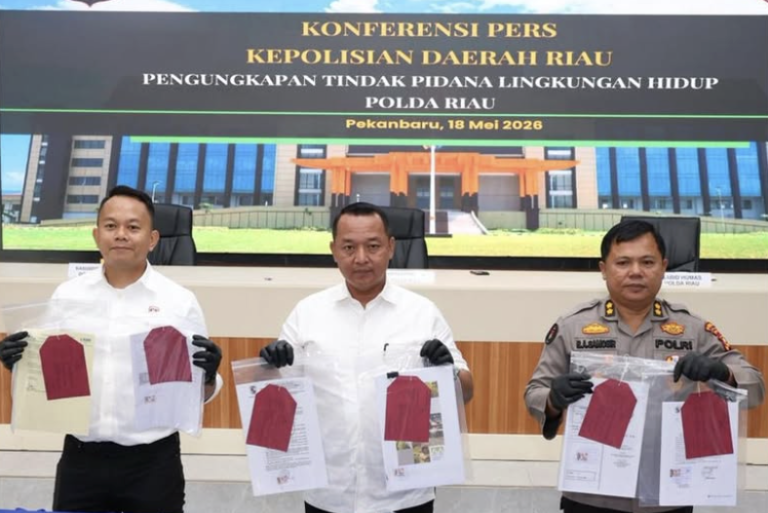
Jakarta — Environmental group Jikalahari has welcomed police action to name palm oil company PT Musim Mas as a suspect in an environmental crime case, calling it a critical step toward holding corporations accountable for ecological damage in Riau.
“The Riau Police Chief’s initiative, carried out through the Special Crimes Investigation Directorate, is crucial as it targets corporations to resolve issues of environmental destruction, particularly the destruction of forests along riverbanks. Corporations, which reap far greater economic benefits and are the primary cause of environmental damage, are rarely held to account,” said Okto Yugo Setyo, coordinator of Jikalahari in a statement on Tuesday, May 19.
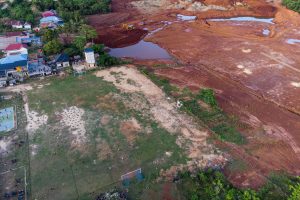
The designation follows an investigation by the Riau Police’s Special Crimes Directorate, which uncovered oil palm cultivation activities within the protected riparian zone of the Air Hitam River, a tributary of the Nilo River, in Pelalawan regency.
Authorities found that the area — located in Estate IV, Division F of PT Musim Mas in Air Hitam village, Ukui district — had been cleared and planted with oil palm between 1997 and 1998, with production beginning in 2002. Police allege the company generated economic benefits for more than two decades from plantation activities in areas that should serve as ecological buffer zones.
According to media reports, the case has caused estimated state losses of Rp187.86 billion, underscoring the scale of environmental and economic impacts linked to the alleged violations.
Jikalahari said the case should serve as an entry point for broader law enforcement targeting problematic palm oil companies across the province. The group urged authorities to apply multiple legal frameworks, rather than limiting the case to violations in river buffer zones.
The organisation also pointed to past findings by the Eyes on the Forest coalition, which in 2015 and 2017 identified PT Musim Mas as a recipient of crude palm oil (CPO) allegedly sourced from illegal activities داخل the Tesso Nilo National Park.
The reports indicated that Musim Mas facilities in Lubuk Gaung received supplies from mills suspected of processing illegal fresh fruit bunches originating from within the protected area. This trade, activists argue, has contributed to long-standing encroachment pressures on the park, a key habitat for Sumatran elephants.
“The application of multiple laws to PT Musim Mas will have a far greater impact. Law enforcement will put a stop to encroachment in the TNTN. If this is done, the Riau Regional Police will not only be saving the river, but also saving the main elephant habitat in Sumatra,” Okto said.
Beyond the specific case, Jikalahari warned that environmental degradation along river basins in Riau is widespread and involves multiple concessions. The group’s data shows dozens of industrial timber plantations (HTI) and oil palm permits overlapping with major watersheds, including 29 concessions in the Rokan River basin, 64 in Kampar, 34 in Indragiri, and 22 in Siak.
Such overlapping land use, they said, has weakened ecological functions and increased the risk of floods and other environmental disasters.
Jikalahari called on police to pursue consistent enforcement against all companies implicated in environmental destruction, stressing the principle of equality before the law.
“The Riau Provincial Police must continue to target all companies that are damaging the river basins in Riau; they must not stop at PT Musim Mas alone,” Okto said.
The Riau Police have yet to publicly detail the full scope of charges or whether additional corporate entities will be named as the investigation progresses. (nsh)
Banner photo: Riau Police Department