by: Tara Indira Aisha Abdullah*
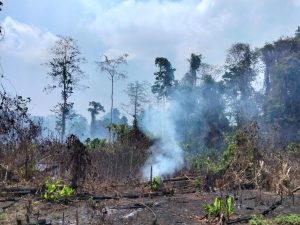
The use and even exploitation of natural resources is often destructive and uncontrolled. Activities such as mining and logging have significantly disrupted and even threatened life on Earth. Climate change is a long-term threat to the Earth caused by human activities. These various influences, which encompass biological, chemical and physical aspects, threaten all life on Earth and even have social and economic impacts. Concrete efforts to raise awareness and engage all parties, including young people, are needed to address this slow but certain disaster.
The dangers of greenhouse gases
Various activities in the industrial sector and the destruction of ecosystems have increased greenhouse gases (GHGs), which contribute to global warming. GHGs consist of certain compounds such as carbon dioxide (CO2), methane (CH4), nitrous oxide, and various fluorine compounds. These GHGs trap the sun’s heat in the Earth’s atmosphere, causing global warming on Earth and in its atmosphere.
According to the IPCC (Intergovernmental Panel on Climate Change, a scientific body under the United Nations tasked with assessing scientific knowledge related to climate change), GHGs are gases in the atmosphere that absorb and emit infrared radiation. These gases can originate from nature or human activities.
Rising temperatures have disrupted weather and climate patterns, causing extreme weather such as storms, droughts and unpredictable heavy rainfall. In addition, global warming is also contributing to the melting of polar ice caps, leading to a rise in sea levels and causing abnormal sea level rises along the world’s coastlines.
According to the Assessment Report 6 – AR 6 (IPCC, 2020), extreme weather, which threatens food security, livelihoods and ecosystems around the world, is now increasingly alarming.
AR6 IPCC emphasises that a temperature increase of 2°C will cause major changes in the Earth’s climate system and exacerbate the impacts already being felt, particularly for humans and biodiversity. However, if temperatures can be limited to 1.5°C, these impacts could be less severe. Therefore, rapid and significant reductions in greenhouse gas emissions are essential to limit further damage. Unfortunately, the Earth has already exceeded the 1.5°C threshold (World Meteorological Organisation, 2024).
The impact of climate change
Climate change not only damages ecosystems but also reduces the quantity and quality of natural resources that provide us with livelihoods. The impacts of climate change include shortages of clean water, damage to agriculture, and the emergence of many new diseases that threaten the survival of humanity and the environment. According to Hsiang et al. (2013), climate change even plays an important role in increasing social conflict on Earth.
Plants and animals also find it difficult to adapt to changes in weather and temperatures and are threatened with losing their habitats. The role of various species in ecosystems and food webs is being compromised.
Lack of knowledge among the general public
Many people underestimate climate change. As a result, there is little effort to prevent it while there is still time. For example, uncontrolled deforestation and oil palm cultivation caused flash floods in Aceh, North Sumatra and West Sumatra in late November 2025. All of this is in the short-term financial interests of a handful of businesspeople who have neglected the long-term economic interests of the wider community.
Based on an analysis by Bank Indonesia (2022), in the long term, economic losses due to climate change could reach a staggering figure of up to 40% of Indonesia’s Gross Domestic Product (GDP). If no meaningful mitigation and adaptation measures are taken, these losses due to climate disasters will be reached by 2050.
Various hydrometeorological disasters (floods and droughts), which are an important aspect of the threat of climate change, require the participation of today’s younger generation. This is because the younger generation will inherit the impact, but they have the power to make long-term changes. The younger generation needs to be accustomed to and educated more.
The seriousness of climate research in China
At the end of 2024, the author had the opportunity to conduct a study visit to the Chinese Academy of Sciences (CAS) in Beijing, China, to explore long-term climate change research. CAS is China’s leading national academy of natural sciences, located in the Xicheng district of Beijing. CAS manages more than 100 institutes that have made important discoveries in biotechnology, physics and new materials.
CAS is renowned for its academic excellence. CAS members have received prestigious awards, including the Nobel Prize. The institution also has strong international partnerships and plays an important role in technological innovation, including renewable energy, information technology, and space exploration.
The Chinese Academy of Sciences has a Climate Change Research Center (CCRC), which is part of the Institute of Atmospheric Physics and focuses on comprehensive climate change research. The CCRC researches adaptation and mitigation strategies, such as reducing carbon emissions and increasing resilience to climate disasters. Through international research collaboration, the CCRC seeks to improve global understanding of climate change and find scientific solutions for widespread application.
CAS also has an Institute of Geographical Sciences and Natural Resources Research (IGSNRR) that conducts highly sophisticated interdisciplinary research. This includes ecological protection, land use and geographic information systems. This interdisciplinary collaboration is intended to address various challenges such as climate change, water security and food security.
Research by the Chinese Academy of Sciences
Research from the Chinese Academy of Sciences shows that terrestrial ecosystems such as forests, grasslands and agricultural land play an important role as carbon sinks. Through long-term monitoring and ecological data analysis, researchers found that the ability of ecosystems to store carbon can be enhanced through sustainable land management, forest restoration and biodiversity protection.
In monitoring the Earth system, CAS has even studied Asian dust transport. It turns out that mineral dust from arid regions plays an important role in connecting land–sea–atmosphere processes. Every year, more than four billion tonnes of dust are released into the global atmosphere. Nutrients such as iron and phosphorus, which can increase phytoplankton productivity, are circulated into the oceans. This phenomenon enhances carbon sequestration through a process known as biological pumping.
CAS research also examines how changes in land use, desertification and global warming can alter the frequency of dust storms and their transport pathways. This transport impacts marine nutrient balance and regional and even global climate systems. Interestingly, dust from East Asia can travel thousands of kilometres across the Pacific Ocean. This demonstrates how interconnected the Earth’s climate system is.
So many new phenomena are occurring as a result of climate change. There is much that the younger generation can do about climate change. Concrete actions that can be taken on a daily basis include saving energy, developing and using renewable energy transport, planting large numbers of trees, adopting an environmentally friendly and sustainable diet, using social media to build collective awareness, and educating and campaigning through creative media that share knowledge across generations.
Furthermore, the younger generation can develop their skills in conducting climate change research. And if necessary, they can study in China.
*The author is a Year 11 student at Bogor State Senior High School I.
Banner photo: Image generated by OpenAI’s DALL·E via ChatGPT (2024)