By: Nopri Ismi and Finlan Aldan
This report is the result of collaborative reporting with the support of the Pulitzer Reporting Grant.
Lives entangled with illegal tin
The first part of this report takes readers to the shoreline of Bangka, where illegal tin mining is not an abstraction but a daily reality that shapes livelihoods, choices, and survival. Through the lives of women, fishermen, and small-scale miners, this section illustrates how entire villages have become structurally dependent on tin—despite falling prices, legal uncertainty, and mounting ecological damage. It captures how the collapse of the tin economy following the corruption scandal has left communities trapped between environmental ruin and the absence of viable alternatives.
Several pontoons with tin suction machines were moored to the shore. The sea at Tanjung Ru, Bakit Village—one of the centres of small-scale tin mining or offshore unconventional mining (TI) on Bangka Island—was quieter than usual.
“If this continues, we could die,” said Ani, a mother who accompanied us as we observed the lives of the miners, in a small shop with rickety wooden walls.
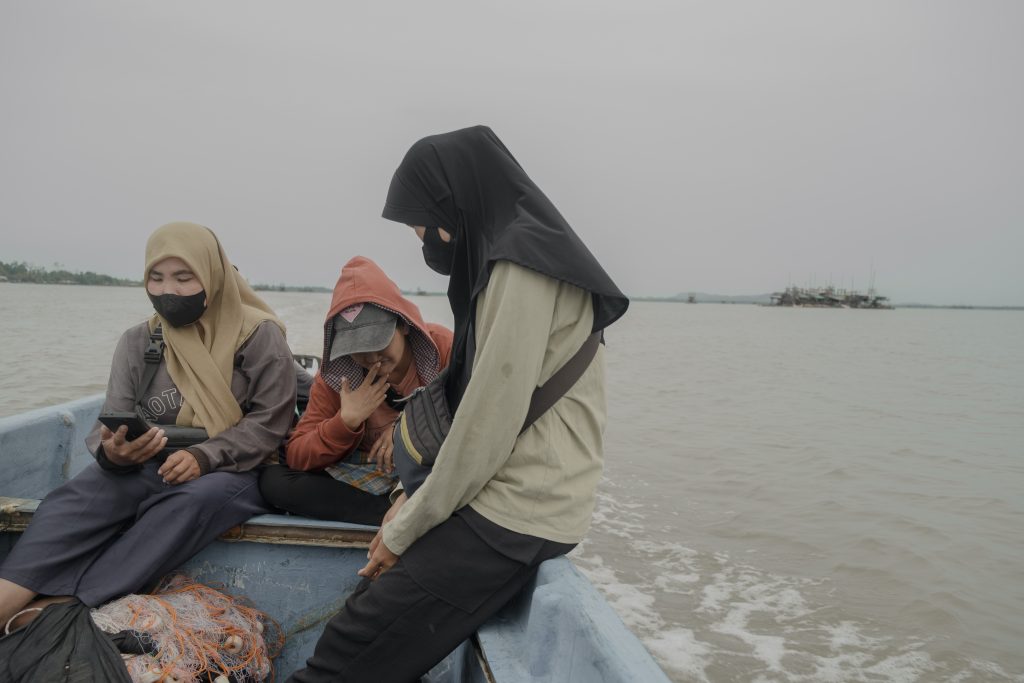
They were anxious because they had not yet received any invitations from the tin miners who were coming and going to the beach. Soon, a boat engine started. The boat carrying the miners left Ani behind and picked up three other women who had been sitting idly on the pier since morning.
The morning drizzle led them to bamboo rafts floating on dozens of drums, which the locals call pontoons. Some are small and can only carry one or two people, while others can support the weight of a dozen people. Smoke billowed, accompanied by the incessant rumbling of diesel engines.
Some will stop at four in the afternoon, while others will continue operating throughout the night. The longer the pontoons work, the more money they can generate. This is because each pontoon extracts tin sand from the seabed, which is the community’s livelihood.
Meanwhile, Ani and her two friends were still feeling down because they had not yet found a boat ride.
“That’s how it is now, Dek. If you don’t know anyone, it’s hard to get a ride. Nowadays, not all miners accept nyanting. It’s not uncommon for us to have to fight for a place on a boat or a pontoon,” she said, referring to the common practice of begging for tin scraps from miners.
Ani, like many other women in the area, has relied on nyanting for decades. This work—dominated by women—has been the sole source of livelihood for Ani and hundreds of others in Bakit Village.
“Back then, we could get at least five kilograms of tin. It was more than enough to help my husband, feed the family, and pay for the children’s school fees. Many of my friends bought new motorbikes and cars; everything seemed easy,” said Ani, reminiscing about the heyday of tin mining in Bakit Village at the end of 2022.
At that time, the price of tin reached Rp250,000 (USD 15) per kilogram at the level of collectors or collectors of tin at the village level. However, the saying of the people of Bangka Belitung, which refers to tin as ‘hot goods’—money from tin is quickly obtained, but it will also quickly disappear—really came true.
Like the entire foundation of the Bangka Belitung tin mining industry, the stability of the money earned from nyanting has proven to be fragile. Since corruption cases engulfed several large companies that manage tin smelting facilities in 2024, the purchase price of tin sand has been cut in half.
“If you ask me if I want to find another job, yes, I do, but what kind of job?” said Ani. “Tin seems to have no value. The highest price it sells for is 135,000 rupiah per kilogram. And even then, if we are given tin, it is often like now. We have to go home empty-handed.”
Amrullah, who at that time served as Head of Bakit Hamlet, also felt the bitter taste of dependence on the tin economy. In early 2022, Amrullah opened six mining units around the Bakit Sea.
One mining unit can produce 50-100 kilograms of tin. It generates millions of rupiah a day. However, two years later, the situation reversed. Tin prices fell, and tin production could only cover operating costs, not employee salaries and machine repair costs. The mining business went bankrupt.
Amrullah was forced to sell all his mining equipment to pay off debts amounting to 70 million rupiah (USD 4,170). “Tin can easily make people rich, but it can also easily make people poor,” he said.
With a population of around 1,500, nearly 90 per cent of the people of Bakit Village depend on the tin mining industry. Not to mention the hundreds of migrants from South Sumatra who have chosen to settle here, lured by the profits from tin mining.
This situation is illustrated by the hundreds of TI pontoons covering the sea surface in Bakit Village. On the coast, a number of suction vessels belonging to PT Timah and its partners are parked.
“Many people are out of work after the corruption was exposed,” said Amrullah, as he accompanied us on our trip to the pier to see the sea at Bakit, which still looked murky.
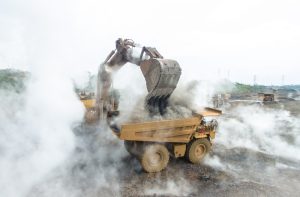
Although the tin mining industry is currently in decline, its ecological impact continues to spread widely. The Bakit Sea is part of the Kelabat Dalam Bay waters—one of two basins in the 32,000-hectare Kelabat Bay landscape. Over the past decade, this area has been known as one of the targets of illegal mining that continues to attract public attention.
More than 10 rivers flow into Kelabat Bay. Among them, the Antan and Primping rivers have already been destroyed by illegal mining. Now, mud and oil flow into Kelabat Bay, turning it into a giant cauldron of mining waste. The swirling ocean currents spread the waste, polluting all the coastal villages there. This includes the sea at Tanjung Sunur, which is about 15 kilometres from the Bakit Sea.
Rustam, a resident of Pangkal Niur Village, Bangka Regency, is one of the few fishermen in Tanjung Sunur who insists on maintaining his profession rather than switching to working on mining pontoons. He invited us to stay at a cottage in Tanjung Sunur that is used by local fishermen to stop by and stay overnight. Rustam is one of the owners of the cottage.
However, before heading to the hut, we crossed over to Belinyu Subdistrict, on the other side of the bay. There, against a backdrop of mangroves, were dozens of pontoons similar to those we had seen in Bakit Village. Each pontoon spewed out a white liquid mixture of water and sediment left over from tin sand filtration.
Despite the decline in tin prices, many people in Belinyu still earn their daily living through illegal mining. Quite a few of them encroach on, and even break into, protected and conservation areas.
“There are many more [miners] behind there,” said Rustam, pointing towards the dense mangrove forest, an area that is part of Gunung Maras National Park, the only national park in Bangka Belitung.
TI miners began operating across from Rustam’s hut in 2019. Nine years earlier, the area had been designated as a concession belonging to PT Timah, a state-owned company embroiled in corruption issues surrounding the tin mining trade.
Despite holding concessions in this location, PT Timah does not actively operate there. Instead, it is surrounded by unauthorised pontoons. As we circled the cluster of pontoons, Rustam kept casting cynical glances at the workers on the boats. He believes that TI’s mining activities have devastated life in Teluk Kelabat Dalam. As a fisherman who staunchly opposes mining activities, he feels that his livelihood is under threat.
Rustam’s hut and the tin mining vessels are separated by a one-kilometre-wide bay. When activity peaks, the roar of the pontoons carries through the night, signalling miners working overtime.
Some of the workers were Rustam’s neighbours. Tin was so promising that many residents of Pangkal Niur Village switched professions from fishermen to miners.
“In our village, initially only five per cent [were miners], now only two per cent are anti-mining!” grumbled Rustam.
However, since corruption cases ensnared many companies in Bangka Belitung in 2024, many people who had been profiting from tin suddenly suffered huge losses. This was because the price of tin sand plummeted to half its original price. According to Rustam, many business owners ended up begging for work as rubber tappers or oil palm labourers.
In the middle of our conversation, Ridwan and Yunus, two of Rustam’s friends who were also fishermen, arrived at the hut. They opened a red plastic bag and poured various types of fish onto a zinc tray. We looked at the variety of fish with awe. However, Ridwan just stared at them with half-disappointed tears in his eyes.
“In the past, one net could catch 30 kilograms. Now it’s only this much!” he said bluntly.
Read the second part of this report.
Read the third part of this report.
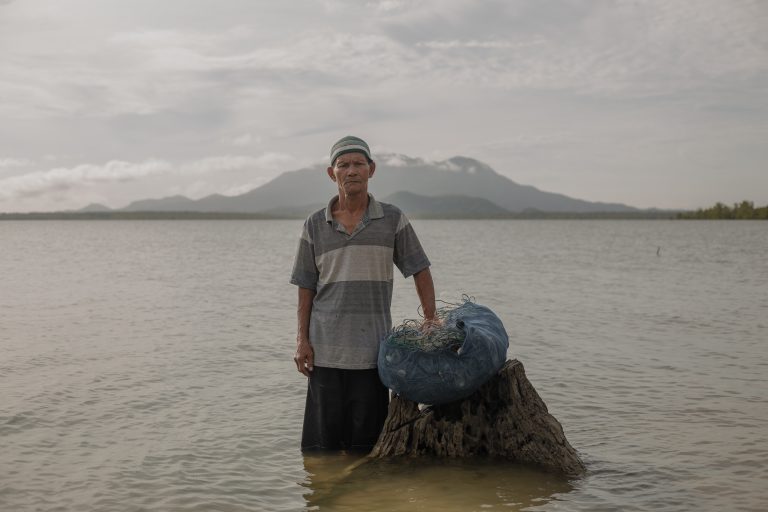
Banner photo: Mang Ridwan, a local fisherman from Tanjung Sunur in Inner Kelabat Bay, has witnessed a steady decline in his yields over the past few decades due to the environmental impact of tin mining. Photo by Nopri Ismi.
Update: Feb 6, 2026; 08.41: moving sponsor detail to top of article.