by: Nabiha Shahab
In the afternoon of March 8, 2026, the structural and philosophical limits of Indonesia’s waste management were breached with lethal force. At Zone IV of the Bantar Gebang Integrated Waste Treatment Site (TPST) in Bekasi, a 50-meter mountain of refuse—equivalent to a 15-story building—collapsed.
Seven lives were extinguished, transport trucks were buried in a tide of sludge, and the primary artery of the capital’s waste disposal was paralysed. The immediate fallout was visible: five-kilometre queues of idling trucks and a city-wide backup in Jakarta neighbourhoods like Koja and Cipinang. However, for a policy analyst, the “grave situation” is the haunting echo of the 2005 Leuwigajah tragedy in Cimahi, where a similar landfill landslide claimed 157 lives. Two decades later, the reliance on the archaic “collect-transport-dump” model remains a definitive failure of urban resilience.
This isn’t just Jakarta’s problem; it is a regional contagion. Depok generates 1,300 tons of waste daily, while Bekasi and Tangerang each exceed 1,000 tons. This crisis is currently masked by the government’s “Adipura” certification system, awarding certificates of excellent environmental status to cities that are, in reality, struggling under the weight of “very dirty” management practices. As the physical mountain fell, it exposed the fiction of sustainable progress, transitioning from a visible tragedy to an invisible atmospheric threat.
Methane and the climate stakes
While the landslide was a physical catastrophe, the site’s most insidious output is methane (CH4). Landfills are the front line of Indonesia’s climate commitments because “open dumping” essentially turns food waste into anaerobic methane factories. As Satya Utama of WRI Indonesia, in a webinar organised by CNN Indonesia ACADEMY Indonesian Journalists 4 Climate last month, explains, methane remains in the atmosphere for only 12 years, yet its global warming potential is 28 to 34 times stronger than CO2 over a century—and a staggering 80 times stronger over a 20-year horizon.
The waste sector accounts for 54% of Indonesia’s methane emissions. Crucially, the current inventory relies on IPCC Tier 1 monitoring, which uses generic “default factors” and offers low accuracy. To meet the Global Methane Pledge signed at COP26, Indonesia must transition to Tier 2, utilising country-specific activity data to drive mitigation. Satya said, “The inventory of emissions currently uses Tier 1. We need Tier 2 monitoring to provide the accurate, localised data necessary for real mitigation.” Without capturing these gases, landfills remain ticking climate bombs, fueling the very fires that have recently ravaged sites in Suwung and Tangerang.
The food waste problem
The driver of the methane spike is a paradox of Indonesian culture: the nation generates 20 million tons of food waste annually while simultaneously battling high rates of stunting and poverty. Nearly 49% of the waste at Bantar Gebang is organic.
Agus Rusli, Director of Waste Reduction at the Ministry of Environment (KLH), identifies the cultural phenomenon of lapar mata (eye hunger) as a major pollutant. During Ramadan, the surge in unconsumed purchases transforms from a social habit into a climate threat.
When food is pressurised into anaerobic landfill zones, it doesn’t just rot; it converts into high-potency methane. Regarding the 2025–2029 roadmap, Rusli notes: “We are expected to manage nearly 100% of our waste by 2029… every person lives by consuming and producing waste, but it must be managed.” The mountain that collapsed was built, in large part, on the back of wasted nutrients that could have fed the 26.36% of the population living in poverty.
The grassroots alternative
Local communities are proving that decentralised circularity is the only viable alternative to the Bantar Gebang model. A community cooperative in East Jakarta, the Koperasi Kompos RW 016, Jatinegara Baru, acts as an “R&D lab” for source-based management.
Operating since 2021, the cooperative uses aerobic composting to produce harmless CO2 and water vapour rather than methane. Their methodology is technically rigorous: a Monday-Wednesday-Friday collection cycle and the deployment of Gen-Z “data collectors” to maintain a digital dashboard of household participation. However, the “Diffusion of Innovation” curve reveals a stark reality. While the cooperative successfully engaged its neighbours, it has hit a “ceiling” at 150–162 houses.
Shanty Syahril, the cooperative’s coordinator, argues that the “Early Majority” of citizens won’t join until the government scales the infrastructure. “It is not that the community does not want to sort; they need a reliable system from the government… We can only scale so much before we need official TPS 3R (Reduce, Reuse, Recycle Waste Treatment Sites) support,” she said. Currently, grassroots innovators are providing the proof of concept, but the state is failing to provide the industrial-scale processing to match their efforts.
Beyond the landslide
The tragedy at Bantar Gebang’s Zone IV is the final warning of a dying system. The physical collapse of the mountain proves that the era of hiding waste in the outskirts of our cities is over. Indonesia’s ability to meet its 2060 Net Zero target depends entirely on the immediate implementation of the Pilah Sampah dari Rumah (Sort Waste from Home) mandate. The nation’s future is a choice between two landscapes: one of mounting trash mountains that claim lives and heat the planet, and another of nutrient cycles that power a circular economy. Indonesia must now choose to transform its waste from a liability into a resource, ensuring that the seven lives lost in Zone IV become the catalyst for a revolution in national sustainability.
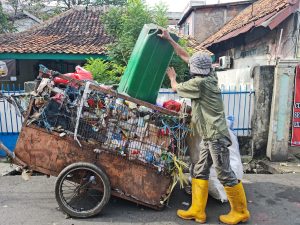
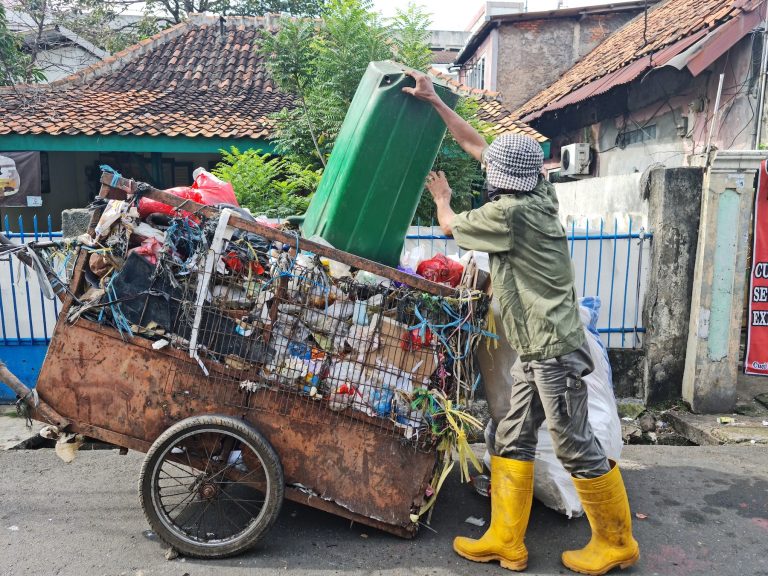
Banner photo: A neighbourhood trash collector in Jakarta filling his cart with unsorted household trash. 6 April 2021. Nabiha Shahab/tanahair.net