Jakarta — Environmental watchdog Jaringan Kerja Penyelamat Hutan Riau (Jikalahari) has reported that about 583 hectares of land burned inside five corporate concessions in Indonesia’s Riau province this year, raising concerns over peatland protection and enforcement of fire-prevention rules.
The group said on Friday, August 28, the fires were identified through hotspot analysis and Sentinel-2 satellite imagery, followed by field verification conducted from August 15 to 24.
The five concessions are PT Arara Abadi Distrik Melako, PT Riau Andalan Pulp & Paper (RAPP) Blok Mandau, PT Tani Subur Makmur, PT Sari Lembah Subur and PT Teguh Karsa Wana Lestari.
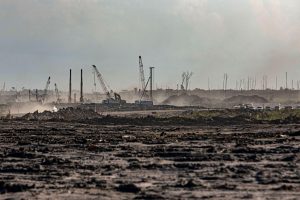
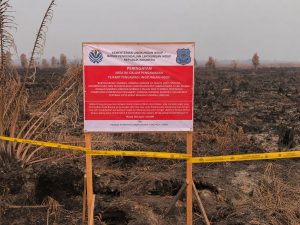
Jikalahari said its investigation found physical evidence of burned vegetation, blackened soil, ash and charcoal at the sites. Several locations were on peatland, including areas classified as protected peatland under government mapping.
The largest area identified was 391 hectares inside the PT Tani Subur Makmur concession in Indragiri Hulu, where the group said the fire likely lasted about 13 days in early August. The area was identified as peatland deeper than four metres and, according to Jikalahari’s spatial analysis, fell entirely within an area designated as protected peatland.
Other burned areas included 83 hectares in RAPP’s Mandau block, 68 hectares in Arara Abadi’s Melako district, 18 hectares in Sari Lembah Subur and 12 hectares in Teguh Karsa Wana Lestari.
Jikalahari said it had found no fire-monitoring tower near four of the five investigated sites — Arara Abadi, Sari Lembah Subur, Tani Subur Makmur and RAPP Mandau. A monitoring tower was found at the TKWL site.
At Arara Abadi, investigators found burned acacia vegetation as well as newly planted oil palms on the burned area. At RAPP Mandau, the burned site was identified as a river buffer area classified as a protected area in the company’s 2017-2026 work plan.
At Tani Subur Makmur, investigators reported burned young oil palms, drainage canals, signs of land clearing and piles of timber. The report said there were also indications of illegal logging at the site, although it noted that the ownership and status of the land should be verified further using licensing and administrative records.
Jikalahari said the findings warranted investigation into possible violations of environmental and forestry laws, including companies’ obligations to prevent and control fires within their concessions. The group’s report said the absence of fire-prevention infrastructure at several sites required further investigation to determine whether companies had complied with their legal obligations.
“We chose to report these findings to the Criminal Investigation Agency (Bareskrim) of the Indonesian National Police because our report last year to the Riau police has yet to be resolved,” Jikalahari Deputy Coordinator Arpiyan Sargita said. “This step is being taken so that Bareskrim can process this new case firmly, while giving the Riau police room to focus on resolving the 2025 forest and land fire report.”
The findings come as Riau faces a heightened fire risk during a dry season that authorities have linked to El Niño conditions. Jikalahari’s report said the Riau government had declared an emergency alert for forest and land fires from Feb. 13 through Nov. 30, while government monitoring data showed 15,738.92 hectares had burned in the province by August.
Jikalahari’s own satellite monitoring recorded 4,492 hotspots in Riau during 2026, with about 74% located on peatland. Of the total, 875 hotspots were inside corporate concessions, including 214 in industrial timber plantations and 661 in oil-palm plantation concessions.
Civil society groups said the fires should not be attributed solely to El Niño.
“Government is wrong to interpret the forest and land fire disaster as being caused solely by natural factors such as El Niño and therefore not pursue corporate accountability,” said Refki Saputra, forestry campaigner at Greenpeace Indonesia. “Forest and land fires are not caused by El Niño, but El Niño increases the risk of fires because peatland ecosystems have been damaged.”
ICEL’s Head of Forestry and Biodiversity Division, Adam Putra Firdaus, called for stronger enforcement as well as broader reforms to Indonesia’s forestry governance.
“First, corporations whose concession areas burn must be punished, affected communities must be protected, and damaged forest ecosystems must be restored,” Adam said. “Second, the state must strengthen the legal basis for forest protection, restoration and law enforcement through a new Forestry Law that contains a new paradigm.”
He also called for a comprehensive review of business licences, particularly those covering ecologically vulnerable areas.
Jikalahari has asked Bareskrim to investigate the five companies using its satellite analysis, coordinates and field documentation. It also called on the Environment Ministry’s law-enforcement unit to investigate environmental impacts and companies’ compliance with fire-prevention obligations.
The report did not establish who started the fires or conclude that any of the five companies had deliberately burned land. Jikalahari said those questions, as well as the companies’ legal responsibility, should be determined through further investigation. (nsh)
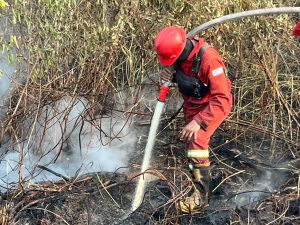
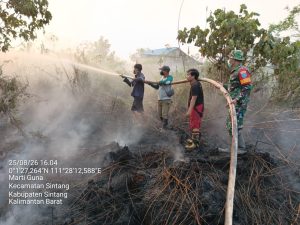
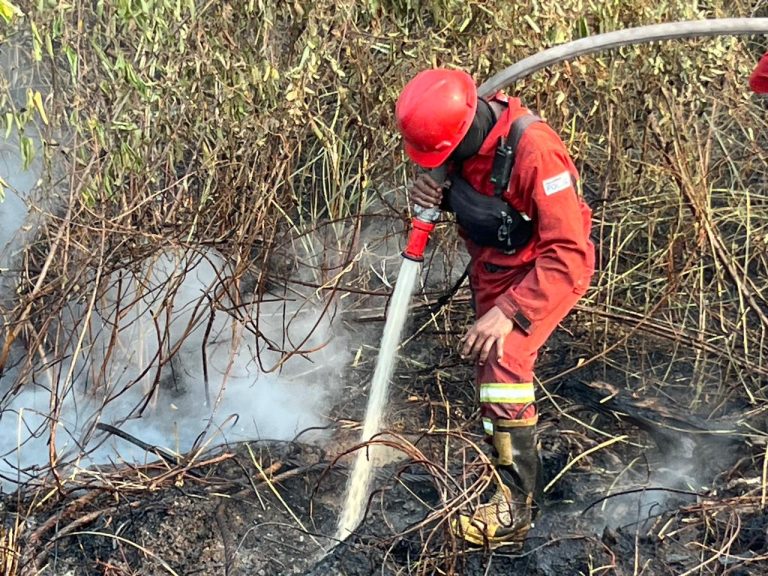
Banner photo: Firefighting efforts in South Sumatra. 31 August 2026. Source: BNPB