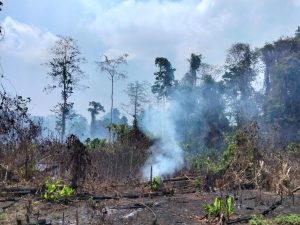
Jakarta — A study by the LinkAR Borneo research team has found that the expansion of oil palm plantations operated by PT Equator Sumber Rezeki (PT ESR) has caused extensive environmental damage and triggered social conflict in the conservation corridor connecting Betung Kerihun National Park and Danau Sentarum National Park.
According to the findings, PT ESR—an oil palm company holding an estate permit (IUP) covering about 16,867 hectares in Batang Lupar district in West Kalimantan—has carried out large-scale forest clearing within a strategic ecological corridor that links the two national parks. Although the concession is administratively classified as non-forest land (APL), researchers warn that its location plays a critical role as a wildlife movement route, ecosystem buffer, and the customary living space of Indigenous Dayak communities.
Based on its findings, LinkAR Borneo urged authorities to suspend land clearing activities in the conservation corridor, review the company’s permits, and conduct independent environmental and social audits. The researchers also called for stronger protection of Indigenous land rights and stricter enforcement of environmental and human-rights safeguards in Kapuas Hulu.
“Forest fragmentation in the Betung Kerihun–Danau Sentarum national park conservation corridor has the potential to disrupt ecosystem connectivity, increase human–animal conflict, and accelerate the biodiversity crisis in Kapuas Hulu,” the research team said, in a statement on Thursday, January 22, warning that unchecked plantation expansion could deepen both ecological and social crises in one of West Kalimantan’s most important conservation landscapes.
LinkAR Borneo documented that during 2025 alone, PT ESR cleared nearly 1,000 hectares of forest, including peatland ecosystems vital for carbon storage and water regulation. Cumulatively, forest loss linked to the company’s operations since 2024 has exceeded 3,000 hectares, with roughly two-thirds of the cleared area identified as orangutan habitat based on Population and Habitat Viability Analysis (PHVA) data.
Field surveys also recorded at least ten orangutan nests within the concession area, indicating active use by the endangered Bornean orangutan (Pongo pygmaeus). Researchers warned that continued land clearing could fragment the conservation corridor, disrupt wildlife movement, and increase the risk of human–wildlife conflict.
Social impacts and community resistance
Beyond environmental damage, the research highlights growing social tensions across several villages surrounding the concession. In Sungai Senunuk and Setulang villages, land handovers for plantation development were carried out through compensation schemes that community members say were poorly explained and unevenly distributed. Payments ranged from Rp3.5 million per hectare for individual plots to varying lump sums for communal land, fuelling confusion and internal disputes
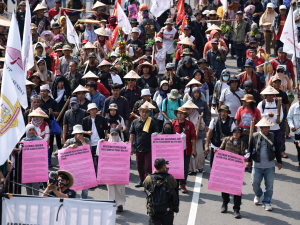
In other villages, including Labian and Labian Ira’ang, Indigenous Dayak Iban communities have openly rejected PT ESR’s presence, citing fears of losing customary land, environmental degradation, and threats to traditional farming systems. The study also reports emerging horizontal conflicts, where individual land claims—allegedly encouraged by company practices—have undermined long-standing communal land management arrangements recognised by local government decrees.
The LinkAR Borneo team further found that the principle of Free, Prior and Informed Consent (FPIC) was not meaningfully fulfilled. Residents in several villages said they never received complete information about concession boundaries, operational plans, or long-term impacts before land clearing began.
Legally, PT ESR is reported to hold only an estate permit (IUP) and has yet to obtain a land-use title (HGU), raising concerns over the legality of its operations in parts of the concession area. (nsh)
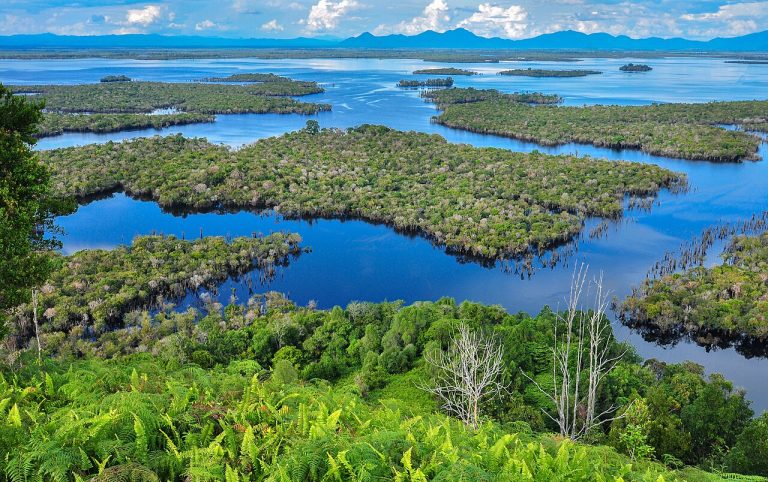
Banner photo: Lake Sentarum National Park. 13 February 2011. Source: RaiyaniM/Wikimedia Commons